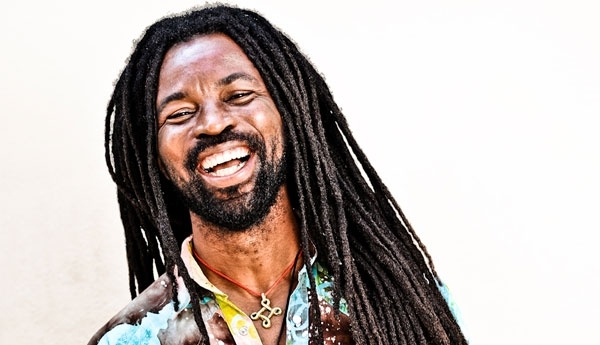
Rocky Dawuni is well known across Africa and the world for his infectious Afro Roots sound and humanitarian activism. His dedication to spread his message of love, positivity, and empowerment, is expressed through both his uplifting, African grooves and his cultural diplomacy. Working alongside organisations such as Product (Red), the UN Foundation and UNICEF, Rocky has become a spokesperson for a variety of global issues including, women’s health and education, HIV Aids advocacy, peace building and clean water. Peacefire is yet another far-reaching project Rocky has recently been involved with. His musical career has always aimed to “ignite the best in all us,” and so, by collaborating with producer, Tom Erba, and Aloe Blacc, Rocky plans, this time, to use his musical expression and cultural experience to “amplify the light” in the Democratic Republic of Congo.
Your musical sound crosses boundaries in terms of genres and locality. Could you describe your evolvement within the industry and how places influence your musical processes?
Rocky Dawuni: The thing is, I grew up in Ghana, mostly living on military barracks because my father was in the army, and at that time the Ghanian army included various people from different tribes which therefore created a mixture of cultures and languages. These tribes were thrown together in something that was much less defined. So, when growing up, I had to gain the ability to learn all these other traditions and cultures because I was communicating with children from different tribes and it really instilled in me a sense of adventure and cross-cultural and tribal adaptation. I think this is where my music took seed and how I came to engage the world with a multinational genre that embraces various cultures.
I feel that in creating music you have a secret responsibility and whatever goes into it has to be something meaningful, it has to add something more to people’s experiences.
How would you describe your overall sound and what does it mean to you personally as a means of expression?
R.D.: I would describe my sound as Afro Roots, a sound that is deeply steeped in Africa and my upbringing, but I also feel that the content of my message and objective, as a way to really to inspire people, requires a certain broader vision when it comes to the overall sound and message. That vision helped expand what Afro Roots meant and so over the years I began to embrace every style of music that had foundations in Africa but took roots in the diaspora including, reggae, soca, Brazilian samba, soul and hip-hop and all these styles influenced me and became integrated into my music. At its heart, my music dwells on simplicity, a way to communicate to people on a less complex level and I think that is something that has contributed to its success. Music, in one way or another, gives us a significant platform to be able to communicate, not only to express ourselves and engage the people within our immediate sphere of influence but also help people beyond that. I feel that in creating music you have a secret responsibility and whatever goes into it has to be something meaningful, it has to add something more to people’s experiences. Music has power. This is always why I consider part of my mission is not to shy away from growing bigger or embracing a wider audience because it only serves to increase the opportunity for my message and what I am trying to put across to the world.
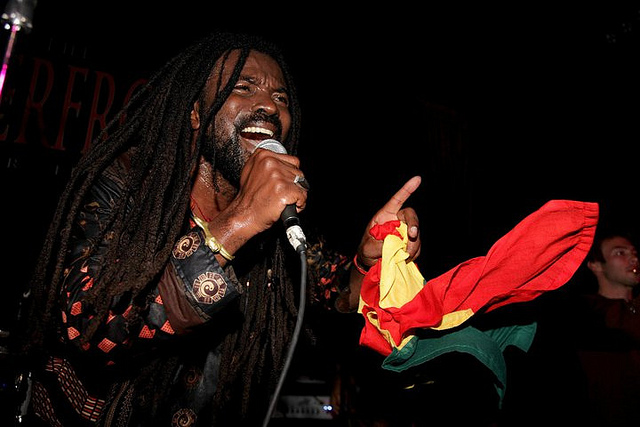 In the Photo: Rocky Dawuni performing at Waterfront Café in Marina del Rey, CA Photo Credit: Myra Vides, 2010.
Your most recent album, Branches of the Same Tree, was nominated for a Grammy award this year, how important is it for you to represent Ghana and Africa in an award ceremony of this kind?
R.D.: It was a great honour to be recognised by the academy for my music. The album doesn’t follow a traditional route as a reggae album or an afrobeat album so it also was something that challenged the paradigm and, in that way, it was a huge stamp of approval for the process of the album. During my entire musical journey, I have never really believed in awards because I felt that music isn’t something you do for the reward, it is something you do because it serves a greater purpose than yourself and that alone is the reward. However, that doesn’t mean that when institutions like the Grammys recognise my work I don’t attach value to it; the nomination has provided a certain honour, especially for my country, for Ghana, because it is the first time my country has been represented on this type of platform and one of the few times that Africa has been nominated in this category. This all adds up to a slice of the platform I was referring to earlier, to be able to reach out further, to more people and keep spreading the music.
Related Articles: “PEACEFIRE:AN INTERVIEW WITH ALOE BLACC“
“PEACEFIRE: AN INTERVIEW WITH TOM ERBA“
Your campaign work for many cultural, social and environmental issues, throughout your career, has been far-reaching. Could you explain how your music integrates with these causes?
R.D.: Growing up on military barracks, in an environment that was heavily politically charged, at a time when the Ghanian military was in political power, created a mixture of music and social thinkers and this was because almost all the soldiers weren’t thinking about anything but the nation and its development. From this early stage, I recognised that it was important for certain voices to be heard, not only through the political sphere but also through music, which could act as a powerful way to bring important initiatives to light.
My music doesn’t aim to burden people with the problems of the world but to help lift the problems.
My music talks about peace, love and understanding but I quickly understood that these things will only happen if you have a practical way of making sure society and communities are given the right tools to live their aspirations. I felt that I needed to also have a practical approach and engage in social issues and other organisations that reflected my world view and have the connection with artistic voices to help amplify the work. I decided to collaborate with people with the same visions and initiate ideas and bring people together to bring a modern dimension to musical activism. To be able to sing about social issues and also work to make sure that the objective and vision is brought to reality is not easy, but very important to me. My music doesn’t aim to burden people with the problems of the world but to help lift the problems. Having a positive outlook and engagement of issues is one major way of overcoming them and so I try to balance that by using my experiences to show that life is always better when the glass is half full.
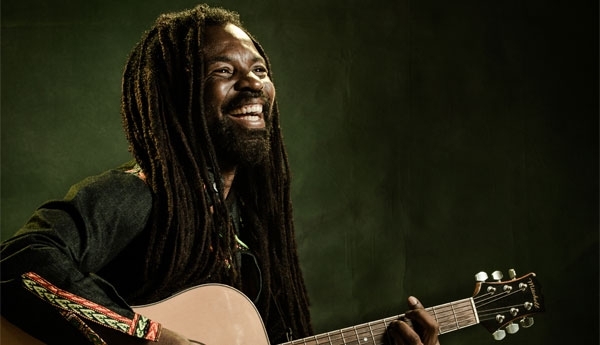 In the Photo: Press Photograph of Rocky Dawuni Photo Credit: Robert Kozek via Cumbancha.com.
What was your initial reaction and subsequent feeling in first discussing the Peacefire project with Tom Erba?
R.D.: It was a natural evolution for me because I was in Rwanda about two years ago in order to engage on a peace building initiative and whilst I was there I also took the opportunity to visit a refugee camp. A high proportion of those refugees were from the Congo and I was able to talk to them to gain an insight into their visions of their country and themselves because their personal aspirations were dependent on when they left the camp. It was from this moment that I felt that I needed to have a more serious focus on what was happening in Congo.
Our goal is to use music in a practical way, visiting the country, engaging musicians, being able to use the power of collaboration and experience the beauty of Congolese culture as a means to amplify the light in the Congo.
I had various ideas including talk of bringing the Kinshasa Symphony Orchestra to the USA, so when I was approached by Tom, with his passion for the project, and knowing both Tom and Aloe well, my desire to be involved was instant, especially following the conversations about Inoss’B, the history of the Congo and its music. The people of the Congo, from the time of their independence, have never enjoyed political stability in the way that other countries, such as Ghana, have experienced, but, despite this, the Congo has produced some of the most amazing music in the midst of all its uncertainties. We deeply considered the best way of bringing the plight of the Congolese people to the forefront and placing the Congo back into everyday conversation at a time when the world is distracted by so many other issues. Our goal is to use music in a practical way, visiting the country, engaging musicians, being able to use the power of collaboration and experience the beauty of Congolese culture as a means to amplify the light in the Congo.
For a full mindmap behind this article with articles, videos, and documents see #peacefire
How do you see your personal contribution to the Peacefire project?
R.D.: I have a certain perception of Africa because I am from Ghana. My music and my involvement in social and cultural organisations and cross-cultural collaborations have given me experience in engaging with communities that will help in the DRC. I hope to steer the power of music as a tool for uplifting hearts, telling stories and inspiring communities. Those aspects are things I have tried to do throughout my career, but, ultimately, it is an African story. Nobody else can tell individual stories except the individual and nobody else will be concerned with that story if that individual does not show enough concern first.
We need to share responsibility and claim the cause of humanity everywhere; apply those rules to everyone and be able to confront all those who are contributing to the problems in the Congo.
It is not just the issue of bringing this message to the Congolese, but also waking up the rest of Africa as to their involvement and needed contribution in working towards a solution. As much as our objective is to engage the world to find lasting solutions, I also want to make sure that other nations in Africa are fully aware of the situation in the Congo. There is a lot of money being made in the Congo, a lot of major organisations and companies are participants of what’s going on in the Congo, whether positively or negatively, and it is time to bring this to the forefront. We need to share responsibility and claim the cause of humanity everywhere; apply those rules to everyone and be able to confront all those who are contributing to the problems in the Congo. It is a matter of igniting a greater conversation and the objective of that conversation is to make sure we move towards justice and a solution so that, in the long run, the ordinary people of Congo feel empowered. At the same time, it is vital to keep the project positive and constantly celebrate the culture and music in the Congo.
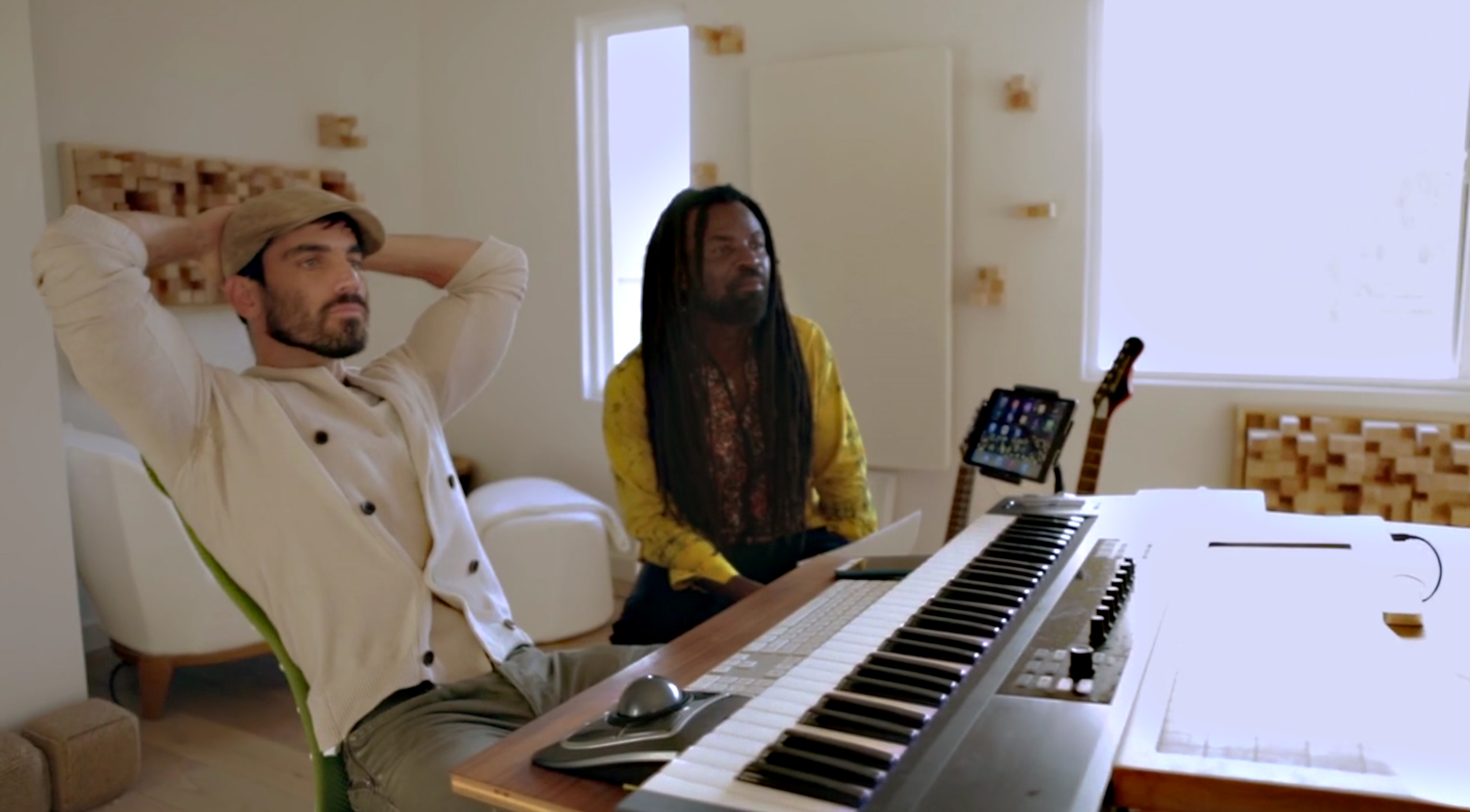 In the photo: Rocky Dawuni and Tom Erba listening back to the rough mix of “Peacefire.”
How much time do you hope to spend in the DRC and do you plan to perform at the music festival in Kinshasa?
R.D.: There is the Peacefire song that the three of us have written and collaborated on, which was the first big step and that song will travel along with us and be added to as we meet other musicians on our journey. We will then perform that song, some of our own music and music that we plan to create while we are there at the festival in Kinshasa. The festival will happen towards the end of June and Aloe Blacc and myself will go over there before then to travel, engage and collaborate in Goma and Kinshasa. We hope to leave the country with an incredible mix of music to keep the world inspired.
I hope to steer the power of music as a tool for uplifting hearts, telling stories and inspiring communities.
As a spokesperson for various global causes, what impact do you think Peacefire will have on the DRC and why do you think music is the best way to bring hope and change?
R.D.: The power of music is a language everyone has. Before we can speak we used sounds to communicate. It is in our nature and makes music such a deep way of connecting and creating communion, bigger than any other language. Once you have a beautiful melody and good beat, it allows freedom of expression because all you have to do is move in the way you feel it. It allows a both an inner and outer validation so it becomes the perfect tool to form agreement, bring people together and uplift everybody and, despite everything, we can all groove to the same beat without conflict. Music is, therefore, the most powerful tool for articulating some of the world’s biggest challenges.
Recommended reading: PEACEFIRE: AN INTERVIEW WITH ALOE BLACC
_ _