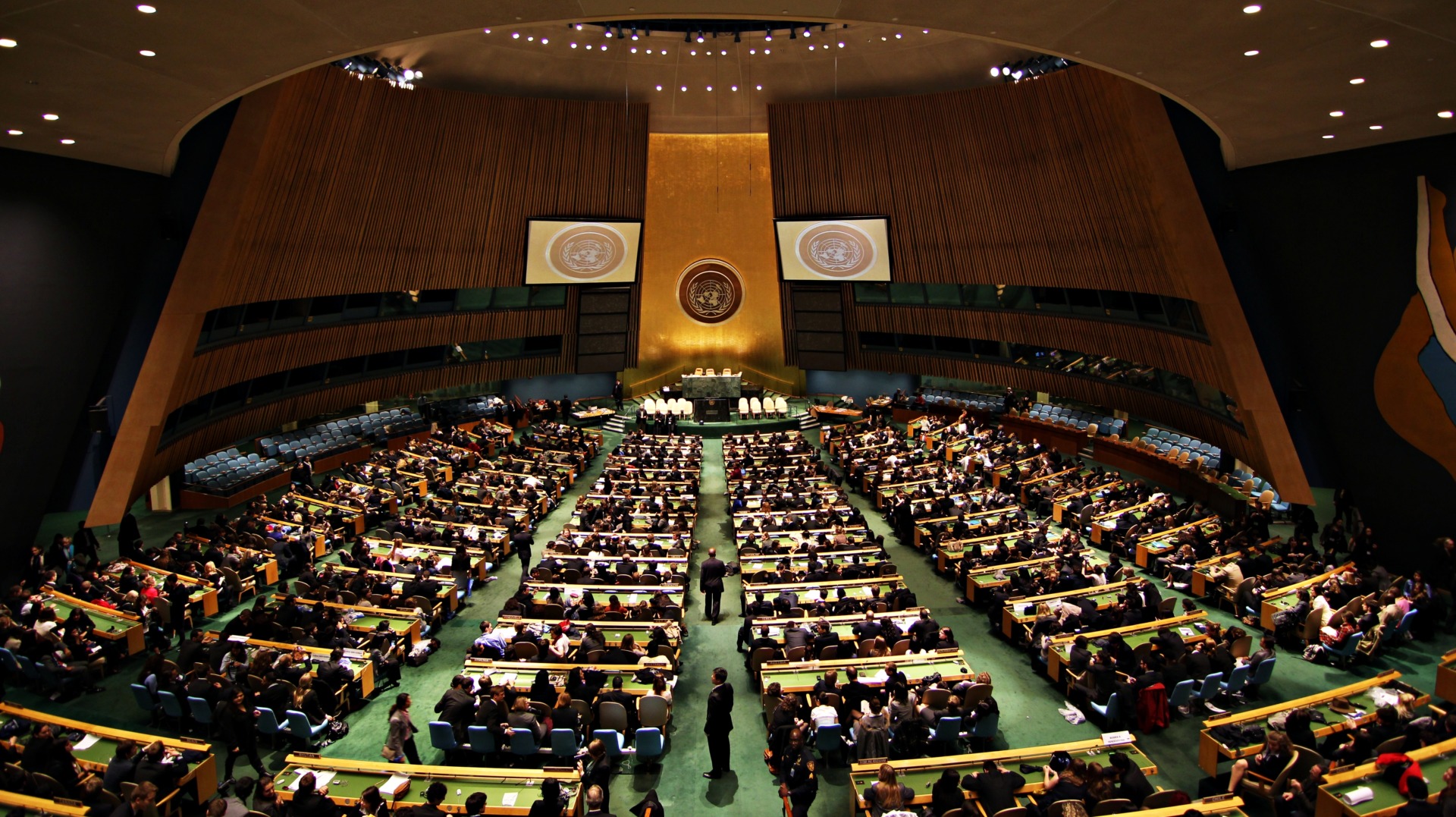
Last week, at the headquarters of the United Nations in New York, the informal hearings with the four candidates for Secretary-General offered a revealing snapshot of how the organization is thinking about its future. Michelle Bachelet, Rafael Grossi, Macky Sall and Rebeca Grynspan each presented distinct visions, shaped by their trajectories and priorities, yet grounded in a shared concern: the multilateral system is under pressure, and expectations are rising faster than its capacity to respond.
The diversity of approaches was evident, but not all carry the same weight in a moment defined by escalating conflict and eroding trust. Michelle Bachelet stood out for placing human rights at the center of her vision, reminding us that sustainable peace cannot be reduced to ceasefires or tactical interventions. By linking peace to equality, inclusion, and the protection of fundamental freedoms, she offers a more structural and ultimately more durable pathway — one that understands stability not as the mere absence of war, but as the presence of justice and opportunity.
In contrast, Rafael Grossi leaned heavily toward a crisis-driven and operational posture, emphasizing rapid intervention and technical capacity. While this reflects the urgency of current conflicts, it risks reinforcing a reactive and, at times, overly securitized approach — one that may blur the line between necessary engagement and a more bellicist reading of the UN’s role, privileging response over prevention.
Macky Sall highlighted the need for more political dialogue and representation in a multipolar world, and Rebeca Grynspan emphasized coordination and delivery within an overstretched system. Both contributions are valuable, yet more incremental in tone.
It is also worth recalling that, although there is no formal rule of regional rotation, leadership choices in the United Nations have often reflected a search for balance. In that sense, the current moment naturally raises the question of a Latin American Secretary-General — and, more strikingly, the long-overdue possibility of a woman finally assuming the post.
Taken together, these perspectives illustrate the breadth of the UN’s mandate — but also its fragmentation. Each candidate highlights an essential dimension of the system: legitimacy, action, representation, and effectiveness. Yet what remains insufficiently articulated is the hierarchy among these priorities. What must come first?
The United Nations was created after the end of World War II, above all, to maintain peace. This is not just one priority among many; it is the foundation upon which all other ambitions depend. Development, human rights, humanitarian action, and even the credibility of multilateralism itself are contingent on a minimum level of stability. When peace collapses, everything else quickly follows. And yet, in today’s discussions, peace is often treated as one item in a crowded agenda, competing with other urgent issues rather than structuring them. This dilution has consequences. It leads to a system that reacts to crises rather than preventing them, that manages symptoms instead of addressing root causes.
Related Articles
Here is a list of articles selected by our Editorial Board that have gained significant interest from the public:
Few areas illustrate this disconnect more clearly than the relationship between conflict and hunger. Wars today are not only fought with weapons; they are also fought through the disruption of food systems. Fields are abandoned, supply chains are interrupted, prices soar, and access to food becomes precarious, especially for the most vulnerable. Hunger, in turn, feeds instability, erodes social cohesion, and can prolong or even reignite conflict. The relationship is circular, reinforcing, and deeply destabilizing. Yet, despite this interdependence, food security is still often confined to humanitarian responses, rather than being recognized as central to peacebuilding.
This was not always the case. The Food and Agriculture Organization (FAO), in fact, predates the United Nations and was founded on a clear and explicit recognition: freedom from hunger is a precondition for lasting peace. Franklin D. Roosevelt, one of the architects of the post-war order, understood that preventing conflict required more than diplomacy; it demanded confronting the structural conditions — poverty, deprivation, and inequality — that make societies fragile and tensions more likely to escalate. Food, in this sense, was never merely about agriculture or nutrition — it was about stability, dignity, and the very foundations of peaceful coexistence.
Today, as the UN navigates a far more complex and multipolar world, that original insight deserves renewed attention. The candidates’ proposals, while valuable in many respects, tend to emphasize instruments — mediation, coordination, efficiency, legitimacy — without always articulating a clear hierarchy of priorities. There is a risk that, in trying to do everything, the organization loses sight of what must come first.
An overly operational approach may improve responsiveness but remain reactive. A primarily normative stance may reinforce legitimacy but struggle to influence events on the ground. A focus on political facilitation may help rebuild dialogue but lack the urgency required in fast-moving crises. None of these approaches is wrong; all are incomplete if not anchored in a clear commitment to preventing conflict as the organizing principle of the system.
Re-centering the UN on peace does not mean narrowing its agenda. On the contrary, it means integrating its various functions more effectively. It means recognizing that food security, climate action, social protection, and economic inclusion are not parallel tracks, but essential components of conflict prevention.
It also means acting earlier, before crises escalate and addressing the underlying inequalities that fuel instability. This requires political will, but also institutional coherence — something the UN has long struggled to achieve.
Editor’s Note: The opinions expressed here by the authors are their own, not those of impakter.com — In the Cover Photo: United Nations General Assembly Hall in the UN Headquarters, New York, NY, United States, April 23, 2011. Cover Photo Credit: Basil D Soufi.