Updated March 15, 2022. The news that Russia asked China for military and economic aid for its war in Ukraine made the headlines around the world on Monday:
Russia has asked China for military and economic aid for its war in Ukraine, reports say.
Beijing has declined to directly condemn Moscow for the invasion and says NATO’s “eastward expansion” is to blame for worsening tensions between Russia and Ukrainehttps://t.co/tFGZCbiwyo pic.twitter.com/v8JzZqNkeX
— AFP News Agency (@AFP) March 14, 2022
China’s reaction? Beijing refused to directly address the reports, instead accusing Washington of maliciously spreading “disinformation” over China’s role in the Ukraine war.
What is the origin of this news? It first surfaced in the US media on Sunday; The Washington Post said the news came from unnamed U.S. officials who did not state the kind of weaponry that had been requested or how China had responded. The next day we learned a little more: Reuters reported that the US told allies in NATO and several Asian countries on Monday that China had “signaled a willingness to provide military and economic aid to Russia, at Moscow’s request”, to support its war in Ukraine; the message, sent in a diplomatic cable and delivered in person by intelligence officials, also said China was expected to deny those plans, according to the official, who spoke to Reuters on condition of anonymity.
Surely Moscow would also deny such news. Historically, in Soviet times, something like this could not have happened. Can anyone imagine the Soviet Empire turning to a “friendly” country and asking for military help? Of course not. Soviet Russia was far too proud to stoop down and ask for anybody’s military and economic aid – political support, always, military and economic aid, never. If the news is correct, Putin would have called for aid from China; this is odd and flies against his behavior so far, as he seems bent on restoring Soviet splendor including, as far as NATO allows it, the historic Soviet borders (which of course include Ukraine).
Another explanation is that Russia’s army is in such dire straits that it urgently needs military help, and Putin doesn’t mind losing face and asking for China’s assistance.
Or is something else at work here? Are we witnessing here an example of disinformation – this time coming out of the US government – the kind that usually spreads around in times of war to destabilize the opponent?
This morning we learned a little more about the context. According to Reuters, at a seven-hour meeting held in Rome between U.S. national security adviser Jake Sullivan with top Chinese diplomat Yang Jiechi, the US raised concerns about China’s alignment with Russia and warned of the isolation and penalties China will face if it helps Russia in its invasion of Ukraine.
So the leaked news about Russia asking for China’s assistance came in the context of American diplomatic maneuvering to “force” China to abandon its neutrality and join the West in imposing sanctions on Russia.
To better understand the situation and China’s likely reaction, let’s look more closely at China’s behavior so far.
China’s probable position
China appears to think that Putin’s war in Ukraine is a big mistake, likely putting Russia on the side of the losers. Indeed, when the UN Security Council and the General Assembly resolutions came up to condemn Russia for its aggression, China did not support Russia, it abstained. And if Russia fails, as it is likely to, then China will be increasingly isolated, surrounded by the West led by America.
This is confirmed by a just-published article in English on the US-China Perception Monitor, an article from a prominent Chinese academic in Shanghai, Hu Wei who explores the “possible outcomes of the Russo-Ukrainian war and China’s choices”.
Hu Wei is a political scientist described on the Monitor as the vice-chairman of the Public Policy Research Center of the Counselor’s Office of the State Council as well as chairman of Shanghai Public Policy Research Association and chairman of the Academic Committee of the Chahar Institute. In short, we can safely assume he’s a well-known pundit whose statements are listened to in China.
This is an incredible analysis of how Putin’s invasion of the world will re-order the global world, largely for the better. By a leading Chinese policy thinker, in Shanghai, originally written in Chinese. Brief thread, but read the whole thing. https://t.co/o3KkayyhkQ 1/
— Ramez Naam (@ramez) March 13, 2022
The article however was written on March 5, well before Russia asked for any military assistance. But in many ways, Hu Wei anticipated what is already happening: Putin’s blitzkrieg failed, he is unlikely to win the war, and even if he moves into Kyiv and installs a puppet government, in Hu Wei’s words:
“…it is still a political hot potato. Russia would thereafter carry a heavy burden and become overwhelmed. Under such circumstances, no matter whether Volodymyr Zelensky is alive or not, Ukraine will most likely set up a government-in-exile to confront Russia in the long term. Russia will be subject both to Western sanctions and rebellion within the territory of Ukraine. The battle lines will be drawn very long. The domestic economy will be unsustainable and will eventually be dragged down. This period will not exceed a few years.”
Hu Wei expects that, as a result of the failed Russo-Ukrainian war, “the United States would regain leadership in the Western world, and the West would become more united.” He predicts that “Germany would greatly increase its military budget” and of course, he was right in that prediction, Germany did raise its military budget to 2 percent of GDP and did so precisely in response to the war in Ukraine.
He also fears “Switzerland, Sweden, and other countries would abandon their neutrality” – indeed, he’s right on that score too, Finland may soon join NATO – and he rightly saw that Nord Stream 2 pipeline would be put on hold indefinitely thus, in his view, “inevitably” increasing Europe’s reliance on US natural gas.
On this particular point, of course, Hu Wei is wrong: Europe is looking to solve its energy problem and great dependence on Russia through other means, specifically, as EU Commission President Ursula von der Leyen said at the press conference following the just-concluded EU Summit in Versailles, through accelerating the transition to green energy (wind power, solar that don’t need imports)to achieve it by 2027 and in the meantime, looking for alternative suppliers (Algeria, Qatar, etc, something Italy is already busy doing).
But the overall conclusion is probably not far off: The US and Europe, Hu Wei writes, “would form a closer community of shared future, and American leadership in the Western world will rebound.”
And, focusing on that supposed American rebound, he imagines a world that is somewhat terrifying for China where Russia no longer counts and China is alone against America and the West: “The power of the West will grow significantly,” he argues, “NATO will continue to expand, and U.S. influence in the non-Western world will increase.”
His vision of the future for China is grim and goes beyond politics: “China will not only be militarily encircled by the U.S., NATO, the QUAD, and AUKUS, but also be challenged by Western values and systems.” And he concludes: ”if China does not take proactive measures to respond, it will encounter further containment from the US and the West.”
What “proactive measures” would China take? Should China support Putin? Not if he loses, Hu Wei is certain about that, and he writes: “Unless Putin can secure victory with China’s backing, a prospect which looks bleak at the moment, China does not have the clout to back Russia.” (bold added)
Given that conclusion, the next step China should take is clear: “China should avoid playing both sides in the same boat, give up being neutral, and choose the mainstream position in the world.” (bold added) This is because China’s neutrality “does not meet Russia’s needs, and it has infuriated Ukraine and its supporters as well as sympathizers, putting China on the wrong side of much of the world.” And he concludes: “The bottom line is to prevent the U.S. and the West from imposing joint sanctions on China.”
Under the circumstances, he argues forcefully for abandoning Putin:
“To demonstrate China’s role as a responsible major power, China not only cannot stand with Putin, but also should take concrete actions to prevent Putin’s possible adventures. China is the only country in the world with this capability, and it must give full play to this unique advantage. Putin’s departure from China’s support will most likely end the war, or at least not dare to escalate the war.” (bold added)
So how likely is China to provide military support to Russia? If one is to believe Hu Wei, not at all likely. Hence the reaction from Beijing saying it refuses to pay attention to this news.
So we are back to the question: How could this news arise?
Let’s start with the possibility that the news was misinterpreted: It arose in the context of a call from Washington bluntly warning China to “avoid helping Russia evade punishment from global sanctions” that have hammered its economy. There is no question Russia is badly hit and some American diplomats, like the former Ambassador to Ukraine feels this request to China is a sign Russia is desperate:
Putin however is unlikely to officially ask for help from China, no matter how desperate – such a move goes deeply counter to both the Russian character (Putin’s macho style) and history (the Soviet legacy).
There is another more compelling explanation in my view. It is fairly obvious that, as the sanctions start biting and Russia finds it difficult to sell its oil and gas to the West (though Germany and others still buy it but at a reduced level), Russia will turn to China to fill the gap in its trade.
Sanctions clearly throw Russia in the arms of China: Its exports to China increase but so do imports, and among them, no doubt there will be military equipment. That does not amount to a request for aid but it does mean that Russia is getting arms from China.
This is happening in the context of commercial exchanges. To elevate them to a form of political commitment or support from China is a bit of a stretch but an easy one to cover – hence the news of a “request” for aid. Even though, historically, Russia is not given to ask for anyone’s aid.
But the news, if mishandled, could actually play in the hands of Putin who does need an ally like China. Indeed, there’s much to the Russia-China relations, not least the opening of the commercial road across the North Pole as Arctic ice melts because of climate change. And that road is of great economic interest to China (it saves up to 4 days of shipping compared to the Suez canal route) – hence China’s displeasure at seeing Russia sink into a useless war.
Throwing China in Putin’s arms is not a smart move. The West would do well to keep in mind that China, as the world’s prime commercial state, needs and wants a world at peace. The war in Ukraine makes China extremely uncomfortable and weary. It is important to keep China in its neutral role at a minimum and encourage it to align itself with the West and the rest of the world, exactly as Wu Hei suggests in his remarkable article.
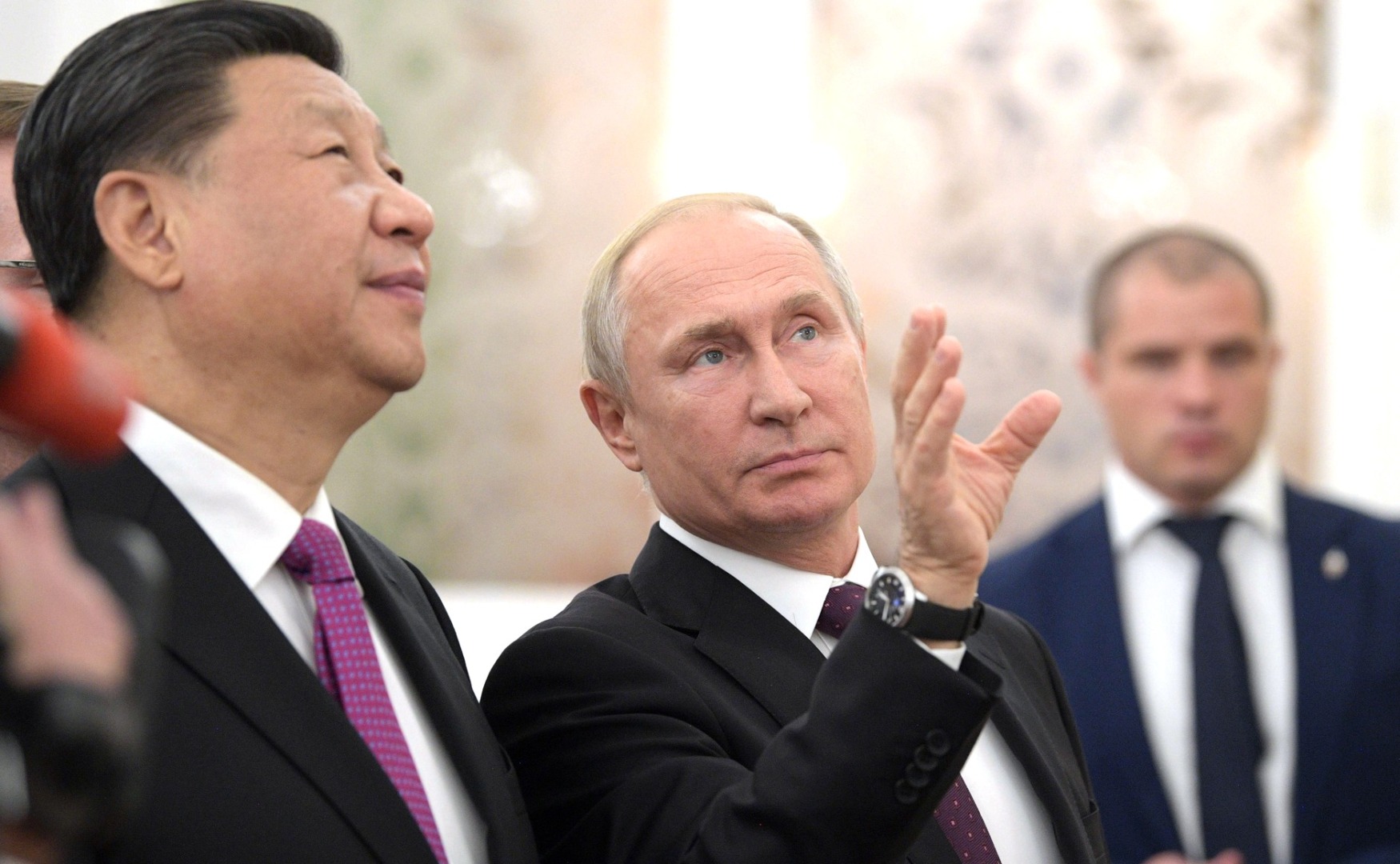
Editor’s Note: The opinions expressed here by Impakter.com columnists are their own, not those of Impakter.com — In the Featured Photo: Russian President Vladimir Putin and Chinese President Xi Jinping. Featured Photo Credit: Wikimedia Commons.