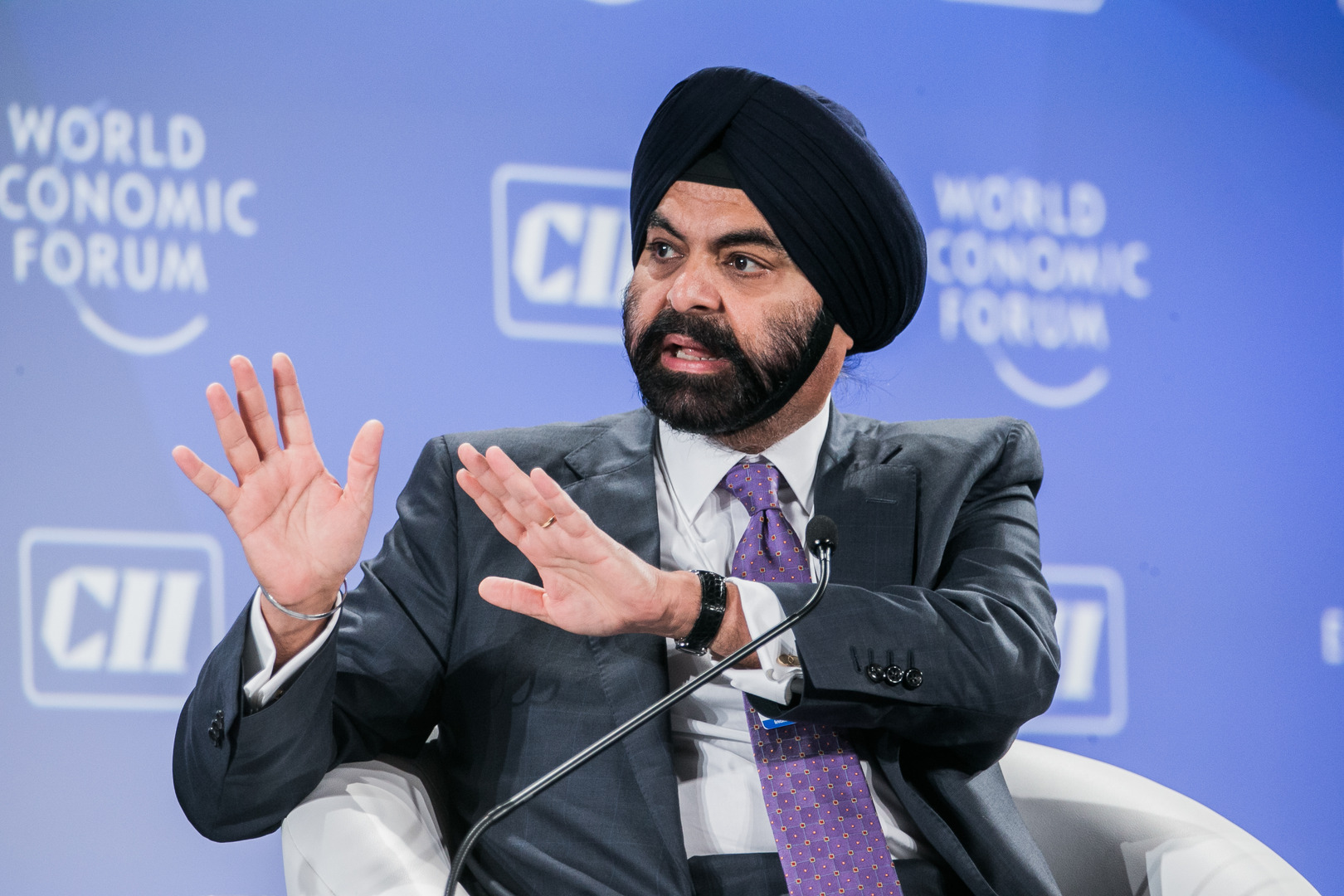
Most international institutions (the IOs) are underfunded or under other forms of attack, with some on what could be called life support. These attacks make it more important than ever that the IOs have competent leadership, with a vision, integrity, and some willingness to listen to the staff of the institutions they supposedly lead. The World Bank has been partly safe from these attacks but its current leader, Ajay Banga (USA), is showing that he does not have the required qualities; the damage already incurred in Banga’s first three years will be difficult to repair without a change in Bank management.
Ajay Banga was an odd choice in 2023 to lead the World Bank though he did fit the usual pattern of a hasty pick made by the Americans because they were unwilling to think about what the job is and how to do it. U.S. pro football teams spend hundreds of millions of dollars each year picking quarterbacks, yet U.S. Administrations, red or blue, typically spend no more than a few hours choosing the person who will manage the world’s largest development bank, with the choice largely dictated by political favoritism and chance acquaintances among the Davosawi. It is unlikely there was much U.S. Government debate about choosing Banga just as there was none about picking his predecessors, except perhaps for Jim Wolfensohn in 1994/95.
Wealth is no disqualification for the Bank’s leadership, but “being wealthy” ought to be. Leaders picked at random from the moneyed classes tend to believe that the world is best run in a definite way, one that accommodates their personal and class interests. Ajay Banga’s immediate background as the CEO of Mastercard fits the rich man’s beginning from the perspective of the hard-headed businessman. As I noted in an earlier article: “The hard-headed businessman is as badly adapted to the World Bank as it is badly adapted to political office. A businessman can fire clients who don’t pay and can sack staff who don’t deliver. The President of the US cannot fire Texas … The President of the WB cannot fire Guinea-Bissau, to take a small example, and cannot fire Argentina, to take a big one, though he will be sorely tempted with both.”
I assumed in 2023 that Banga would soon tire of the Americans and their micromanagement. I was wrong; not only does Banga seem to be staying at the Bank but is working to ingratiate himself with the Trump regime, notably in weakening the Bank’s leadership in the green transition and in accommodating Trumpian interests. While such accommodations are part of the job, and the Bank has survived them in the past, Banga has now done something much worse, as we see below.
The World Bank and the Board of Peace
The Board of Peace (BoP) was approved by United Nations Security Council Resolution 2803 (November 2025) and announced at the World Economic Forum in Davos in January 2026. The BoP’s Charter gives it a broad mandate for conflict zones globally — with Gaza as its immediate focus — but makes no mention of the Palestinian Authority of the Palestinian people. Its nine-member Executive Board is chaired “for life” by Donald J. Trump, and includes Marco Rubio, Steve Witkoff, Jared Kushner, Tony Blair, Nickolay Mladenov, Robert Gabriel, Marc Rowan, and Ajay Banga.
The structure of the BoP has raised concerns among civil society organizations, researchers, and US legislators, about the incompatibility of BoP governance — which combines private investors, political operatives, and a multilateral institution in a single executive body without conflict management protocols — in contrast to the Bank’s mandate and Articles of Agreement.
The Gaza Trust Fund Tie-In With the BoP
The Financial Intermediary Fund (FIF) for Gaza Reconstruction and Development (GRAD) was established in November 2025 after some consultation with the Trump administration. It was decided that the World Bank would serve as its “limited trustee” — a role that departs from its function in comparable trust funds (Ukraine, Haiti) in which the Bank retains full fiduciary accountability throughout the trust fund’s life. The trustee agreement between the World Bank and the Board of Peace defining the conditions for fund management has not been published.
The GRAD establishment document states that the Bank bears “no responsibility or accountability, fiduciary or otherwise, for the use of funds after transfer.” On its face, this statement is incompatible with the World Bank’s standard FIF Trustee framework, under which the Bank provides financial and fiduciary services including “accounting, reporting, financial and fiduciary management, and adherence to established procedures and internal controls.”
Moreover, this limited structure strips standard World Bank safeguards once the FIF is endowed. As of April 7, 2026, the sole confirmed transfer to GRAD was US$1.25 billion from the US State Department, reprogrammed from US disaster and peacekeeping funds on March 26, 2026.)
Ajay Banga’s dual BoP roles
Banga has two roles in the BoP structure, one as a personal member of the BoP Executive Board, and second as the head of the institution serving as limited trustee of the GRAD, e.g., the World Bank. These dual roles create inherent conflicts of interest.
Banga has publicly characterized his BoP membership as separate from his World Bank responsibilities and described political leaders as “deciders” and the Bank as “worker bees.” While the BoP does not identify Banga with his World Bank title explicitly, this is well understood; accordingly, any major external commitment should have been authorized by the World Bank’s Executive Board.
Related Articles
Here is a list of articles selected by our Editorial Board that have gained significant interest from the public:
- Trump’s Board of Peace Explained: Mandate, Power, and Global Implications
- The IMF and World Bank Are Reforming Their Main Debt Sustainability Assessment Tool — Here’s Why It Matters
- Peace First: Why the Next UN Secretary-General Must Recenter the Organization on Its Founding Purpose
- A (Non) Modest Proposal for the G20: A Sustainable World Commission to Achieve the SDGs
Why Ajay Banga should leave the World Bank
Here are the reasons Ajay Banga should not continue as World Bank President.
The Bank’s Articles of Agreement prohibitions
Article IV Section 10:
The Bank and its officers shall not interfere in the political affairs of any member; nor shall they be influenced in their decisions by the political character of the member or members concerned. Only economic considerations shall be relevant to their decisions, and these considerations shall be weighed impartially.
In November 2025 — before UN Security Council Resolution 2803 had been adopted — Banga wrote to the U.S. Administration endorsing a draft resolution, which essentially is lobbying by Banga for a geopolitical instrument that would create a new international body of which he would personally become a member.
Article V Section 5(b and (c)):
(b) The President shall be chief of the operating staff of the Bank and shall conduct, under the direction of the Executive Directors, the ordinary business of the Bank. Subject to the general control of the Executive Directors, he shall be responsible for the organization, appointment and dismissal of the officers and staff.
(c) The President, officers and staff of the Bank, in the discharge of their offices, owe their duty entirely to the Bank and to no other authority. Each member of the Bank shall respect the international character of this duty and shall refrain from all attempts to influence any of them in the discharge of their duties.
There is no public record of any Board resolution, decision, or minute authorizing Banga’s membership on the Board of Peace Executive Board, whether in his institutional or personal capacity. The absence of any recorded authorization is compounded by the “personal capacity” framing in that Banga may have created personal legal obligations — including potential fiduciary duties to the BoP — without the Board’s knowledge, thereby implicating the Bank’s institutional credibility in a body it did not formally approve.
Article V 8(b):
(b) In making decisions on applications for loans or guarantees relating to matters directly within the competence of any international organization of the types specified in the preceding paragraph and participated in primarily by members of the Bank, the Bank shall give consideration to the views and recommendations of such organization.
Banga assumed his BoP Executive Board role apparently without the Bank having given “due weight” to the International Court of Justice (ICJ) July 19, 2024, advisory opinion on the illegality of Israeli policies in the Occupied Palestinian Territory. The ICJ’s advisory opinion found that Israel’s prolonged occupation of Palestinian territory — including Gaza — is unlawful under international law, and that states and international organizations have obligations not to render aid or assistance that maintains that unlawful situation.
No public record has been available of any formal Bank assessment of whether the GRAD structure and BoP board role are consistent with the Bank’s obligations under Article V Section 8(b) considering the ICJ opinion, or whether legal advice on this point was sought from the General Counsel.
GRAD was apparently established without compliance with Bank Trust Fund policies.
GRAD was created under a “limited trustee” structure, without any indication of compliance with required Bank Operational Policies regarding Involuntary Resettlement or for Projects in Fragile and Conflict-Affected Situations, both of which are applicable, as follows:
- As to involuntary resettlement, nearly all of Gaza’s population has been displaced since October 2023. Any reconstruction program affecting resettlement, land use, property, and the right of return engages this Operational Policy. The limited trustee structure denies the Bank’s obligation to ensure compliance with the use of funds. No public assessment has been disclosed.
- With respect to conflict situations, the relevant Operational Policy requires a conflict-sensitivity assessment before Bank engagement in fragile or conflict-affected situations. Gaza is such a situation, and no such assessment has been made for the GRAD trust fund.
The Bank’s Code of Professional Ethics
The World Bank code of professional ethics requires senior officials to avoid situations where their interests — or those of parties with whom they have a close professional relationship — conflict with their institutional duties. There is no public record of any such assessment.
What Can Be Done?
The management and oversight of the Bank are the responsibility of its Board of Executive Directors. The Bank’s Board must authorize a thorough review of whether there are failures to comply with elements of the Bank’s Articles of Agreement, including Banga’s role in the Board of Peace, the absence of relevant public information (such as the terms of GRAD), as well as actions that do not comply with Bank Operational Policies.
Such a review should be supervised by the Board’s Audit Committee and carried out by the Integrity Vice Presidency (INT). There is precedent for this action — a complaint made against former World Bank President, Paul Wolfowitz, was undertaken by the Board’s Audit Committee. To protect the Bank’s global reputation, the Board must take up these questions immediately.
Others can raise the issues described here, whether in or outside the Bank. Any Executive Director of the World Bank Group can file a complaint acting in their individual or representative capacity; a civil society organization with documented standing can do so; or two or more persons adversely affected in the territory in question (Gaza), in which case an additional Inspection Panel request may be warranted under the 2025 Accountability Mechanism.
In short, the World Bank and the entire World Bank Group need better leadership to fulfill their basic mission, “to end extreme poverty and promote shared prosperity on a livable planet.”
** **
The author appreciates the gracious personal assistance and editorial skills of Richard Seifman in preparing this version of my Substack article “Why is Ajay Banga still President of the World Bank?”
Editor’s Note: The opinions expressed here by the authors are their own, not those of impakter.com — In the Cover Photo: Ajay S. Banga, then-President and Chief Executive Officer of Mastercard, speaking at the India Economic Summit 2017 in New Delhi, India. Cover Photo Credit: World Economic Forum / Benedikt von Loebell / CC BY-NC-SA 2.0