Fresh vegetables are key to better nutrition and health around the world. Teaching farmers the best way to grow vegetables is essential. This article explores how Ugandan farmers develop best practices through experimentation, innovation, and exchange of local knowledge.

Growing vegetables is a means to diversify agricultural production, improve nutrition and health and adapt to climate change. Therefore, between 4–5 March 2020, over 600 farmers from eight villages in Hoima, Uganda, came together to learn about this practice. The event provided an opportunity for farmers and experts to share knowledge and skills in vegetable production.
Related topics: Enhancing capacity for resilient agriculture – Raising farmers’ awareness with radio broadcasts – A Farmer-Responsive Approach
The novel activity promoted experimentation, collective learning, innovation, and entrepreneurship.
Pilot farmers and vegetable experts talked about and demonstrated key elements of five production steps, including seedling production, soil and water conservation, fertilization, crop protection and safe use of pesticides. These novel approaches were tested on tomato, green cabbage, eggplant, and green pepper crops.
Take full advantage of this day and the knowledge that you will receive to start growing vegetables in the right way. First, we are learning about tomatoes; then we will visit the cabbage, eggplant and green pepper pilot farmers. All these crops have high market demand, apart from nutritional benefits.
Mr. Mbabazi Benson, Local Council Leader
East West Seed Knowledge Transfer, the Alliance of Bioversity International and the International Center for Tropical Agriculture (CIAT), in collaboration with Wageningen Centre for Development Innovation, the World Vegetable Centre and the National Agricultural Research Organization (NARO) of Uganda, are implementing a one-year pilot project on vegetable production in Uganda.
The project started in October 2019 and is being implemented in Hoima District, Kyabigambire sub-county, where the Alliance and NARO already collaborate on participatory crop improvement, conservation of agrobiodiversity and adaptation to climate change, with the support of the CGIAR Research Program on Climate Change, Agriculture and Food Security (CCAFS). If successful, the collaborating organizations aim to scale the pilot to many more farmers in the Hoima area.

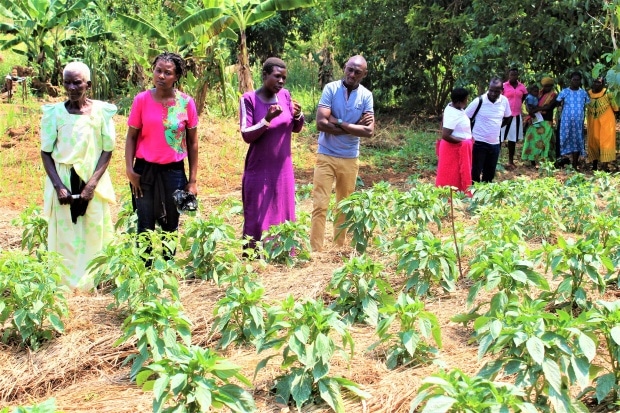
Knowledge exchange on innovations, experiments and entrepreneurship in vegetable production takes place in Hoima, Uganda. Photo: R. Vernooy (Alliance of Bioversity International and CIAT)
Innocent Kaija, a pilot farmer from Katikara Village, shared his experience with the project:
“I was supported by East West Seed and the Alliance to establish a demonstration farm with three different varieties of tomatoes: two newly-introduced varieties and one purchased at the local market.”
Innocent noted that prior to beginning this pilot, he faced the challenges of poor extension services and was reliant on trial and error in his farming. He shared that the vegetable pilot now guides him technically, and he is learning different techniques to deal with pests and diseases.
Scaling prospects: Farmers are taking up promising varieties of vegetables
Farmers pointed out that most of the local varieties of vegetables face many challenges, in particular early and late blight diseases. “We received some rain when we planted, although it stopped raining immediately after that. Due to the rain, the local varieties were infected by blight. However, Padma, an East West Seed tomato variety, performed well and had lower susceptibility to early and late blight,” noted Innocent Kaija. “Padma produced 70 to 100 fruits per plant while the local varieties only had 7 to 15 fruits per plant.”
Padma has good resistance to water stress compared to the local varieties. It is a fast-maturing type whose fruits can be harvested within two months of transplanting.
Eggplant farmer Evelyn Kugonza said that, after the promising pilot, she planned to produce eggplants on a larger piece of land, targeting bigger markets in Kampala, apart from the already available local market. She enthusiastically added: “I am bringing women and youngsters together so that we can form a vegetable growing group and buy a vehicle to transport the fruits to market.”
The vegetable project has provided an opportunity for farmers to learn and appreciate the importance of five key tips for a successful vegetable farm:
(1) strict usage of top quality seeds,
(2) provision of daily attention and care to the plants,
(3) quick intervention when problems arise (e.g. pests and diseases),
(4) maintenance of the fields from weeds, invasive plants, and rubbish,
(5) on-time harvesting, consumption, and selling.
Combining these elements will support farmers in diversifying their food systems, producing nutritious alternatives while also catering to high market demand.
About the author: Tobias Recha is a Research Fellow at the Alliance of Bioversity International and CIAT. Ronnie Vernooy is a Genetic Resources Policy Specialist at the Alliance of Bioversity International and CIAT. Annet Kizza is the Country Manager at East West Seed Knowledge Transfer. David Baguma is the Team Leader at East West Seed Knowledge Transfer. Joshua Mwanguhya is the Project Coordinator at East West Seed Knowledge Transfer. Elizabeth Kabakoyo and Moses Kasozi are Knowledge Transfer Officers at East West Seed Knowledge Transfer. Sylvester Dickson Baguma is the Director of NARO Bulundi. Jasper Ahumuza is a Research Technician at NARO Bulundi. Ronald Kakeeto is a Senior Research Officer at NARO Bulundi.
EDITOR’S NOTE: The opinions expressed here by Impakter.com columnists are their own, not those of Impakter.com. Photo Credit: R. Vernooy (Alliance of Bioversity International and CIAT)