 This article is part of our Editorial Series called “GFAR impakters”. This is done in partnership with GFAR – The Global Forum on Agricultural Research and Innovation – For more follow on Twitter: #GFARImpakters or view here.
‘Youth are the pillars, changers and builders of the nation. They have a huge power to change the system and develop our country.’ This is what the youth of YAD (Youth for Agriculture Development, Nepal) believe.
I still remember the initial days of the YAD organisation. The young people involved did not believe in their strengths, but longed for establishment; we lacked support from our parents, teachers, friends and institutions, we had a funding problem and a small number of members. Back then we did not think that we would succeed, instead believing that we would just become the playing cards of society. Our hope and strength was becoming weaker day by day. But the four of us stood up straight and said: ‘we will do, we will show them and we will become successful. We will make them understand and we will win them over.’
Our hope and strength was becoming weaker day by day. But the four of us stood up straight and said: “we will do, we will show them and we will become successful. We will make them understand and we will win them over.”
Using these motivational words, we found a way to work and spent more than twelve hours on documentation, planning and organizing the team. After all of this hard work, we developed our company bylaws, putting them into different objectives:
1. To train farmers and the agriculture-oriented public about agriculture and the environment
2. To conserve the environment and to develop the community seed bank
3. To continue to support research programs
4. To carry out productivity enhancement training, and possibly business management training
5. To develop a climate-smart agricultural system
6. To train the academic and non-academic youth for the enhancement of their skills.
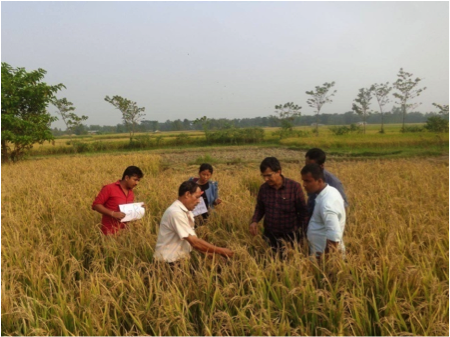 In the photo: Dr. Jagadish Timsina, NRNA Australia and FORWARD Nepal team visit a field
After the first year we had the opportunity to work and research with the Forum for Rural Welfare and Agricultural Reform for Development (FORWARD Nepal) for three years in nutrient management for rice, wheat and maize. Local village development committees (VDCs) supported and funded our training programs, and the District Agriculture Development Office (DADO) as well as other institutes provided us with Helping Hands volunteers. After we gathered a large number of young members and started working as team, we completed a variety of projects.
Research-oriented program
We have conducted a research program focusing on rice, wheat, maize and other crops in amalgamation with the Non-Resident Nepali Association (NRNA), FORWARD, the Nepal Agricultural Research Council (NARC) and the International Maize and Wheat Improvement Center (CIMMYT). Over the past three years in Jhapa, Morang and Lamjung, we have carried out an evaluation of the Nutrient Expert model in rice, maize and wheat in collaboration with FORWARD and NRNA, Australia. The program has also included a study of the various weed management options for maize in Lamjung and Dang in cooperation with the University Grants Commission, Nepal and CIMMYT, as well as transplanting and direct seeding of rice in Lamjung with NARC. Finally, we have carried out systematic rice intensification in the Kavre district with the Institute of Agriculture and Animal Science (IAAS), and foliar application of panchagavya, an organic fertilizer, in cauliflower, an activity that took place in Lamjung with the National Agricultural Research and Development Fund (NARDF).
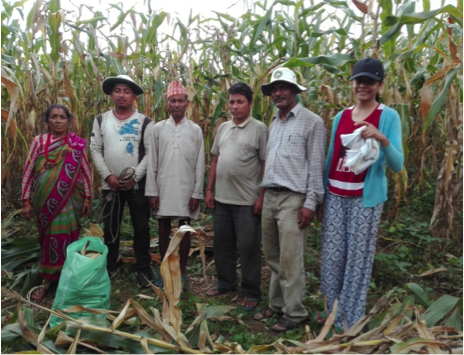
In the photo: Maize research program in Dang
Training and workshop-oriented program
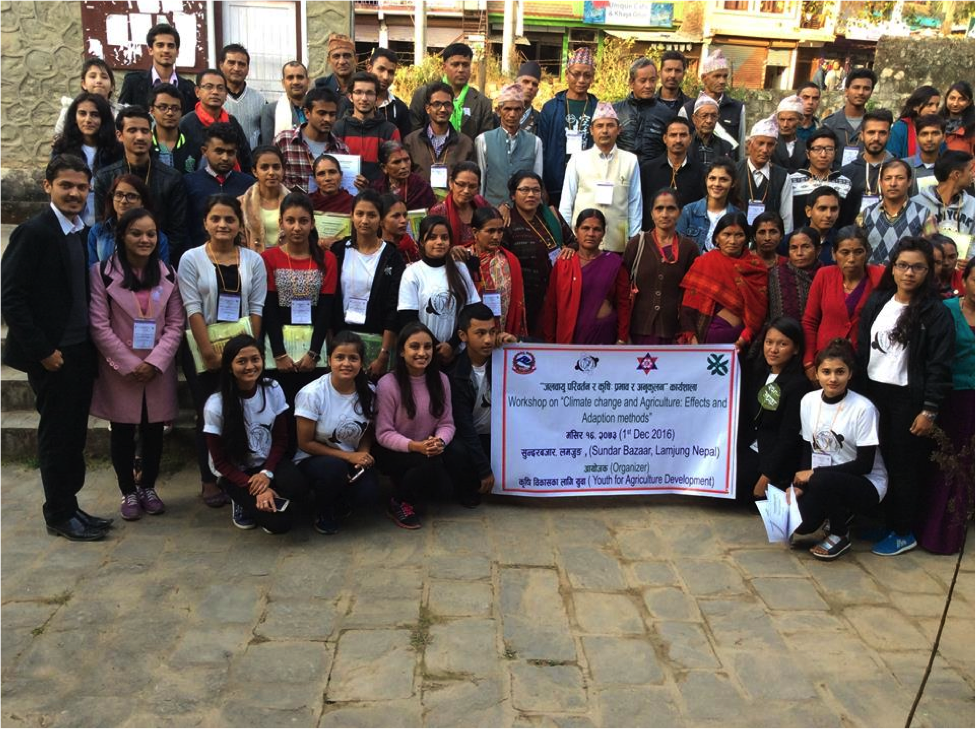
We have conducted training in areas such as direct seeding of rice with NARC and vegetable seed production in Lamjung, Nutrient Expert modelling for Agriculture university graduates and soil sample-taking. We have also held training and workshops on Geographic Information Systems (GIS), research data analysis, Climate-Smart Agriculture, the importance of nutrients to farmers and Decision Support System for Agrotechnology Transfer (DSSAT) modelling training with FAO.
Awareness and collaborative program
Events from this program include: World Wildlife Day, Clean Up Nepal, International Youth Day, World Environment Day, the Agri-Quiz Contest, the Agri-drawing Competition and a charity program promoting e-fundraising for earthquake victims.
Publication
We have published not only research articles but also a book to make people aware of agriculture and cultivation in the Agrimagazine, Krishi Darpan.
Cultivation for fund collection and demonstrations to farmers
Cultivation has included cucumber, summer squash, improved onion, cauliflower, cabbage and tomato cultivation.
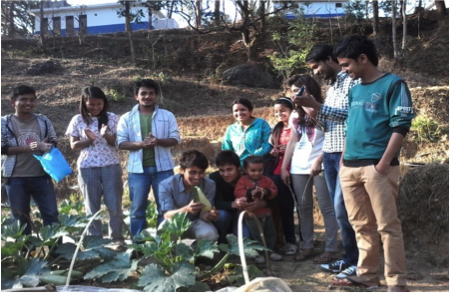
In the photo: First harvest of summer squash
In addition to these programs, we have to deal with various challenges. For example, during the establishment of YAD we had to work with an extended and tedious process of organisational registration. On top of this, it is often difficult to continue to engage the young members working for the organisation, and since most members are university students we sometimes struggle to connect with external in-line working groups, meaning suitable program identification and specialisation is frequently lacking. With no reliable income sources to YAD, active members often lack an incentive and thus motivation. We also have problems with fund collection, owing to the varying interests of funding agencies and negatively-biased attitudes towards young people. There is even an impediment to planned programs due to an excess preoccupation with being politically correct.
Although we are now a big family with over 200 regular members, life members and volunteers, we still lack funds to conduct the program on a large scale.
‘We the youth of this organisation are an organization for the nation. Youth for nation and nation for youth.’