Healthy, thriving, and resilient coral reefs are essential for a healthy planet. One billion people depend on coral reefs for coastal protection, recreation and tourism, sources of animal protein, and fisheries. Coral reefs support livelihoods and generate values of up to USD 9.9 trillion each year. Coral reefs also hold strong cultural and traditional values with a significant proportion of dependency from Indigenous Peoples, local communities, and island nations. Yet, despite this immense value to people and nature, coral reefs continue to face mounting threats.
It is estimated that approximately 50% of coral reefs have been lost since the 1950s. The Global Coral Reef Monitoring Network (GCRMN), an operational network of the International Coral Reef Initiative (ICRI), highlighted a 14% loss of the world’s coral reefs in 2009-2018, driven by climate change and anthropogenic stressors.
On 15 April 2024, the US National Oceanic and Atmospheric Agency (NOAA) and ICRI emphasized the continuing decline of these critical ecosystems through the announcement of the world’s Fourth Global Coral Bleaching Event. This event, the second in ten years, was confirmed by NOAA and ICRI’s network of global coral reef scientists.
Mass bleaching of coral reefs since early 2023 (Figure 1) has been confirmed in over 50 countries, territories, and local economies, including Florida (US), the Caribbean, the Eastern Tropical Pacific (including Mexico, El Salvador, Costa Rica, Panama, and Colombia), Australia’s Great Barrier Reef, large areas of the South Pacific (including Fiji, Vanuatu, Tuvalu, Kiribati, and the Samoas), the Red Sea (including the Gulf of Aqaba), the Persian Gulf, and the Gulf of Aden. Reports have also been confirmed of widespread bleaching across parts of the Western Indian Ocean, including Tanzania, Kenya, Mauritius, Seychelles, Tromelin, Mayotte, and off the western coast of Indonesia.

This finding must be viewed as an urgent call for immediate action for coral reefs and a clear warning for the state of the global Ocean, its biodiversity, and the entirety of the human population who depend on it. Where coral bleaching results in mortality (Figure 2), especially on a widespread scale, it impacts economies, livelihoods, food security, and more. Coral reefs harbor upwards of 25% of all marine biodiversity. Thus, their decline threatens the existence and survival of at least one in every four living organisms in the Ocean.
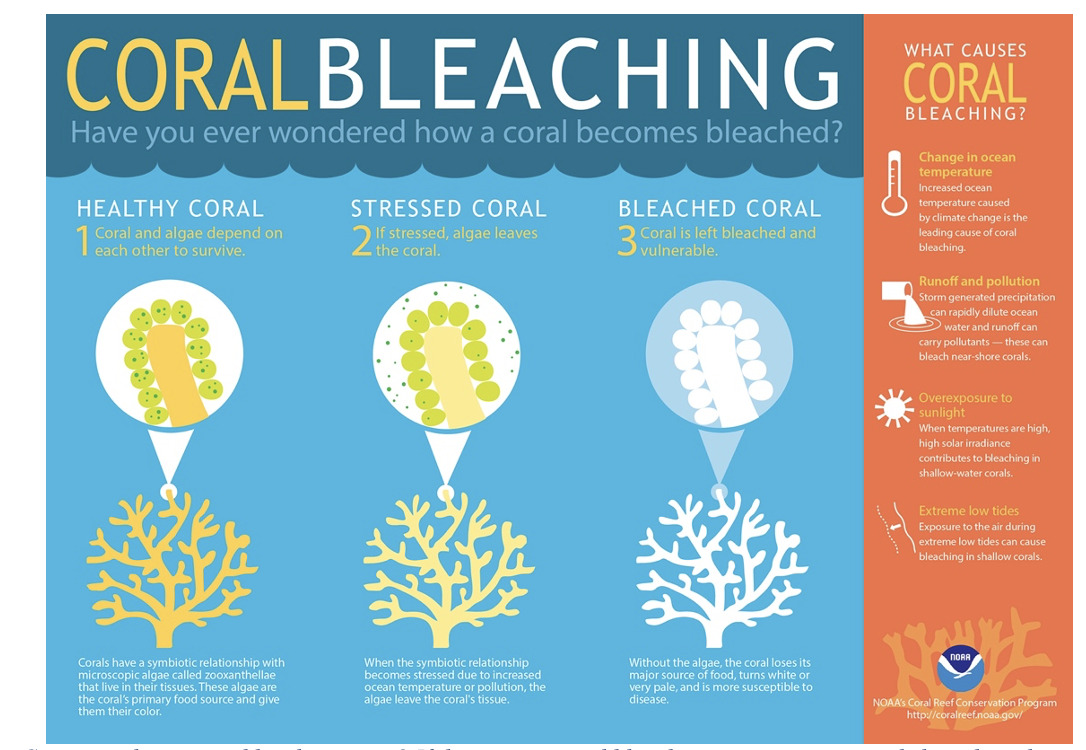
However, it is important to remember that coral bleaching does not always lead to coral death. Rather, if the stress driving the bleaching diminishes, corals can recover, and reefs can continue to provide ecosystem services through maintaining biodiversity and nature’s health. Where corals can recover, bleached corals often exhibit reductions in growth and impaired reproduction output for up to five years following the bleaching event and are highly susceptible to disease for up to two years post-bleaching.
While coral reefs can recover from bleaching events, the increased frequency of such events, driven by climate change, reduces the window of recovery for corals, thus leading to a continued decline in reef health. Therefore, the impacts of bleaching can significantly impair the resilience and recovery potential of coral reefs. This drives the need for a rich suite of solutions that promote the conservation, protection, and resilience of coral reefs.
Related Articles: Why Coral Reefs Need All Our Attention | How Robots Could Help to Restore Coral Reefs | The Great Coral Bleaching of 2022: 91% of Reefs Affected | Can Stock Market Theory Save the World’s Coral Reefs?
The Fourth Global Coral Bleaching Event requires global action. ICRI, a partnership of 101 international members, currently co-chaired by NOAA and the US Department of State, is steadfast in applying resilience-based management actions for coral reefs. In response to the three previous global bleaching events as well as regional and local events, ICRI and its members have advanced coral interventions and restoration in the face of climate change. ICRI develops and shares best practices for the effective management of coral reefs through the implementation of its Plan of Action.
ICRI also urges all its partners and other stakeholders to support the Coral Reef Breakthrough aiming to secure the future of at least 125,000 square kilometers of shallow-water tropical coral reefs with investments of at least USD 12 billion to support the resilience of more than half a billion people globally by 2030. These targets are critical for driving momentum for action and are in line with the targets of the Kunming-Montreal Global Biodiversity Framework (GBF), and many national 2030 strategies. The targets are supported by four specific action points:
- Stop drivers of loss;
- Double the area of coral reefs under effective protection and bolster resilience-based efforts;
- Accelerate restoration to impact 30% of degraded reefs by 2030; and
- Secure investments from public and private sources of at least USD 12 billion.
Global bleaching events do not affect all coral reefs equally and require global, regional, and local interventions. This emphasizes the importance of regularly monitoring coral reef ecosystems, and not just during bleaching events. Networks such as the Global Coral Reef Monitoring Network and national programmes such as the US Coral Reef Task Force provide mechanisms for reporting on the impact of bleaching on the world’s coral reefs, alongside regional bleaching observation networks.
To share key messages and resources about coral bleaching, its impacts, causes, and solutions currently being implemented and developed, ICRI has developed the Coral Bleaching Hub, to support responses, policy, and planning and encourage global cooperation. On 14 May 2024, ICRI will also be hosting a webinar to present and discuss the status of the Fourth Global Coral Bleaching Event and the role of the coral reef community in building resilience, supporting recovery, and monitoring the impacts of this global event.
Now, more than ever, we need to act for coral.
** **
 This article was originally published by the International Institute for Sustainable Development (IISD) and is republished here as part of an editorial collaboration with the IISD. It was authored by Francis Staub, Global Coordinator at the International Coral Reef Initiative (ICRI) Secretariat, and Thomas Dallison, Strategic Advisor at the ICRI Secretariat.
Editor’s Note: The opinions expressed here by the authors are their own, not those of Impakter.com — Cover Photo Credit: Li Fei.