
In the 1990s, India’s vulture population collapsed due to the unintended knock-on effect of a veterinary drug for cattle, with some vulture species suffering losses of 91-98%. Given the keystone role of vultures for natural sanitation, their disappearance raised human mortality rates. Between 2000 and 2005, this led to an estimated 100,000 additional human deaths annually and estimated losses of nearly $US 70 billion per year. Many similar stories have been occurring throughout Asia and the Pacific. In Southeast Asia’s Coral Triangle, coral bleaching and habitat degradation threaten the livelihoods of over 100 million people.
These are not merely environmental crises, but also economic ones. Economic activity both depends on and shapes the health and biodiversity of natural systems. The services we obtain from the ecosystem represent important factors of production. Loss of biodiversity — the variety of species that interact to produce the different ecosystem services — leads to loss of important inputs in economic production. Although there is increasing awareness of the perils of climate change, the effects of biodiversity loss remain poorly understood. Our work proposes a theoretical model to understand the mechanisms that link them.
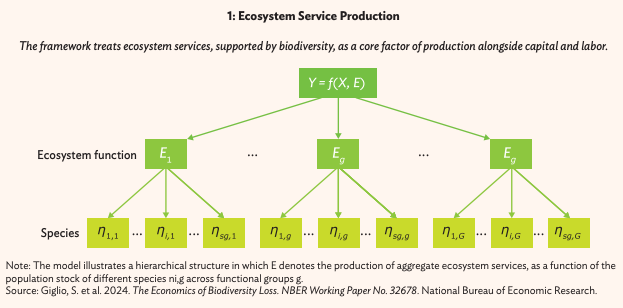
Figure 1 illustrates how biodiversity drives the production of ecosystem services. The first layer of Panel 1(a) shows how aggregate ecosystem services are produced by the interaction of distinct, complementary functions — some provisioning goods (e.g., food, fuel, timber, medicines) and others regulating processes (e.g., pollination, water purification, carbon storage). Because these functions are complements, losses in any one reduce ecosystem services directly and indirectly, and are not easily offset by improvements in others. For example, a loss in pollination cannot simply be replaced by better water filtration or sanitation. Since ecosystem services complement land, labor, and capital, their decline can lower economic output even when these other inputs increase.
The bottom layer of Panel 1(a) shows that ecosystem functions depend on the interaction of multiple species that play similar, but not fully interchangeable, roles. In general, ecosystem services are an increasing and concave function of biodiversity. This implies that when many species in an ecosystem can contribute to providing a certain ecosystem function, the loss of any single species has limited negative effects; as biodiversity declines, however, the marginal importance of each remaining species increases.
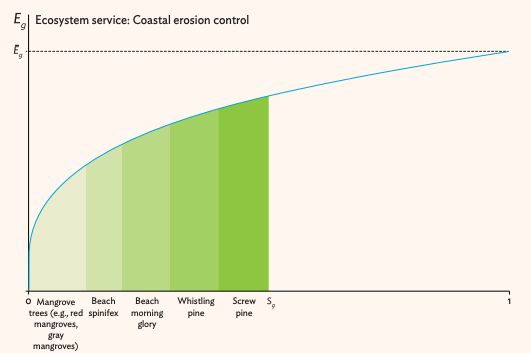
Figure 1(b) illustrates this mechanism for coastal erosion protection, which is provided by partially substitutable species such as mangroves and screw pines. Starting from a very biodiverse ecosystem (i.e., to the right of the graph), the loss of some species has only limited effects on total production (the slope is flatter there). However, losses in biodiversity also make the ecosystem more fragile to further losses (the slope steepens as more and more biodiversity is lost): the ecosystem becomes more fragile. Because ecosystem services are an important input to the economy, increased ecological fragility exposes the economy to potentially severe losses.
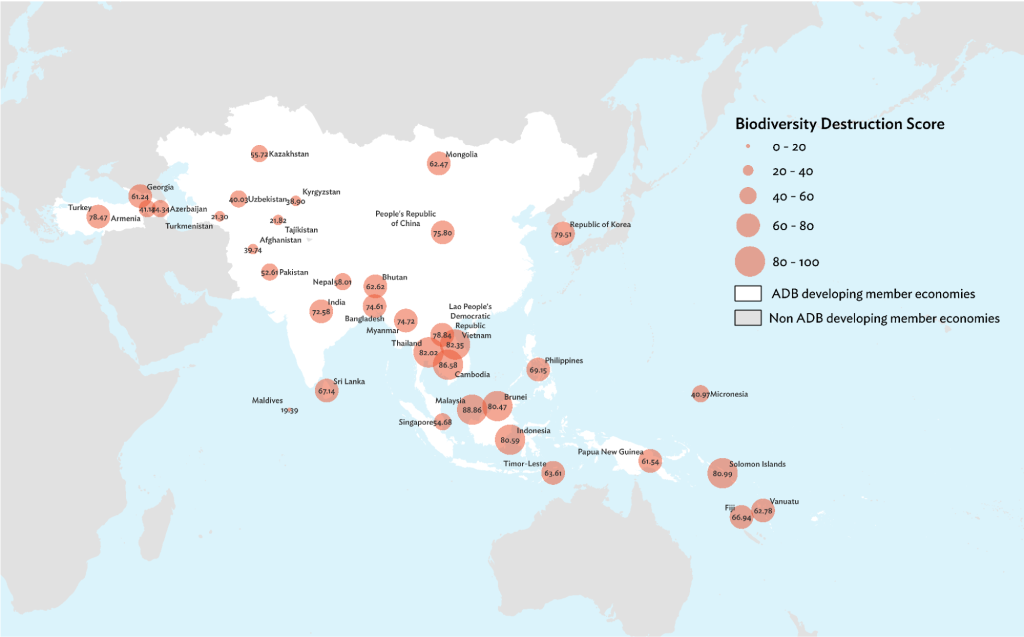
Exposure to biodiversity loss varies across regions. Figure 2(a) captures the overall scale of biodiversity loss across countries, while Figure 2(b) presents a biodiversity risk exposure score, which reflects how unevenly those losses are distributed across ecological functions. Countries such as Malaysia and Indonesia, where biodiversity loss is particularly severe, exhibit some of the highest exposure scores.
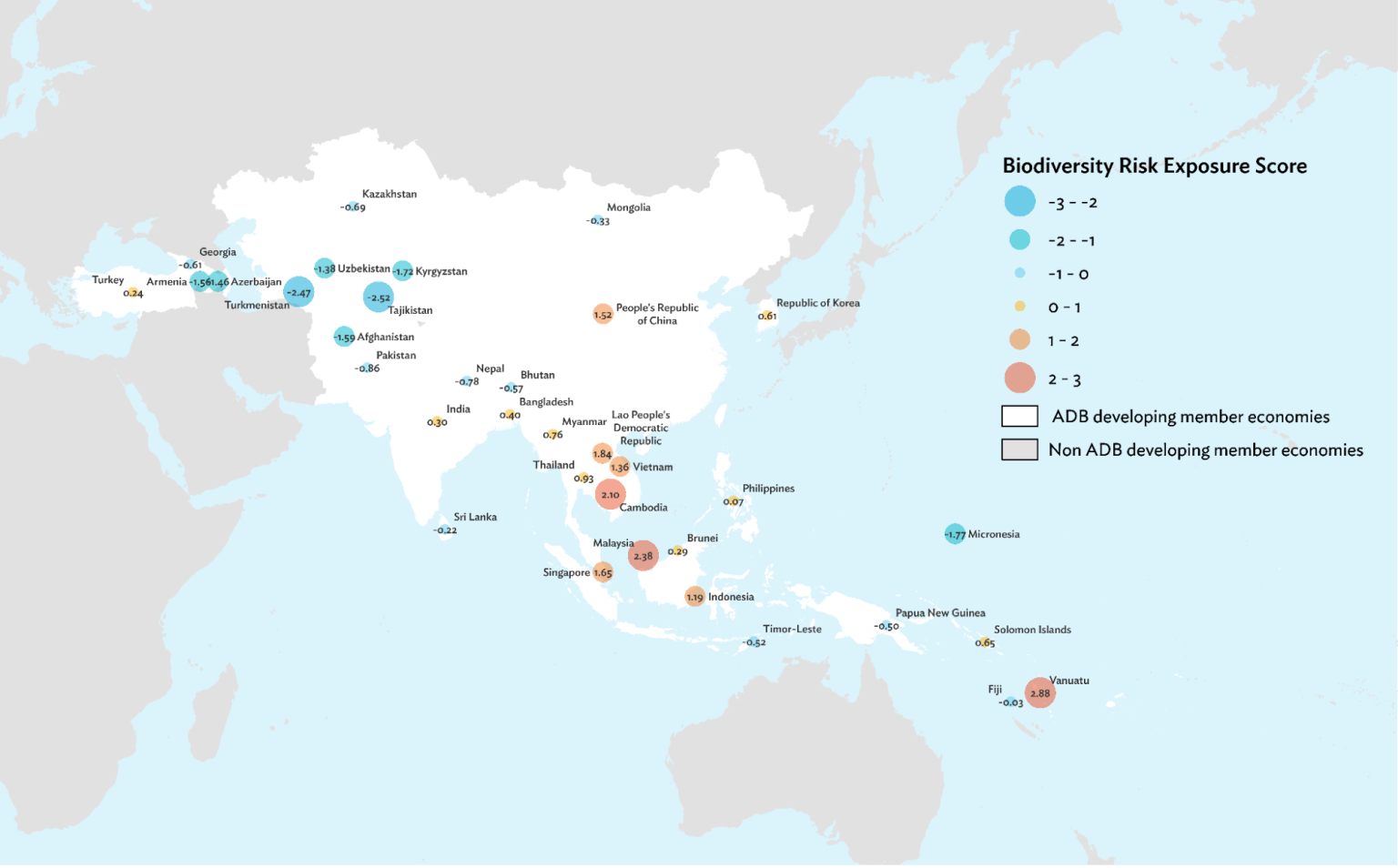
However, Figure 2(b) also reveals that risk is not restricted to countries with high average biodiversity destruction. Economies like Singapore, despite lower aggregate losses, also face biodiversity risk due to pronounced functional imbalances — that is, concentrated declines among the functions that play a key role in providing ecosystem services.
These effects have also rippled across the financial markets. There is growing evidence that biodiversity risk is increasingly reflected into asset prices. However, market participants currently believe that this risk is still underpriced. Therefore, to avoid further abrupt losses to the economy, it is essential to implement the appropriate policies and financial instruments to mitigate biodiversity loss.
In recent years, new financial instruments have emerged to support biodiversity conservation. Biodiversity bonds allow investors to provide upfront capital for conservation projects, often through highly rated issuers that can raise funds at low interest rates. Some investors even accept lower returns, so the additional savings are reallocated toward further ecosystem restoration.
In October 2024, the ADB issued its first biodiversity and nature bond, which was purchased by Japan’s Daiichi Life Insurance Company to finance nature-positive projects across the region. Debt-for-nature swaps work differently: they restructure or forgive part of a country’s debt in exchange for commitments to fund local conservation. For example, in July 2024, the United States and Indonesia signed a deal to redirect over $US 35 million toward protecting the Coral Triangle region.
Related Articles
Here is a list of articles selected by our Editorial Board that have gained significant interest from the public:
In addition to financial instruments, policymakers have turned to market-based solutions to promote conservation for local stakeholders. In July 2025, the European Commission announced that they will develop rules for “nature credits” that pay farmers to protect their ecosystems — a more targeted incentive than their existing subsidies for farmers.
Given the growing exposure of financial markets to biodiversity and climate risks, it is crucial for regulators and investors to integrate these risks into financial decision-making. For example, the Monetary Authority of Singapore has introduced robust environmental risk management guidelines requiring financial institutions to assess both climate and biodiversity risks. These measures help steer capital toward sustainable projects and strengthen the protection of ecosystems.
While many biodiversity policies resemble those used to mitigate climate risks, biodiversity loss is far more complex to address. Unlike carbon emissions, which induce the same cost on society no matter where they are emitted, the value of each species (and therefore the cost of its loss) depends on local conditions: how many similar species remain, how fragile the ecosystem is, and how essential the function is to the economy or environment. Designing taxes, trading systems, or biodiversity offsets requires knowing which species matter most in each ecosystem, and comparing them because their ecological and economic roles vary by region.
Because species differ in their economic and ecological importance, achieving “no net loss” of species does not necessarily translate into “no net loss” of ecosystem function. Nevertheless, the framework highlighted in Figure 1 suggests a guiding principle: conservation should focus first on ecosystems with few remaining species that perform essential functions.
Much remains to be done to value and protect the natural systems we depend on. A growing body of research highlights the urgent need to treat biodiversity loss as a first-order economic risk deeply intertwined with climate change and the economy. Protecting nature is not simply an environmental goal, but also an investment in long-term economic resilience and prosperity.
** **
This article was originally published under Creative Commons by 360info™
Editor’s Note: The opinions expressed here by the authors are their own, not those of impakter.com — Cover Photo Credit: Pexels.