Impakter
  • Environment
    • Biodiversity
    • Climate Change
    • Circular Economy
    • Energy
  • FINANCE
    • ESG News
    • Sustainable Finance
    • Business
  • TECH
    • Start-up
    • AI & Machine Learning
    • Green Tech
  • Industry News
    • Entertainment
    • Food and Agriculture
    • Health
    • Politics & Foreign Affairs
    • Philanthropy
    • Science
    • Sport
  • Editorial Series
    • SDGs Series
    • Shape Your Future
    • Sustainable Cities
      • Copenhagen
      • San Francisco
      • Seattle
      • Sydney
  • About us
    • Company
    • Team
    • Global Leaders
    • Partners
    • Write for Impakter
    • Contact Us
    • Privacy Policy
No Result
View All Result
Impakter logo
No Result
View All Result
Progress in a Static Environment: F1 Teams Take Sustainability Into Their Own Hands

Progress in a Static Environment: F1 Teams Take Sustainability Into Their Own Hands

Impakter interviews Mercedes-AMG F1 Sustainability Lead Alice Ashpitel to learn more about the company sustainability efforts, including their use of sustainable biofuel to transport its F1 team across Europe and beyond

Paolo FeserbyPaolo Feser
December 20, 2022
in Corporations, Environment, Impact, Sport
0

In 2019, Formula One announced its plan to become Net Zero by 2030, promising to reduce its carbon footprint throughout its operations, such as the sport’s commitment to developing a 100% sustainable fuel that will be used in their cars beginning in 2026. 

Sustainability has been a focal point of the sport as it seeks to distance itself from its classic image as loud and polluting sport governed by petrol heads and tobacco companies, with F1 CEO Stefano Domenicali going as far as to say sustainability is their number one priority. 

Yet, fans are dubious of these commitments to sustainability. 

The development of a sustainable fuel for F1 cars will only cover 0.7% of the sport’s total carbon footprint; the real damage is caused by the sport’s logistical activity, which accounts for nearly half of the total carbon footprint.
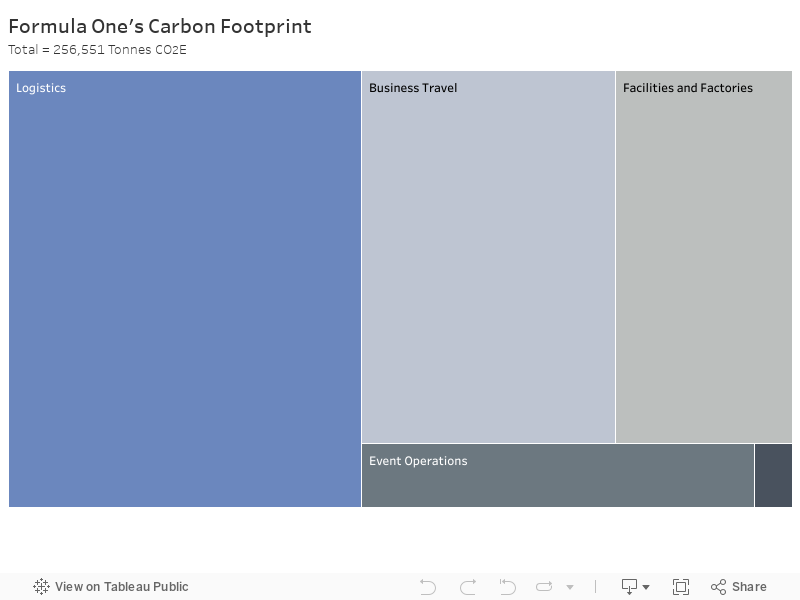
Moreover, with the release of their 2023 calendar, it appears that sustainability is not much of a priority at all. Despite a promise to redesign the calendar to be more efficient, their new 2023 calendar, which includes an additional two races, will extend their total carbon footprint by an estimated 10,000 tonnes of CO2 compared to their current 2022 calendar, an increase of 15%.

F1’s bold claims of a passion for sustainability, with no tangible evidence to back them up, are driving the sport into the gravel known as “greenwashing.”

But this does not mean that serious sustainability progress has not been made within the sport. F1 teams have taken sustainability into their own hands by doing what they do best – innovating.

To learn more about the efforts of the Mercedes F1 team in particular, we spoke with Alice Ashpitel, Lead of Sustainability at Mercedes-AMG Petronas F1. 

The team’s objective, Alice tells us, is to become the “most sustainable sports team” by “investing in industry-leading sustainability strategies.”


Related Articles: Formula 1 World Champion Sebastian Vettel Retires | Is Formula 1 Pushing the Planet to Its Finish Line? | Formula 1 Releases Its 2023 Calendar and Forgets the NetZero Pledge

Mercedes hopes that by focusing on logistics, they will be able to reduce their carbon footprint despite the pressures of an expanding calendar. The team has been investing into more sustainable fuels for its land and air freight.

“We are committed to using our global motorsport platform to be leaders in the journey towards not just sustainable racing but a more sustainable future,” says Alice.

For the European leg of the season, where cargo is transported solely by trucks, Mercedes have been trialling their Hydrotreated Vegetable Oil (HVO 100) biofuel, “a 100% renewable fossil fuel free product derived from vegetable oils, waste oils and fats.”

“Sustainability isn’t standing still,”

— Alice Ashpitel.

Analysis has shown that the HVO 100 biofuel, which was used for approximately 1400 km for 16 of their trucks, reduced freight emissions by 44,091 kg CO2, representing an 89% reduction compared to their usual diesel fuel.

Following the trial’s success, Mercedes is looking to implement their HVO 100 fuel for the rest of the European races, which could save around 230,000 kg CO2 for the 2023 calendar.

However, 98% of a team’s logistical carbon footprint comes from its air freight, flying in around 100 personnel and 34 tonnes of cargo to each race. 
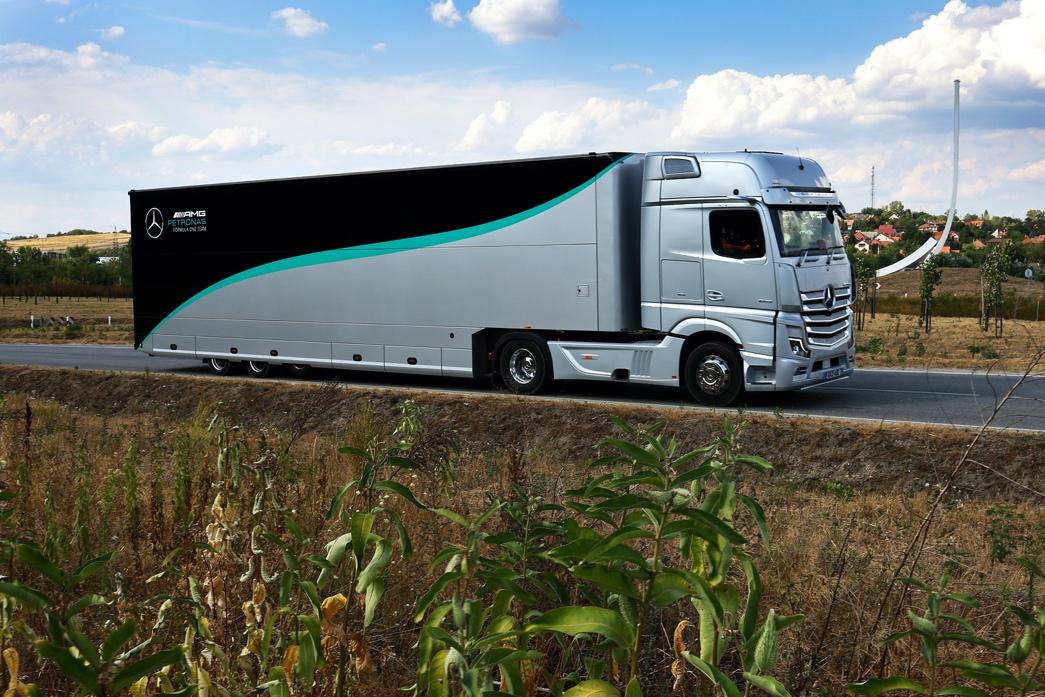
In the Photo: Mercedes-AMG Petronas F1 freight truck. Photo Credit: Mercedes-AMG Petronas F1.

To combat this, Mercedes F1 has become the first global sports team to invest in Sustainable Aviation Fuel (SAF), which uses either renewables or waste-derived material, to help the team achieve a 50% reduction in their air freight footprint for their race personnel.

“We have an embedded top-down approach to sustainability,” says Alice, adding that “on top of this [SAF], we are working with a book-and-claim system to offset our emissions further.”

Mercedes F1 was able to reduce their carbon emissions by 60% last year compared to the same period in 2018.

But even with all this innovation, Mercedes still has a long journey ahead. The cargo of their air freight, the bulk of its emissions, is still being transported by conventional fossil-fuels. It is estimated that approximately 450 billion litres of SAF will be required annually to meet their Net Zero targets, despite the fact that only 100 million litres were produced last year. 

For a start at least, Mercedes are showing promising signs to meet these lofty goals. 

“Sustainability isn’t standing still,” says Alice, “we are continuously working on improving on these goals and to keep innovating to reach these goals”.

Mercedes and F1 have both expressed their passion for sustainability and set themselves targets to reach their Net Zero goals by 2030. However, whereas the former has tangibly demonstrated their commitment to sustainability through innovation and implementation, the latter has shown no real commitment to sustainability despite its claims. F1 still has a long way to go before convincing fans that sustainability is their top priority.


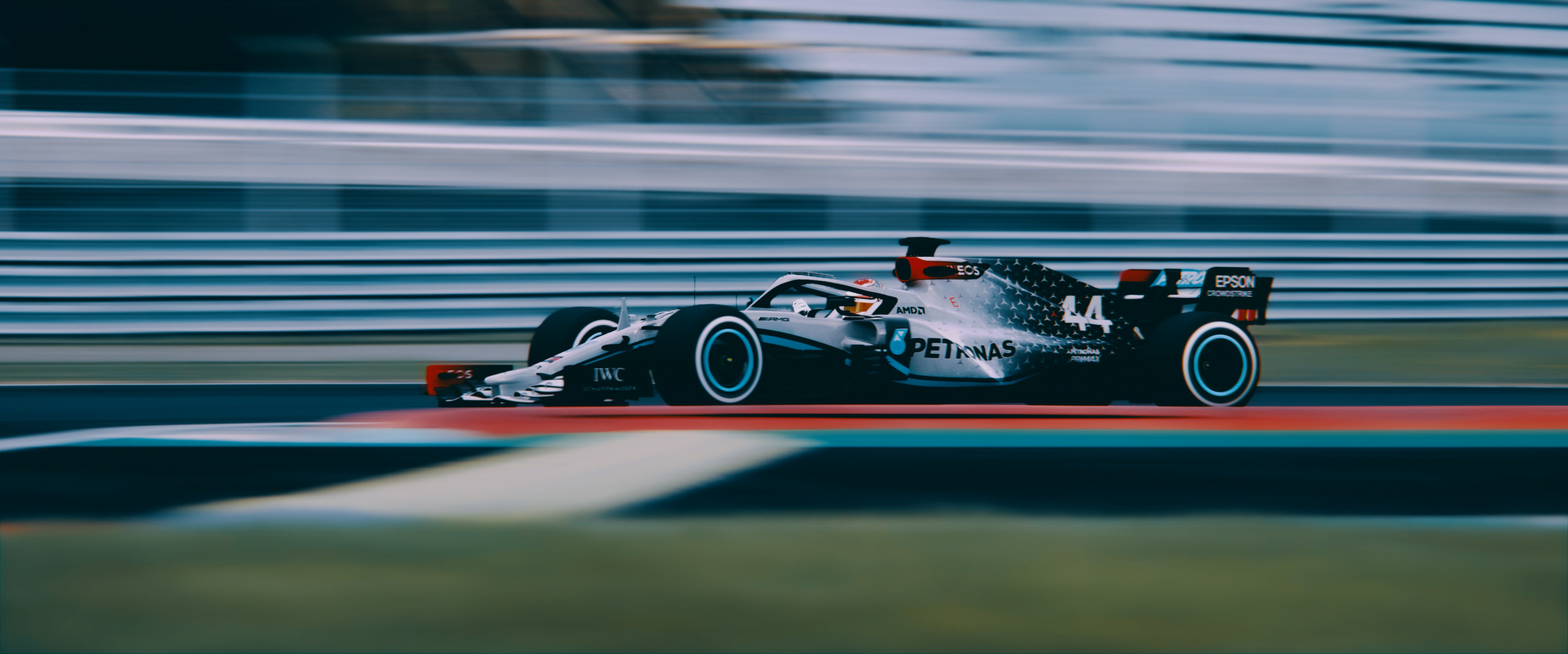
Editor’s Note: The opinions expressed here by the authors are their own, not those of Impakter.com — In the Featured Photo: Mercedes-AMG Petronas F1 car. Featured Photo Credit: Jon Hillenbrand.

Tags: biofuelcarbon footprintF1Formula OneMercedesRacingsportSustainability
Previous Post

Your Sustainable Agenda for 2023

Next Post

The New Role of Cities in the Climate Crisis: An Interview With Ms. Maimunah Mohd Sharif

Related Posts

Native American Sovereignty
Society

Native American Sovereignty and Environmental Sustainability

Sustainability is defined as harvesting or using a resource so that it is not depleted or permanently damaged. Environmental sustainability...

byDr. Annis Pratt
November 11, 2025
Sustainable EU Tourism - Shaping the Tourism of Tomorrow
Circular Economy

Tourism at a Crossroads: Europe’s Path to Sustainability and Resilience

Tourism is among Europe’s most dynamic and prominent industries, stimulating local economies, generating jobs, and promoting cultural exchange. However, it...

byIntellera – Part of Accenture
November 7, 2025
Cybersecurity Meets Sustainability
Green Tech

Cybersecurity Meets Sustainability. Responsible Digital Hygiene for Mac Users

Nowadays, security and stability are increasingly intertwined. And Mac users traditionally consider their devices to be more secure than other...

byHannah Fischer-Lauder
October 30, 2025
Baler Compactors
Circular Economy

Compressing Waste, Expanding Impact: How Baler Compactors Advance Corporate Sustainability

It is easy to see the glitzy side of sustainability. Solar panels, windmills, electric fleets. But there’s more to sustainability...

byHannah Fischer-Lauder
October 29, 2025
blue economy
Biodiversity

Blue Economy: A Solution for Yemen?

Editor's note: This article is the first in a two-part series exploring the profound potential of the Blue Economy as...

byTareq Hassan - Executive Director of the Sustainable Development Network Canada (SDNC)
October 15, 2025
How Companies Can Harness AI’s Full Potential to Drive Positive Change
AI & MACHINE LEARNING

How Companies Can Harness AI’s Full Potential to Drive Positive Change

Since the EU AI Act came into force, Europe has marked a turning point in how companies must approach the...

bySofía Bergareche
October 7, 2025
White buildings with orange roofs sit alongside the coast in Split, Croatia.
Environment

EU Rolls Out New Toolkit for Sustainable Tourism

This month, the European Commission (EC) released a new communication toolkit to help stakeholders promote sustainable tourism on the continent. ...

byBenjamin Clabault
September 30, 2025
Sustainability Leaders
Corporations

Preparing the Next Generation of Sustainability Leaders

Sustainability used to be considered a niche concern, perhaps even a luxury. But rising concerns about climate change and our...

byHannah Fischer-Lauder
September 30, 2025
Next Post
Ms. Maimunah Mohd Sharif

The New Role of Cities in the Climate Crisis: An Interview With Ms. Maimunah Mohd Sharif

Recent News

Innovation in Accounts Receivable - Photo credits: reallywellmadedesks

Why Intelligent Accounts Receivable Software Is the Next Big Shift in Fintech

November 12, 2025
ESG News regarding: only 16% of companies on track to hit net zero targets by 2050 per Accenture report, Orsted completes green transformation, EU and UK to begin carbon market link negotiations, China to expand renewable energy sector

Only 16% of Large Companies on Track for Net Zero

November 12, 2025
Bill Gates memo

Climate, Gates and COP30

November 12, 2025
  • ESG News
  • Sustainable Finance
  • Business

© 2025 Impakter.com owned by Klimado GmbH

No Result
View All Result
  • Environment
    • Biodiversity
    • Climate Change
    • Circular Economy
    • Energy
  • FINANCE
    • ESG News
    • Sustainable Finance
    • Business
  • TECH
    • Start-up
    • AI & Machine Learning
    • Green Tech
  • Industry News
    • Entertainment
    • Food and Agriculture
    • Health
    • Politics & Foreign Affairs
    • Philanthropy
    • Science
    • Sport
  • Editorial Series
    • SDGs Series
    • Shape Your Future
    • Sustainable Cities
      • Copenhagen
      • San Francisco
      • Seattle
      • Sydney
  • About us
    • Company
    • Team
    • Global Leaders
    • Partners
    • Write for Impakter
    • Contact Us
    • Privacy Policy

© 2025 Impakter.com owned by Klimado GmbH