When thinking of the work of statisticians, the image of croplands and farm fields probably does not come to mind, but in fact, agricultural statistics are vital to understanding and addressing the on-the-ground realities of food insecurity, and more professionals are needed in this field to improve the world’s food productivity, sustainable production and to end hunger. Although traditionally underrepresented, young Africans, women in particular, are now working to bridge the data gap in their countries in the hope of improving the agricultural landscape in Africa.
Amid the lush savannahs of Côte d’Ivoire, Désirée Christelle and Deborah Conan arrive in the Dabou region, specifically in the village of Konou, as part of a master’s programme in agricultural statistics under the Global Strategy to Improve Agricultural and Rural Statistics (GSARS) programme. Led by the Food and Agriculture Organization of the United Nations (FAO) and supported by the Bill & Melinda Gates Foundation and the European Union, this programme is a long-term initiative to enable the production of more and better agricultural statistics in developing countries.
The village of Konou is particularly known for its rubber, palm tree and cassava production, and Désirée and Deborah have come to understand the agricultural process behind the numbers.
“Does it yield as much as it used to? What changes have occurred in productivity?” Désirée asks a group of local farmers.
Their answers will help these young agricultural statisticians learn how statistical theory applies to real life agricultural production and yield.
“Yield” is a crucial metric for farmers and agronomists, but also statisticians to obtain data about the success of a crop. Higher yields often indicate more productive and efficient agricultural practices.
But, to really understand yield, one must understand how a crop is actually produced and harvested. Along with their peers from many different parts of Africa, Désirée and Deborah are there to observe how rubber is collected by farmers and how to measure it. For that, they need to comprehend the process of “tapping”.
Armed with a machete, a farmer starts to “tap” or make incisions in the bark of the rubber tree to harvest latex. The milky sap that flows down the trunk is collected in containers and then processed to manufacture various rubber products.
After the demonstration, Ankouvi Nayo, an FAO Statistician, teaches students how to set up “yield squares” that measure the harvest per tree, a technique that can be applied to other products such as cocoa and cashews. By combining theory and real-life mechanics, the young statisticians can start making their calculations.
“Numbers are indispensable tools to improve the agricultural world. Numbers guide decision-making, and they don’t lie,” says Deborah.
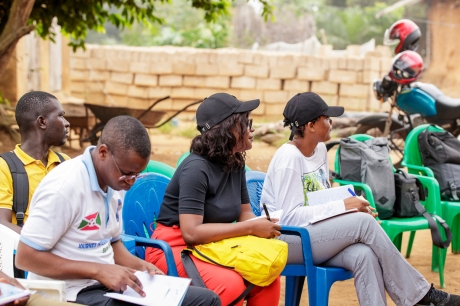
Deborah and Désirée are both Ivorian agronomists. Deborah was inspired to pursue the career by her grandparents who are cocoa producers, and Désirée by the magic of seeing seeds bloom even as a city kid.
In the end, their intense desire to help their country made them cross paths at the National Higher School of Statistics and Applied Economics (ENSEA) of Abidjan, where they are now pursuing a Master of Agricultural Statistics. This programme is designed to equip young African statisticians with relevant and up-to-date training to improve the quality of agricultural statistics in their respective countries.
Related Articles: Sustainable Agriculture is the Key to Ending Hunger | How Alleviating Risk for Farmers Could End Hunger | How Big Companies Can Help End Hunger | We Can End Hunger and Meet Climate Goals For an Extra USD 14 Billion per Year
FAO, along with its partner the United Nations Economic Commission for Africa, offers scholarships to applicants in African countries to pursue this one-year, highly competitive master’s programme.
The programme entails an immersive experience, combining theoretical knowledge with practical applications tailored to the specific challenges faced by the agricultural sector. The curriculum covers a range of topics, from data collection and analysis to implementing sustainable practices and leveraging technology.
“What I love most about my work is going to the source, collecting information from producers, processing it and seeing the results. The impact it could have on sustainability, on my country,” says Deborah. “This allows the leaders of my country to make well-informed decisions for both the nation’s development and the well-being of the producers themselves.”
Indeed, agricultural statistics are crucial not only for better production, but also for policymaking, resource allocation and market planning, aiding governments in formulating strategies for food security, rural development and sustainability.
FAO actively promotes the importance of agricultural statistics, providing support to member countries in strengthening their statistical systems, encouraging best practices and emphasizing the role of reliable data in achieving food security and sustainable agriculture. Without reliable data, it is hard to know the realities on the ground, whether agricultural yields are increasing or decreasing and whether that is having an impact on hunger for local communities.
“Since 2012, FAO has been the proud host for the Global Strategy to Improve Agriculture and Rural Statistics to address the decline in the agricultural statistics systems in many developing countries. One of the components is the scholarships,” explains FAO Senior Statistician and Coordinator of the GSARS programme, Neli Georgieva Mihaylova.
In 2023, 48 scholars from 24 African countries were offered scholarships for this master’s programme and graduated successfully—43 percent of them were women.

In a world where women continue to be highly underrepresented in the field of sciences, FAO works to address gender disparities in access to resources, education and opportunities within the agricultural sector.
“The better equipped women are in holding leadership positions in statistics, the more effectively they can improve our realities,” says Deborah.
“Thanks to us, the newly trained agricultural statisticians, we can provide figures that will enable our policymakers to make informed decisions based on the actual state of our lands and the information we collect. So, this is quite significant,” adds Désirée, inviting all other agriculture-statistics-curious to not think twice about entering this field of work.
** **
This article was originally published by the Food and Agriculture Organization of the United Nations (FAO) and is republished here as part of our editorial collaboration with the FAO.
Editor’s Note: The opinions expressed here by the authors are their own, not those of Impakter.com — Featured Photo Credit: ©FAO/Hug Tiadji.