At a time when the world, battered by COVID-19, is watching with dismay the rocky transition from Trump to President-Elect Biden, a group of 17 world scientists reminds us that maybe all our worries are futile. What is at risk is something far more important: The very survival of humanity. The prognosis is dire and it comes in a just-released major perspective paper: “Underestimating the challenges of avoiding a ghastly future” published in Frontiers in Conservation Science.
On the basis of a comprehensive yet concise assessment of the state of our civilization, these scientists – experts from major institutions including Stanford University, UCLA, and Flinders University – are telling us in no uncertain terms that the very survival of all species, ours included, is threatened.
And that the outlook is far more dire and dangerous than is generally understood.
The causes are well known: A loss of biodiversity and accelerating climate change in the coming decades coupled with ignorance regarding the state of our environment and political inaction across the planet.
In the researchers’ view, world leaders need a ‘cold shower’ to come to their senses and plan and act in time to avoid a “ghastly future”. Professor Paul Ehrlich of Stanford University noted that no political or economic system, or leadership, is prepared to handle the predicted disasters, or even capable of such action:
“Stopping biodiversity loss is nowhere close to the top of any country’s priorities, trailing far behind other concerns such as employment, healthcare, economic growth, or currency stability.
While it is positive news that President-elect Biden intends to reengage the US in the Paris Climate accord within his first 100 days of office, it is a minuscule gesture given the scale of the challenge.
Humanity is running an ecological Ponzi scheme in which society robs nature and future generations to pay for short-term economic enhancement today”.
A year ago, Paul Ehrlich was adamant that our civilization is about to collapse:
His conviction that we, as a species, are headed for disaster, hasn’t changed, on the contrary.
The lead author of the paper, Professor Corey Bradshaw of Flinders University in Australia says he and his colleagues have summarised the state of the natural world in “stark form” to help clarify the gravity of the human predicament:
“Humanity is causing a rapid loss of biodiversity and, with it, Earth’s ability to support complex life. But the mainstream is having difficulty grasping the magnitude of this loss, despite the steady erosion of the fabric of human civilization.
In fact, the scale of the threats to the biosphere and all its lifeforms is so great that it is difficult to grasp for even well-informed experts.”
Difficult to grasp for them? Imagine how hard it is for us. This kind of information however helps to bring home the magnitude of the threat.
They found that major changes in the biosphere are directly linked to the growth of human systems (summarized in Figure 1, reproduced below). While the rapid loss of species and populations differs regionally in intensity, and most species have not been adequately assessed for extinction risk, certain global trends are obvious:
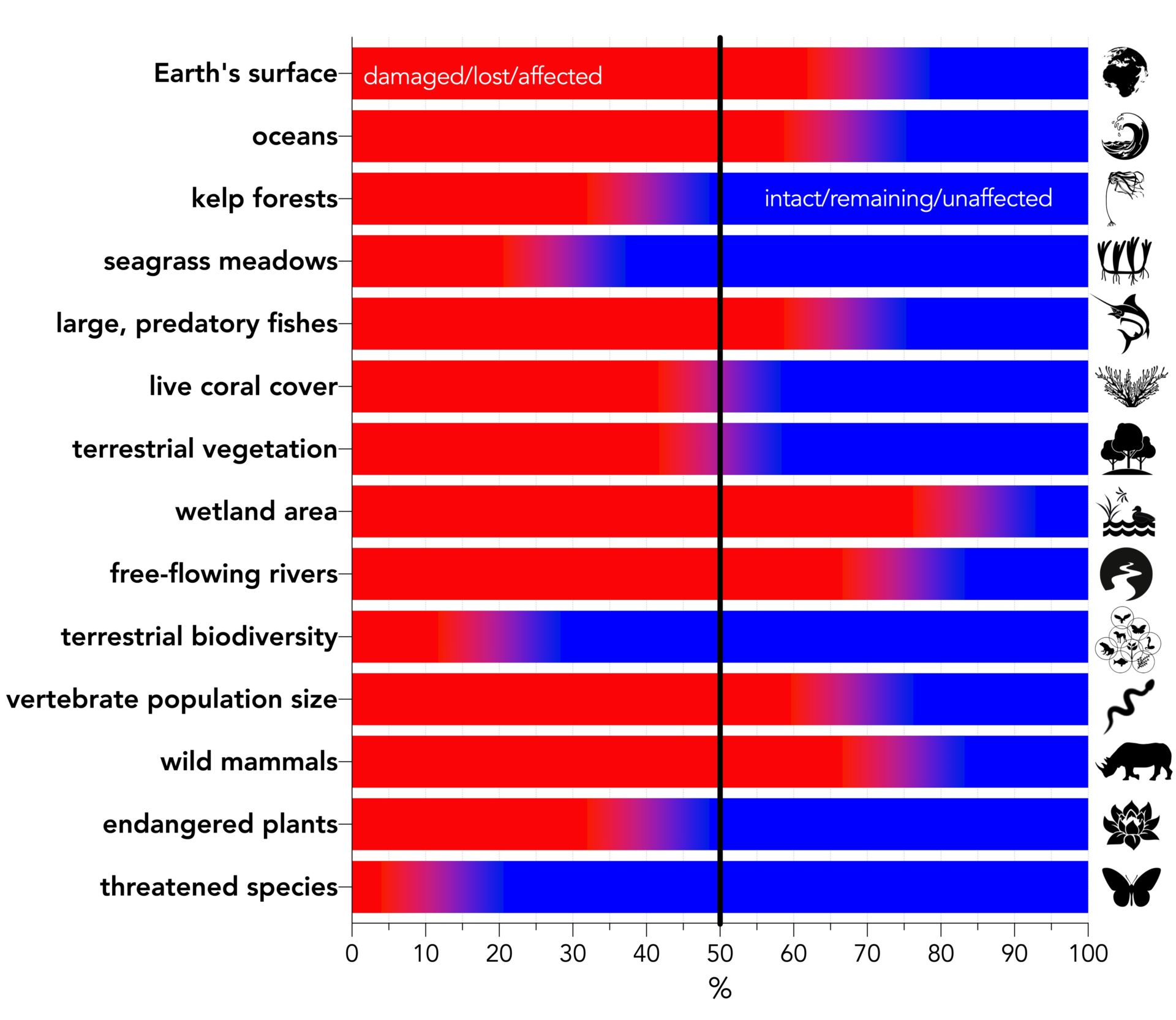
The red color in the above diagram is a striking visual warning of the extent of the damage to our biosphere. No area has escaped, and the greatest damage proportionately has been wrought to wetland areas and free-flowing rivers, both worse off than the oceans that are certainly not doing well.
Overall, perhaps 1 million species are threatened with extinction in the near future out of an estimated total of 7–10 million eukaryotic species on the planet, with around 40% of plants alone considered endangered. Today, the global biomass of wild mammals is less than a quarter of that estimated for the Late Pleistocene, while insects are also disappearing rapidly in many regions.
Freshwater and marine environments have also been severely damaged. More than two-thirds of the oceans have been compromised to some extent by human activities, live coral cover on reefs has halved in less than 200 years, kelp forests have declined by some 40%, and the biomass of large predatory fishes is now less than a third of what it was only 100 years ago.
As a result of these disastrous losses in biodiversity, we are now getting inter alia reduced carbon sequestration, reduced pollination, soil degradation, poorer water and air quality, more frequent and intense flooding and worse fires. All this of course directly compromises human health.
Yes, the COVID-19 pandemic did not appear out of nowhere. It came directly from the impact of humans on the Earth’s ecosystem.
It should come as no surprise that we are on the path of a sixth major extinction, a fact that is now scientifically undeniable. How is humanity behaving under the circumstances?
Projected population growth tells us what is the future we should expect. We already know that the impact of population growth, combined with an imperfect distribution of resources, leads to massive food insecurity. By some estimates, 700–800 million people are starving and 1–2 billion are micronutrient-malnourished and unable to function fully, with prospects of many more food problems in the near future. Large populations and their continued growth are also drivers of soil degradation and biodiversity loss.
Populations growth also increases the chances of pandemics that fuel ever-more desperate hunts for scarce resources. Population growth is also a factor in many social ills, from crowding and joblessness to deteriorating infrastructure and bad governance. There is mounting evidence that when populations are large and growing fast, they can be the sparks for both internal and international conflicts that lead to war. We all know that this “massive ecological overshoot is largely enabled by the increasing use of fossil fuels.”
So why should humans continue to multiply on the face of this Earth? The paper’s conclusion is implacable (highlight added):
Although population-connected climate change will worsen human mortality, morbidity; development, cognition, agricultural yields, and conflicts, there is no way—ethically or otherwise (barring extreme and unprecedented increases in human mortality)—to avoid rising human numbers and the accompanying overconsumption. That said, instituting human-rights policies to lower fertility and reining in consumption patterns could diminish the impacts of these phenomena.
For the paper’s authors, it all boils down to a massive political failure.
Failed International Goals
None of the recently-agreed goals have been achieved, whether the SDGs or any of the others:
It is, therefore, no surprise that none of the Aichi Biodiversity Targets for 2020 set at the Convention on Biological Diversity’s (CBD.int) 2010 conference was met (Secretariat of the Convention on Biological Diversity, 2020). Even had they been met, they would have still fallen short of realizing any substantive reductions in the extinction rate. More broadly, most of the nature-related United Nations Sustainable Development Goals (SDGs) (e.g., SDGs 6, 13–15) are also on track for failure, largely because most SDGs have not adequately incorporated their interdependencies with other socio-economic factors.
The paper notes that we, the public, are generally more aware of climate change than biodiversity loss. But this does not translate into effective policies. Regarding the Paris Climate accord, the assessment is pessimistic (highlight added):
Regarding international climate-change accords, the Paris Agreement set the 1.5–2°C target unanimously. But since then, progress to propose, let alone follow, (voluntary) “intended national determined contributions” for post-2020 climate action have been utterly inadequate.
Diagnosis: Political Tribalism and Political Impotence
Whether we look at the international or national level, the diagnosis is clear: “political impotence” is what the paper authors call it:
Given these misconceptions and entrenched interests, the continued rise of extreme ideologies is likely, which in turn limits the capacity of making prudent, long-term decisions, thus potentially accelerating a vicious cycle of global ecological deterioration and its penalties. Even the USA’s much-touted New Green Deal (U. S. House of Representatives, 2019) has in fact exacerbated the country’s political polarization (Gustafson et al., 2019), mainly because of the weaponization of ‘environmentalism’ as a political ideology rather than being viewed as a universal mode of self-preservation and planetary protection that ought to transcend political tribalism.
The Solution: The Survival of Humanity Requires that We “Change How We Do It”
Good communication is essential: Experts should “tell it like it is” and no longer hide or diminish the extent of the problem.
This does not mean however that one should be a fatalist and accept our species extinction as a fait accompli. It’s not yet a done deal and there is much that can be achieved – maybe even save our species. But we will need to learn how to do things differently. In the words of the paper’s authors:
The gravity of the situation requires fundamental changes to global capitalism, education, and equality, which include inter alia the abolition of perpetual economic growth, properly pricing externalities, a rapid exit from fossil-fuel use, strict regulation of markets and property acquisition, reigning in corporate lobbying, and the empowerment of women. These choices will necessarily entail difficult conversations about population growth and the necessity of dwindling but more equitable standards of living.
I have only summarized here the main points. For more information and to read the contributions of each one of the experts, check out their perspective paper, click here.
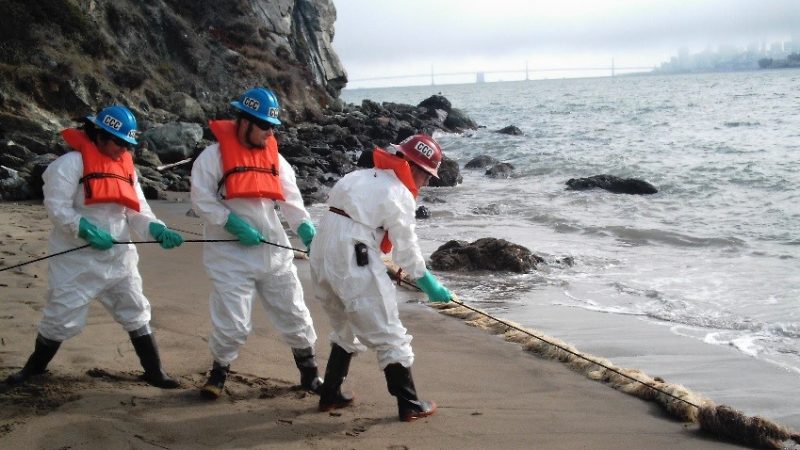
Featured Image: California Conservation Corps crews are trained for quick response to clean up oil spills and rescue birds and wildlife. Source: CCC oil spill response