In September 2020, the investigative podcast “Radiolab” published an episode exploring the story of a mysterious fungal infection appearing simultaneously on three different continents. The fungus, or yeast, was eventually identified as Candida Auris, which can cause severe infection in patients and has a mortality rate of anywhere between 33-72%.
What was causing these new, rapidly spreading, drug-resistant infections to synchronously crop up all over the world? The prevailing theory came down to a change in our climate.
As countries all over the world continue to set new record temperature highs each year, it has been posited that we’ll see fungi adapt to these changing environments and be, unlike before, capable of infecting human bodies.
This is not the only climate-fueled disease theory starting to emerge as we see big changes in our environment.
In a Centers for Disease Control and Prevention (CDC) “Climate Change and Infectious Diseases” report (last updated in August 2022), the dangers of a rise of Lyme disease, Valley Fever, and West Nile virus are outlined as public health threats on the rise due to hotter summer days and warmer winters. It states that between 2004 and 2018, the number of reported illnesses transmitted through mosquito, tick, and flea bites nearly doubled in the US.
On our changing planet, we’ve witnessed unprecedented floods and record-breaking rainfall around the world last year and climate experts predict that these cases will only become more frequent and severe as we continue down our path of warming.
The current state of malaria infections
With the increase in flooded streets, parks, and plains, there have been more opportunities for malaria to spread as mosquitoes have a wider selection of breeding grounds. The World Health Organization (WHO) 2023 “World Malaria Report“ has found that cases of malaria have been on the rise, though partly exasperated by the COVID-19 pandemic.
From 2021 to 2022, the world saw an additional 5 million cases of malaria, with the highest contributing increase coming from Pakistan due to the country’s devastating floods in 2022.
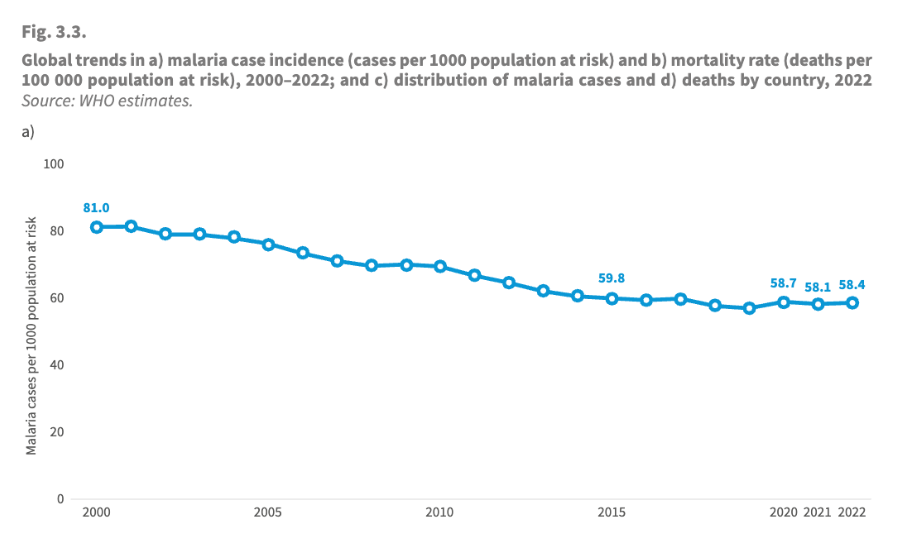
While the WHO cannot definitively state that the threat of malaria is worsened by climate change without outstanding empirical evidence, the report states that the organization has declared climate change as the single biggest health threat facing humanity.
Warmer winters and hotter summers
Not only are mosquitoes responsible for the transmission of malaria but also of West Nile and Dengue fever. The transmission of these diseases has been predicted to increase in historically colder regions due to climate change.
Given more opportunities to populate due to warmer winters, mosquito breeding could occur exponentially, bringing more risk to the spread of life-threatening diseases.
Fungi and algal blooms
As median environmental temperatures and human basal temperatures align more closely, the CDC also cautions that we may see a rise in Valley fever, among other fungal infections. These organisms, which previously only survived in hot and dry climates, are now also found in the Pacific Northwest region of the US.
Related Articles: The One Health Story: It’s More Than Infectious Diseases | Cholera and Climate Change: What’s the Link? | Our Emissions Are Aggravating Almost 60% of All Infectious Diseases | Dealing With Infectious Disease Outbreaks: Up to the Job? | Global Warming Puts Us on the Verge of Virus Spillover
While we veer toward 1.5 C of warming over pre-industrial levels, dangerously close to the proverbial tipping point, scientists have raised concern over the increased growth of algae in waters for drinking or containing livestock.
How is the world bracing itself for a climate-fueled pandemic?
At this year’s United Nations Climate Change Conference, COP28, most leaders from nations around the world agreed upon courses of action to limit climate change. On the conference’s dedicated health day, 123 countries signed a pledge to “place health at the heart of climate action.”
While this commitment seems to point towards progress in the fight for equitable action against climate change, agreements made at COP tend to fall short of the necessary commitments needed to deliver climate justice.
The WHO has outlined its courses of prevention against the effects of climate change while the CDC lists a multitude of organizational forces amongst the National Center for Emerging and Zoonotic Infectious Diseases (NCEZID). The CDC’s efforts include task forces to research and prevent the spread of diseases through insects, partnering with local and Native communities to research and surveil risk regions, and employing research to understand fungal resistance to antibiotics.
Some scientists, as reported by the BBC, are turning toward satellite imagery to predict where malaria outbreaks may form by tracking weather patterns and finding stagnant water breeding grounds. Predictive models formed through generative technology may also even hold the key to preventative measures.
Ultimately, experts tell us it comes down to the elimination of planet-warming fossil fuels and a just and concerted climate solution. Currently, the goal of reaching net zero by 2030 still requires $41 trillion USD of its $55 trillion goal.
Editor’s Note: The opinions expressed here by the authors are their own, not those of Impakter.com — In the Featured Photo: Pink glowing Psychedelic mushrooms on a magic piece of land. Featured Photo Credit: Igor Omilaev.