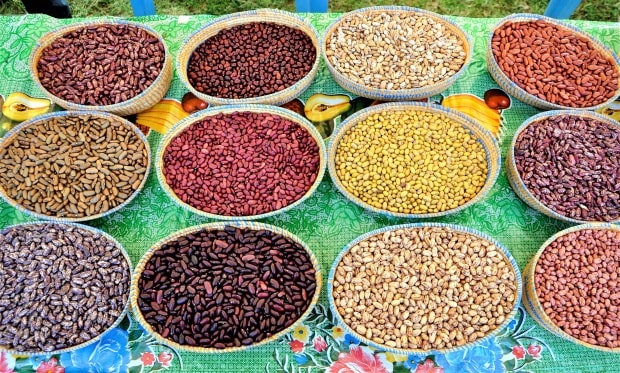


Western Kenya now houses its very own community seedbank, a collection of the region’s biological diversity.
Article in collaboration with: CGIAR Research Program on Climate Change, Agriculture and Food Security (CCAFS) seeks to address the increasing challenge of global warming and declining food security on agricultural practices, policies and measures through strategic, broad-based global partnerships.
Farmers from across Kenya, Uganda and Tanzania traveled from their agricultural fields to Nyando in Western Kenya to celebrate the launch of the community’s new seedbank. “We were travelling long journeys for seeds” said farmer Evelyn Kugonza, “but now we are travelling short distances, because we have a seedbank. It has expanded our knowledge and our income.” Community seedbanks are now housed in two of East Africa’s Climate-Smart Villages (CSVs) in Nyando, Kenya and Hoima, Uganda.
Related topics: Climate-Smart Village Cauca: an example of agricultural and social transformation – Imagining challenging climate futures – Farmers and climate to profit from more precise fertilizer management
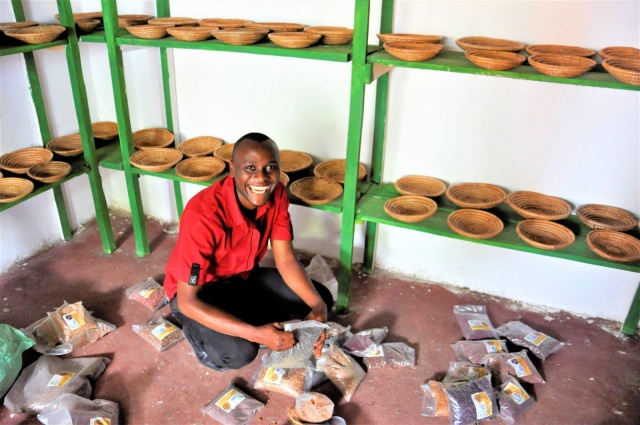
Ronny Philly Muga, a volunteer at the seedbank, helps with the final preparations for the launch of Nyando’s community seedbank. Photo: S. Samuel (CCAFS)
Nyando’s community seedbank* is the result of four years envisioning and laboring towards a seed diverse future. Together with the region’s dedicated farmers, and the lead of Bioversity International, the CGIAR Research Program on Climate Change, Agriculture and Food Security (CCAFS) in East Africa along with key multi-level partners** has been instrumental in getting this project off the ground.
The seedbank allows farmers to access a wide range of diversity for climate change adaptation, and helps them protect and conserve their biological diversity and improve seed storage. In doing so, the seeds go hand in hand in boosting the adaptive capacity of farmers, by housing climate resilient varieties and the essential seed diversity that helps shield their livelihoods from climate risks.
A snapshot into Nyando’s community seed bank
The millet, sorghum and bean seeds that fill Nyando’s seedbank have been exchanged from the national genebanks of Kenya, Uganda and Tanzania, using climate and geospatial mapping to identify them from a pool of genetic resources held by the genebanks.
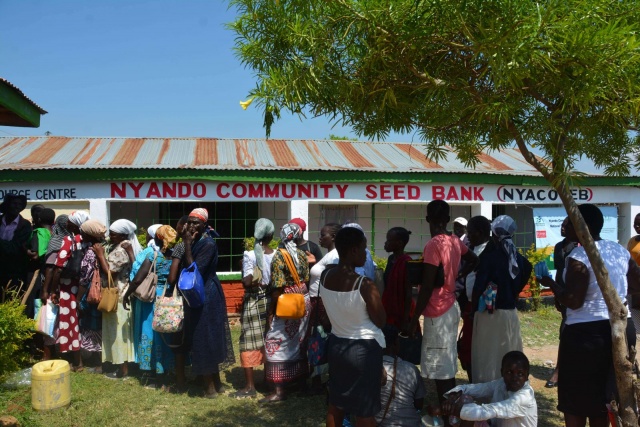
A lively community seed fair accompanied the seedbank launch, showcasing and exchanging diverse seed varieties from across East Africa. Photo: S. Samuel (CCAFS)
A total of 220 seed varieties were identified and then exchanged from the multilateral system of access and benefit sharing*** using Standard Materials Transfer Agreements (SMTAs)—the process for requesting genetic materials across parties of the multilateral system—between the three competent authorities. The seeds were multiplied and evaluated for suitability to agroecological conditions in Nyando by the Kenya Agricultural & Livestock Research Organization (KALRO) and Bioversity International along with farmers. The seeds were then tested on site to evaluate their resilience to climate change, pests and diseases. The seeds that remain after the selection, are, at least for now, the “crowd favorites.”
To make sure the seedbank can remain a bountiful community resource in the future, farmers have developed guidelines for its sustainability. “The criteria is that when you take one seed you return two, if you take five, you return ten, that is how we keep it sustainable,” said David Musuya, Field Technician with CCAFS, referring to the conditions set by the farmer members themselves.
For now, the community seedbank houses 100 sorghum, 100 millet and 20 bean varieties. And with the seedbank’s “return” policy, this is only set to multiply, boosting the resilience of all participating farmers. In many ways, seed diversity is like free insurance when you face a changing climate.
From subsistence to sales
Moving from subsistence farming to the terrain of markets can be difficult for farmers. “Understanding the business and restrictive seed sale laws that require certification are leading challenges,” said Ruth Nabaggala, Seed Market Development Associate with PELUM Uganda. To address these setbacks, farmers were exposed to the ins and outs of financial management and marketing strategies during a two-day training workshop on seed business management for seedbanks. Farmers shared their following key challenges and opportunities to making sound seed business management a reality.
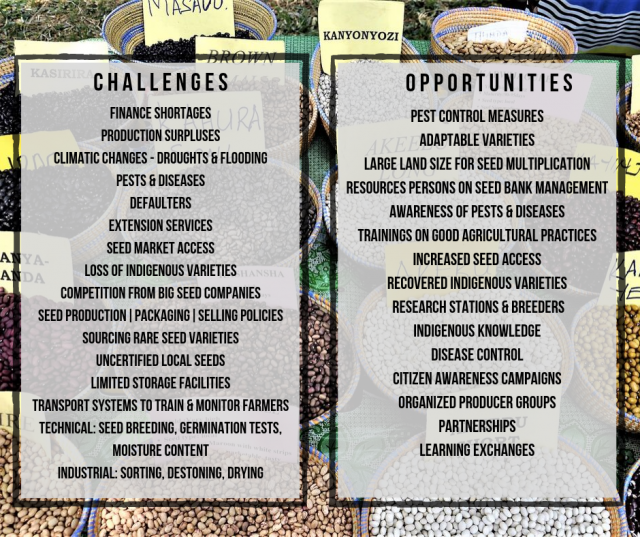
Compiled and elaborated by S. Samuel (CCAFS)
“As farmers, we have to have accountability, we have to know how we are going to invest every season, if we are improving or moving backwards,” said Evelyn Kugonza. “We were asking ourselves how we were going to plan. Now we are happy, we have learned to make a business plan; that is important.”
It is vital that momentum continues to grow, expanding seed sharing across the region. Nyando’s community seedbank not only reflects a critical step in building the economic resilience of farmers, it is instrumental in preserving the biological sovereignty of their livelihoods.
*The seedbank is supported by the Benefit Sharing Fund (BSF) of the International Treaty for Plant Genetic Resources for Food and Agriculture (ITPGRFA) under the project “Open Source Seed Systems for Climate Change adaptation in Kenya, Uganda and Tanzania.”
**Key partners include KALRO, Genetic Resources Research Institute (GeRRI), Sustainable Agriculture and Natural Resource Management Africa (SANREM Africa), HIVOS East Africa, Uganda’s National Agricultural Research Organization (NARO), and Tanzania’s Plant Genetic Resources Center (TPGRC).
***This system was developed by the ITPGRFA and serves as an open-access international platform for conservation, sustainable use and equitable sharing of plant genetic resources for food systems.
About the author: Seble Samuel is the Communications and Knowledge Management Officer for CCAFS East Africa. Gloria Otieno is an Associate Scientist at Bioversity International.
EDITOR’S NOTE: The opinions expressed here by Impakter.com columnists are their own, not those of Impakter.com. Photo Credit: S. Samuel (CCAFS)