
Impakter
  • Environment
    • Biodiversity
    • Climate Change
    • Circular Economy
    • Energy
  • FINANCE
    • ESG News
    • Sustainable Finance
    • Business
  • TECH
    • Start-up
    • AI & Machine Learning
    • Green Tech
  • Industry News
    • Entertainment
    • Food and Agriculture
    • Health
    • Politics & Foreign Affairs
    • Philanthropy
    • Science
    • Sport
  • Editorial Series
    • SDGs Series
    • Shape Your Future
    • Sustainable Cities
      • Copenhagen
      • San Francisco
      • Seattle
      • Sydney
  • About us
    • Company
    • Team
    • Partners
    • Write for Impakter
    • Contact Us
    • Privacy Policy
No Result
View All Result
  • Environment
    • Biodiversity
    • Climate Change
    • Circular Economy
    • Energy
  • FINANCE
    • ESG News
    • Sustainable Finance
    • Business
  • TECH
    • Start-up
    • AI & Machine Learning
    • Green Tech
  • Industry News
    • Entertainment
    • Food and Agriculture
    • Health
    • Politics & Foreign Affairs
    • Philanthropy
    • Science
    • Sport
  • Editorial Series
    • SDGs Series
    • Shape Your Future
    • Sustainable Cities
      • Copenhagen
      • San Francisco
      • Seattle
      • Sydney
  • About us
    • Company
    • Team
    • Partners
    • Write for Impakter
    • Contact Us
    • Privacy Policy
No Result
View All Result
Impakter
No Result
View All Result

How Climate Change Intertwines With Inequity To Erode Nutrition

byCGIAR
December 21, 2020
in Food, Impact

Equity is a fundamental component of climate change and nutrition research, says new paper co-authored by CCAFS scientists.

The climate crisis is generating a nutrition and health crisis and widening inequalities. With COP26 now postponed to November 2021, this is an important moment to look for new ways to take action that embody a just transition to low carbon economies, one that protects the health and nutrition of at-risk populations. In this context, we have conducted a new multidisciplinary review to examine how climate change interacts with inequity to affect nutrition.

We set out to identify a body of work that joins the dots between climate change and malnutrition through various pathways (see figure). Through mapping the ever-growing body of framework literature linking climate change to health and nutrition outcomes, we saw a clear gap in the research – identifying how issues of inequity (the differences in outcomes and processes that are unnecessary, avoidable, unfair and unjust, shape nutrition outcomes) in the context of climate change. We built on these frameworks and developed our own Climate Change and Nutrition Meta-Framework. Through a systematic review process, we identified and mapped primary research evidence onto this framework.
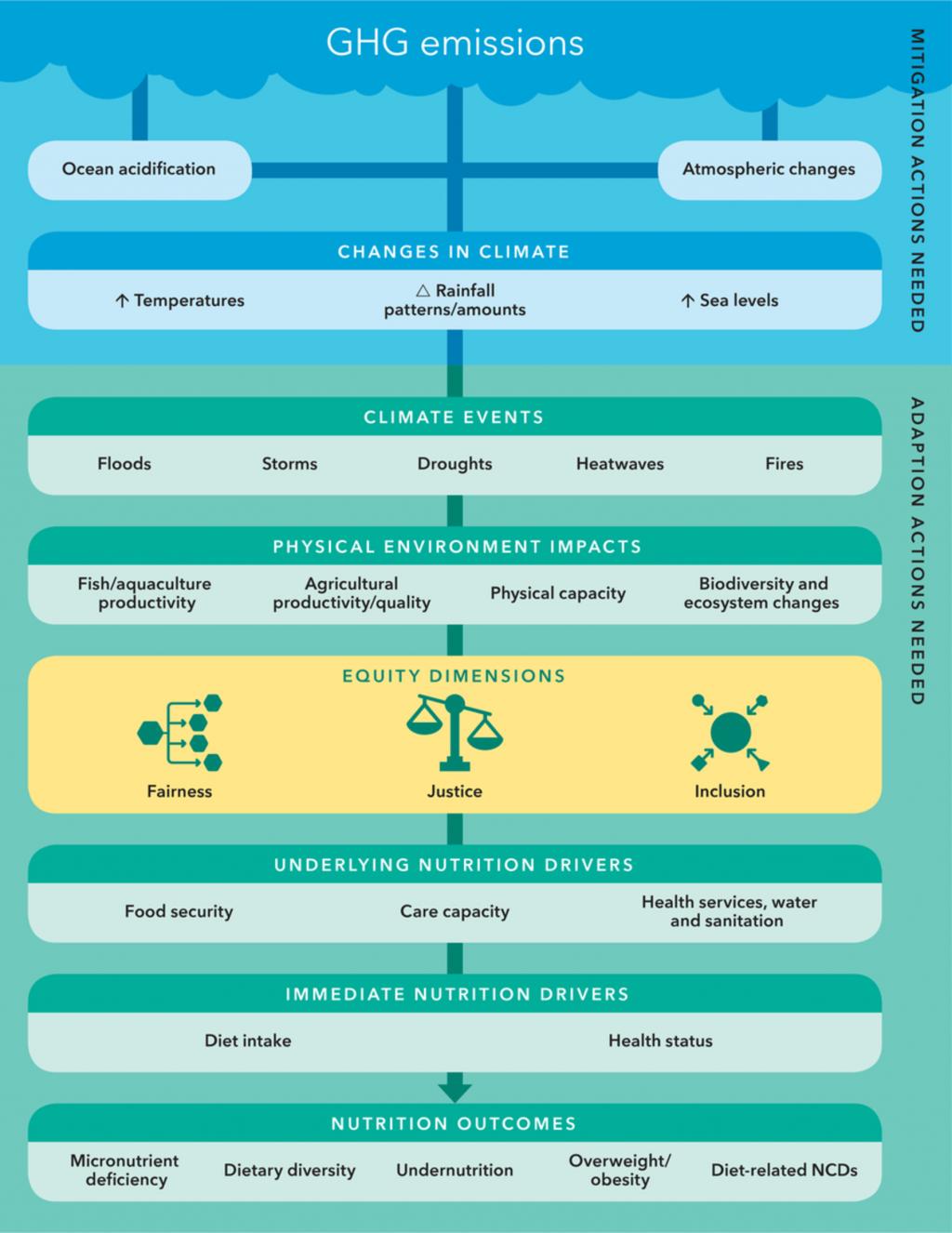
Climate Change and Nutrition Meta-Framework
Figure 1: Climate change and nutrition meta-framework.

Moreover, we wanted to dig deeper into exactly what types of inequities were being identified (such as inequitable nutrition outcomes on the basis of gender, ethnicity, socio-economic status etc), and how well the literature incorporated how and why these inequities exist, through considering how injustice such as discrimination and exclusion in decision making feature in the literature.

We included forty-six studies that made these connections. We found that while the literature identifies the types of inequities (most commonly based on place of residence, occupation, and socioeconomic status), only a small subsection elaborate on the ‘causes of the causes’ as to what is perpetuating these inequities. The literature which was well positioned to take a more holistic understanding of inequity was of mixed-methods or qualitative design, and focused on gender, and ethnicity as the sources of inequity.


Related Articles: Apple Commits to be Carbon Neutral by 2030  | Nourish the World, Protect the Planet | COVID and Nutrition

Perhaps we have a longer history of conducting research with these groups with an ‘equity lens’ that acknowledges the systemic processes that have increased their vulnerability. However, the overwhelming majority of literature did not elaborate further than the distribution of population nutrition outcomes, most often as part of quantitative climate change scenario modelling.

This is an important gap because without research connecting inequitable nutrition outcomes with the processes and systems that underpin and drive them it is harder to identify (much less implement) equitable climate change mitigation and adaptation solutions that are appropriate to the needs of vulnerable people.

We largely see this work as a starting point of demonstrating how it is possible to bring together these critical issues of malnutrition, climate change and inequity, and in doing so learn from what is already out there, and highlight key research gaps. Although, there is also an argument to be made for potential policy implications.

In theory there is recognition that the impacts of climate change are not felt equally, and the ‘same’ climate effect will create different threats, costs and new opportunities, largely due to pre-existing inequalities. This has led to the concept of a ‘just transition’ to lower-carbon economies. In policy and program practice, however, equity considerations, particularly in relation to health are lacking from climate change policies and from the models which largely inform them.

Climate policies can be positive, neutral, or negative with regard to their impacts on health and inequalities. In order for positive impacts to occur, policy design and its implementation need to be inclusive of many stakeholder perspectives and informed by contextual factors. These contextual factors mirror the equity dimensions incorporated in our research (considerations of who is vulnerable, who is included and excluded in decision making, what processes of injustice and discrimination perpetuate unfair outcomes). We see these considerations as critical to future climate policy discussion.

Our review team (including Nicholas Nisbett, Laura Cramer, Stuart Gillespie and Philip Thornton) embodied the multidisciplinary approach required to tackle these interrelated challenges, with climate, social science and nutrition and methodological expertise coming together. This work is therefore a great demonstration of multisectoral working which is essential for tackling challenges that occur at the interfaces of multiple crises.


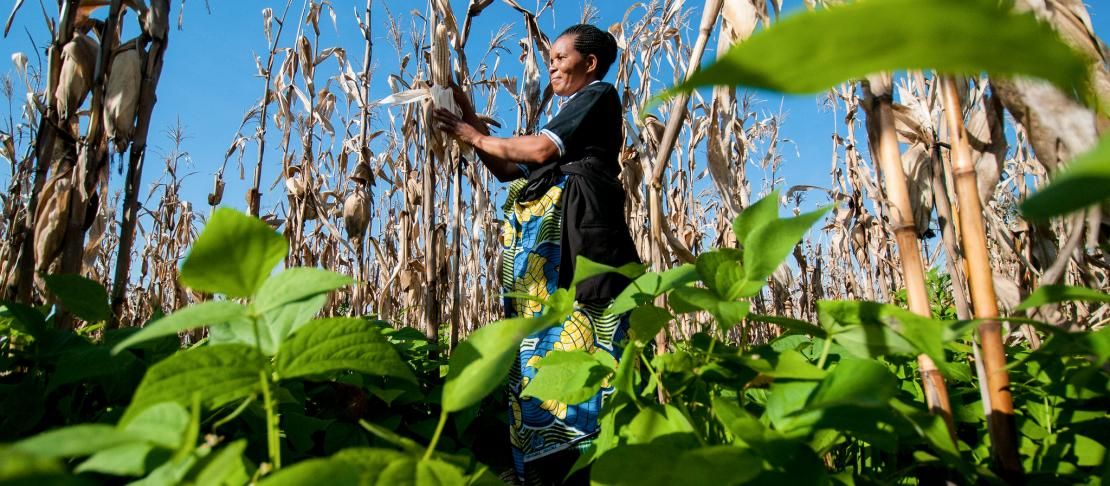
Editor’s Note: The opinions expressed here by Impakter.com contributors are their own, not those of Impakter.com. Photo Credit: G. Smith (CIAT)

Tags: ClimateNutritionresearchSDG15
Previous Post

Youth Take Charge of Climate Activism, but to What Avail? 

Next Post

Post COVID-19: A Changed Business Landscape Requires New Solutions – the G30 Proposal

Related Posts

COP30 softens climate language; Private climate data firms see surge; South Korea partners on sustainable aviation fuel; Freedom Holding publishes 2025 sustainability report.
Business

COP30 Draft Drops Fossil-Fuel Language, Alarming Climate Advocates

November 24, 2025
ESG News regarding: EU proposes to re-examine SFDR; Insurers struggle with mapping and managing climate risk in Africa; Fire at the climate summit in Brazil; UN demands Iran to disclose nuclear material stockpile.
Business

SFDR Re-examination Proposed by EU

November 21, 2025
China Launches First Coal-to-Chemicals Plant Powered by Green Hydrogen
Business

China Launches First Coal-to-Chemicals Plant Powered by Green Hydrogen

November 20, 2025
Next Post
Post COVID-19: A Changed Business Landscape Requires New Solutions – the G30 Proposal

Post COVID-19: A Changed Business Landscape Requires New Solutions - the G30 Proposal

Related News

BNP Paribas AM Invests in Farming Decarbonization Platform FarmCarbon

BNP Paribas AM Backs FarmCarbon to Cut Farm Methane

March 19, 2026
ESG news regarding California pipeline restart raising legal and environmental concerns, China offering Taiwan energy security amid push for reunification, massive methane leaks across the globe threatening climate, and Trump hosting White House event as biofuel quotas for 2026–2027 are finalized.

California Pipeline Reopens After Years of Closure

March 18, 2026

Impakter informs you through the ESG news site and empowers your business CSRD compliance and ESG compliance with its Klimado SaaS ESG assessment tool marketplace that can be found on: www.klimado.com

Registered Office Address

Klimado GmbH
Niddastrasse 63,

60329, Frankfurt am Main, Germany


IMPAKTER is a Klimado GmbH website

Impakter is a publication that is identified by the following International Standard Serial Number (ISSN) is the following 2515-9569 (Printed) and 2515-9577 (online – Website).


Office Hours - Monday to Friday

9.30am - 5.00pm CEST


Email

stories [at] impakter.com

By Audience

  • TECH
    • Start-up
    • AI & MACHINE LEARNING
    • Green Tech
  • ENVIRONMENT
    • Biodiversity
    • Energy
    • Circular Economy
    • Climate Change
  • INDUSTRY NEWS
    • Entertainment
    • Food and Agriculture
    • Health
    • Politics & Foreign Affairs
    • Philanthropy
    • Science
    • Sport
    • Editorial Series

ESG/Finance Daily

  • ESG News
  • Sustainable Finance
  • Business

About Us

  • Team
  • Partners
  • Write for Impakter
  • Contact Us
  • Privacy Policy

© 2026 IMPAKTER. All rights reserved.

No Result
View All Result
  • Environment
    • Biodiversity
    • Climate Change
    • Circular Economy
    • Energy
  • FINANCE
    • ESG News
    • Sustainable Finance
    • Business
  • TECH
    • Start-up
    • AI & Machine Learning
    • Green Tech
  • Industry News
    • Entertainment
    • Food and Agriculture
    • Health
    • Politics & Foreign Affairs
    • Philanthropy
    • Science
    • Sport
  • Editorial Series
    • SDGs Series
    • Shape Your Future
    • Sustainable Cities
      • Copenhagen
      • San Francisco
      • Seattle
      • Sydney
  • About us
    • Company
    • Team
    • Partners
    • Write for Impakter
    • Contact Us
    • Privacy Policy

© 2026 IMPAKTER. All rights reserved.