While much of the attention on the Iran War has focused on its economic impact on specific, largely industrialized countries, the impact on the Global South, especially agricultural economies, is more severe. There is an immediate impact on availability and on the resulting rise in fertilizer costs, with about 20% of globally traded fertilizer traditionally coming from the blocked region.
But as crucial as fertilizer is for most farmers, so too are pesticides, and most of these are affected by the current impasse since they are synthesized from hydrocarbons, which are derived from petroleum, known as hydrocarbon feedstocks. Further, such pesticides are often coated in microplastics to ensure a more controlled release of the product. The largest provider worldwide is Monsanto’s Roundup, owned by Bayer, which contains glyphosate as the primary ingredient.
Glyphosate may be widely banned in European countries, but depending on a ruling by the United States Supreme Court, it could also be banned in the U.S., which could have undetermined consequences for export sales and imports of products produced with glyphosate.
The Glyphosate Issue
Glyphosate past use, and current research on whether it is or is not a significant health risk, along with microplastic potential harm, has been the subject of earlier, in-depth articles.
For most Europeans, the answer is clear: Glyphosate poses a health threat. Years ago, when the FAO last assessed the issue jointly with the WHO, it concluded that, “based on current exposure levels and usage, it does not pose a cancer risk, maintaining an acceptable daily intake (ADI).” But that was long before more current research was at hand, which suggests that the toxic effects of glyphosate include links to cancer, liver/kidney damage, endocrine disruption and developmental issues.
Glyphosate Use in the Global South
Notwithstanding, many developing countries’ agricultural sectors are heavily dependent on glyphosate-based herbicides like Roundup. This reliance is partly driven by the widespread adoption of genetically modified (GM) Roundup Ready crops, such as soybeans, corn, and cotton, which allow farmers to spray entire fields to kill weeds without harming the crop.
To better understand the extent of global reliance on glyphosate, it is useful to look at several major agricultural countries:
- Brazil: As a global agricultural powerhouse, Brazil is one of the highest users of glyphosate, utilizing it extensively in large-scale soy, corn, and cotton production.
- Argentina: Argentina’s massive soy production sector relies heavily on no-tillage farming methods and Roundup Ready technology.
- India: India uses substantial amounts of glyphosate for weed control in crops like tea and rice, particularly with shortages in manual labor.
- South Africa: Roundup is used heavily as a primary weed killer in South African agriculture.
- China: A major producer and exporter of glyphosate, Chinese farmers utilize significant quantities of the herbicide on local farmland
Related Articles
Here is a list of articles selected by our Editorial Board that have gained significant interest from the public:
The United States and the future global availability of glyphosates
In February, President Trump signed an Executive Order invoking the Defense Production Act to boost domestic production of glyphosate-based herbicides and elemental phosphorus. The order frames continued access to glyphosate as a crucial national security issue and necessary for food security.
This was widely viewed as counter to Make America Healthy Again (MAHA), which generally opposes pesticides, and prominently glyphosate. Bayer, which acquired Monsanto in 2018, is the only company that makes glyphosate in the U.S. It is important to note that the current U.S. Health and Human Services Secretary Robert F. Kennedy Jr. has long said that glyphosate causes cancer. Despite this clear view in the past, he has defended the Executive Order.
On April 27, 2026, the U.S. Supreme Court will hear arguments in a critical glyphosate case.
The petitioner, Monsanto, in the Supreme Court Case, Monsanto Company v. Durnell, argues that under the Federal Insecticide, Fungicide, and Rodenticide Act (FIFRA), it cannot be held liable for failing to warn of a cancer risk associated with its products because the Environmental Protection Agency (EPA) has not found such a risk exists. EPA had found that glyphosate and Roundup do not cause cancer and that “a warning stating otherwise is neither required nor permitted under FIFRA,” as the company states in its brief to the court.
Thus, the narrow legal issue is whether FIFRA pre-empts a “label-based failure-to-warn claim” when the EPA has not required the warning.
But the decision will have far more impact than the simple interpretation of legislative application. A decision to ban glyphosates will have repercussions in the United States and abroad. Domestic farmers will have to find other ways to defend against pests, while imports from countries that continue to use it will be denied access to American markets.
While not definitive, the facts and issues are very different, and of course, the Monsanto case has not yet been argued. A recent decision by the Supreme Court upended an earlier $745 million environmental ruling in favor of a Louisiana Parish over Chevron concerning the protection of coastal resources, giving oil companies a big win. Coupled with Trump’s strong support for continuing glyphosate use, does not augur well for prohibiting glyphosates.
But there is no easy, good, or bad outcome
This is an instance in which there is no easy answer, given a difficult choice. With the current blockade of the Straits of Hormuz, the impact on world food production is staggering. Farmers need pesticides, and a major source of those pesticides comes from producers in the Middle East. Nevertheless, the harmful effects from the combination of glyphosates and microplastics will certainly affect the health of millions of people over time.
Whatever the U.S. Supreme Court decides on April 27, it will have a major impact on agriculture and human health. Stay tuned.
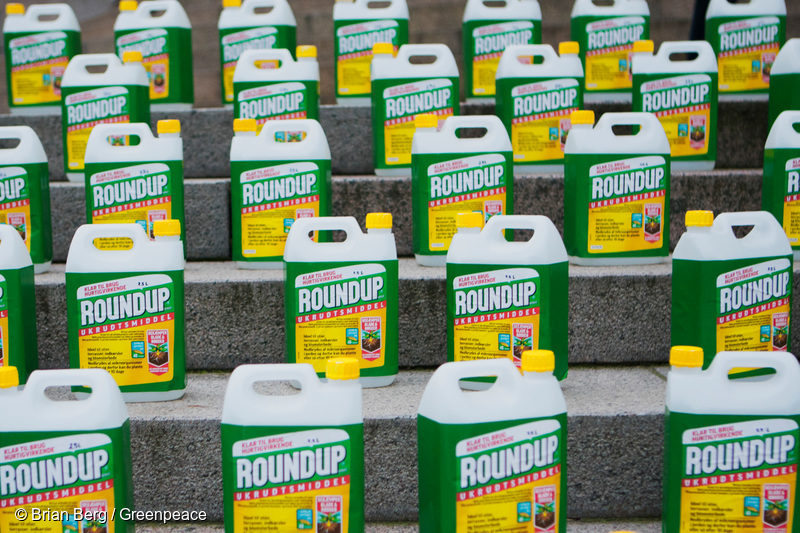
Editor’s Note: The opinions expressed here by the authors are their own, not those of impakter.com — Cover Photo Credit: On the day that EU countries voted on the future of glyphosate herbicides, Danish parliamentarians displayed 222 litres of Roundup in containers to illustrate the volume of herbicide consumption on Danish fields, Nov. 8, 2016. Cover Photo Credit: ©Brian Berg/Greenpeace.