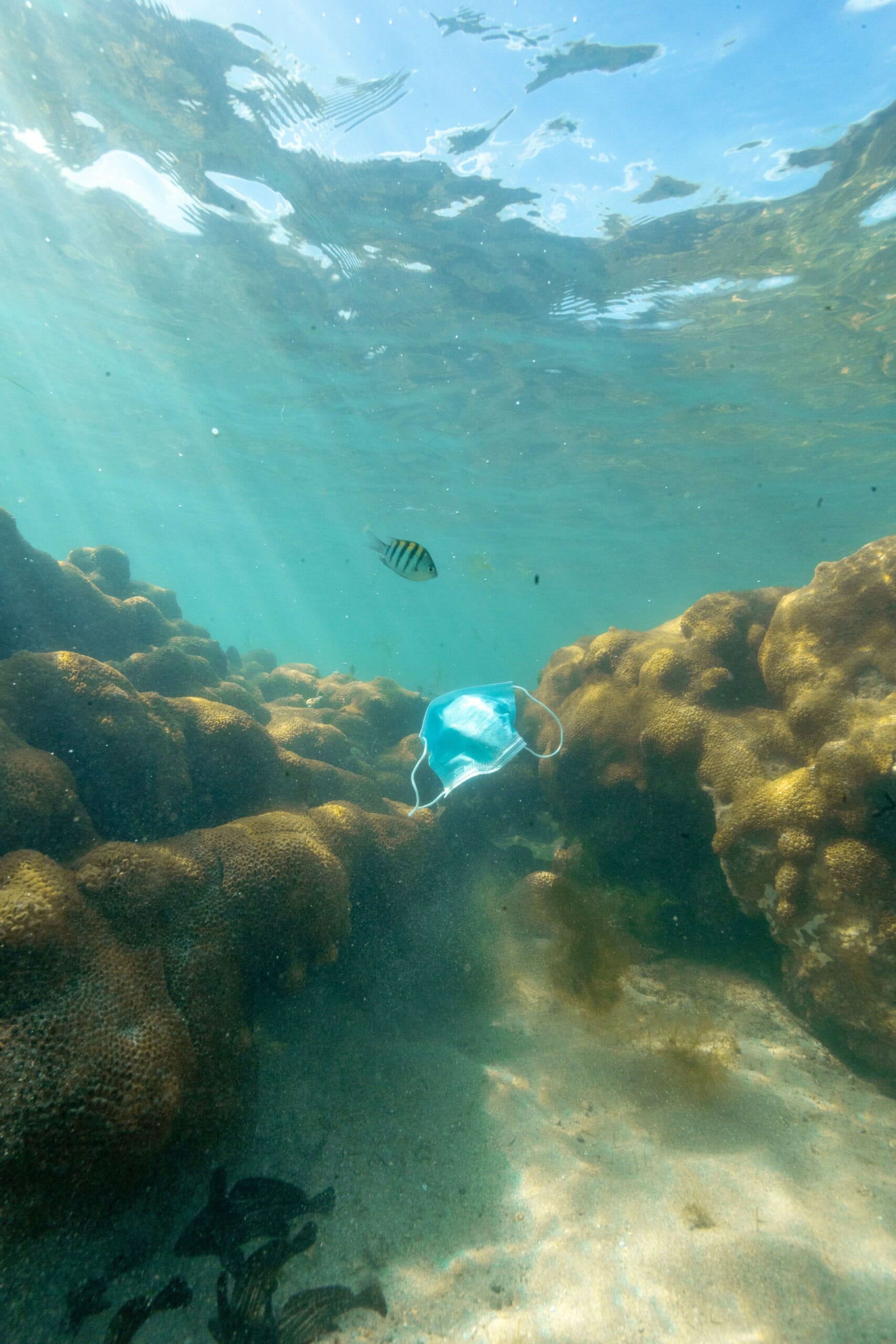
The pandemic has led to an increased demand for single-use plastics. Research has revealed that around 25,900 tonnes of COVID-19 related plastic has leaked into the ocean. This is equivalent to the weight of more than 2000 double decker busses.
Prior to this study, the effects of pandemic-related waste were suspected to be significant. The new research carried out by Yiming Peng and Peipei Wu from Nanjing University, has revealed the magnitude of the issue. Modelling based on current findings predicts that, by the end of the century, almost all the pandemic-associated plastics end up in either the seabed (28.8%) or beaches (70.5%).
More than 25,000 tonnes of PPE and other types of Covid-related plastic waste has entered Earth's oceans, a new study estimates – and 71% of this is due to wash up on beaches by the end of the year. https://t.co/weEJTAa9iK
— Toby Young (@toadmeister) November 9, 2021
Plastic pollution is the biggest issue for marine wildlife
The report says that “the released plastics can be transported over long distances in the ocean, encounter marine wildlife, and potentially lead to injury or even death”. The most visible impacts of marine plastics are the ingestion, suffocation, and entanglement of hundreds of marine species.
In March this year, researchers found the first case of a fish entrapped in a medical glove in the Netherlands. And, in Brazil, a protective mask was found in a dead penguin’s stomach. These are just two examples amongst many others.
The impact on marine wildlife and ecosystems even reaches humans. Toxic contaminants accumulate on the surfaces of plastic materials because of prolonged exposure to seawater. When marine organisms ingest plastic debris, the contaminants accumulate in the food web. The effects of the transfer of contaminants between marine species and humans through seafood consumption is yet to be adequately researched but there are chances that this might be a significant human health hazard.
Most excess waste comes from hospitals treating COVID patients
The majority of waste found came from hospitals. Peng and Wu said their research suggested 87.4% of excess waste was from hospitals rather than from individuals. For instance, individual PPE usage only contributed 7.6% and packaging and test kits accounted for 4.7% and 0.3% respectively.
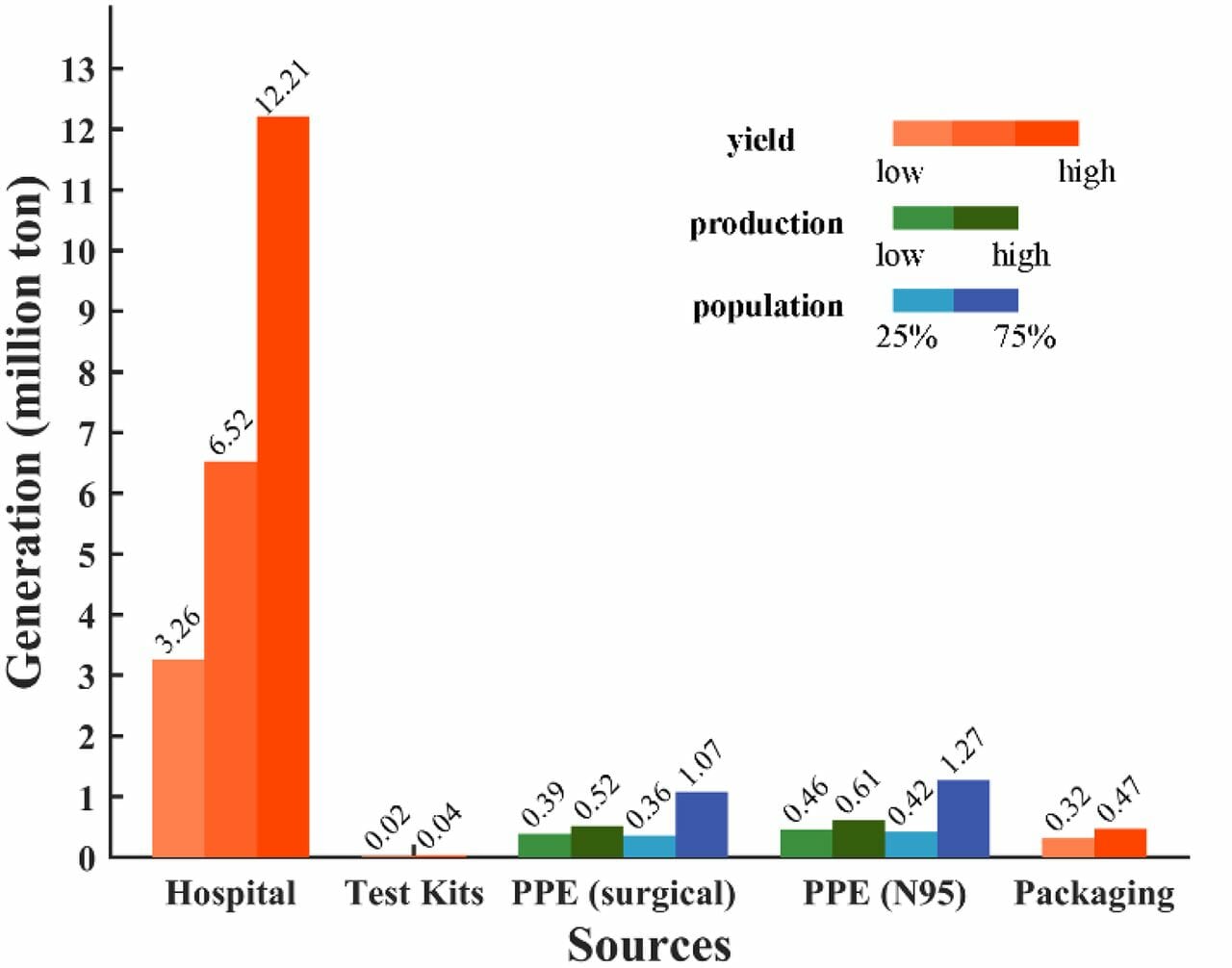
A graph to show Global generation of mismanaged plastics from different sources (hospital medical waste, test kits, PPE, and online packaging) attributable to the COVID-19 pandemic. Source: Peng et al. Plastic waste release caused by Covid-19 and its fate in the global ocean.
Single-use plastics have been at the forefront of our ability to control the virus, and this has been none more so than the case in hospitals. As Dr Christian Dunn has highlighted, plastic has proven to be a “wonderful, versatile and lifesaving” product.
However, hospitals are not completely to blame. Dr Dun also discusses a recently identified phenomenon called “hygiene theatre”. This term refers to individuals and businesses making sure they look like they’re fighting the pandemic but are not doing anything to real effect. For instance, incorrectly wearing single-use face masks or restaurants using disposable laminated menus. With no significant preventative effect, these measures are simply for show and pointlessly add to the accumulation of COVID waste on the seabed and beaches.
Related Articles: COVID Waste: How to Manage Hazardous Wastes in the Current Pandemic | Sub-Saharan Africa: Sustainable and Transformative Recovery
Asia is by far the biggest contributor
The COVID-associated plastic waste study found that Asia is responsible for 46% of the mismanaged plastic waste, largely due to the high level of mask-wearing by individuals living there. This is followed by Europe who are responsible for 24%, and North and South America at 22%.
The study also suggests that 73% of the discharge of COVID-associated plastics to the ocean is from Asian rivers. The Shatt al-Arab in south-eastern Iraq has carried a staggering 5,200 tonnes of PPE waste to the ocean, and the Indus River, which comes from western Tibet has carried 4,000 tonnes.
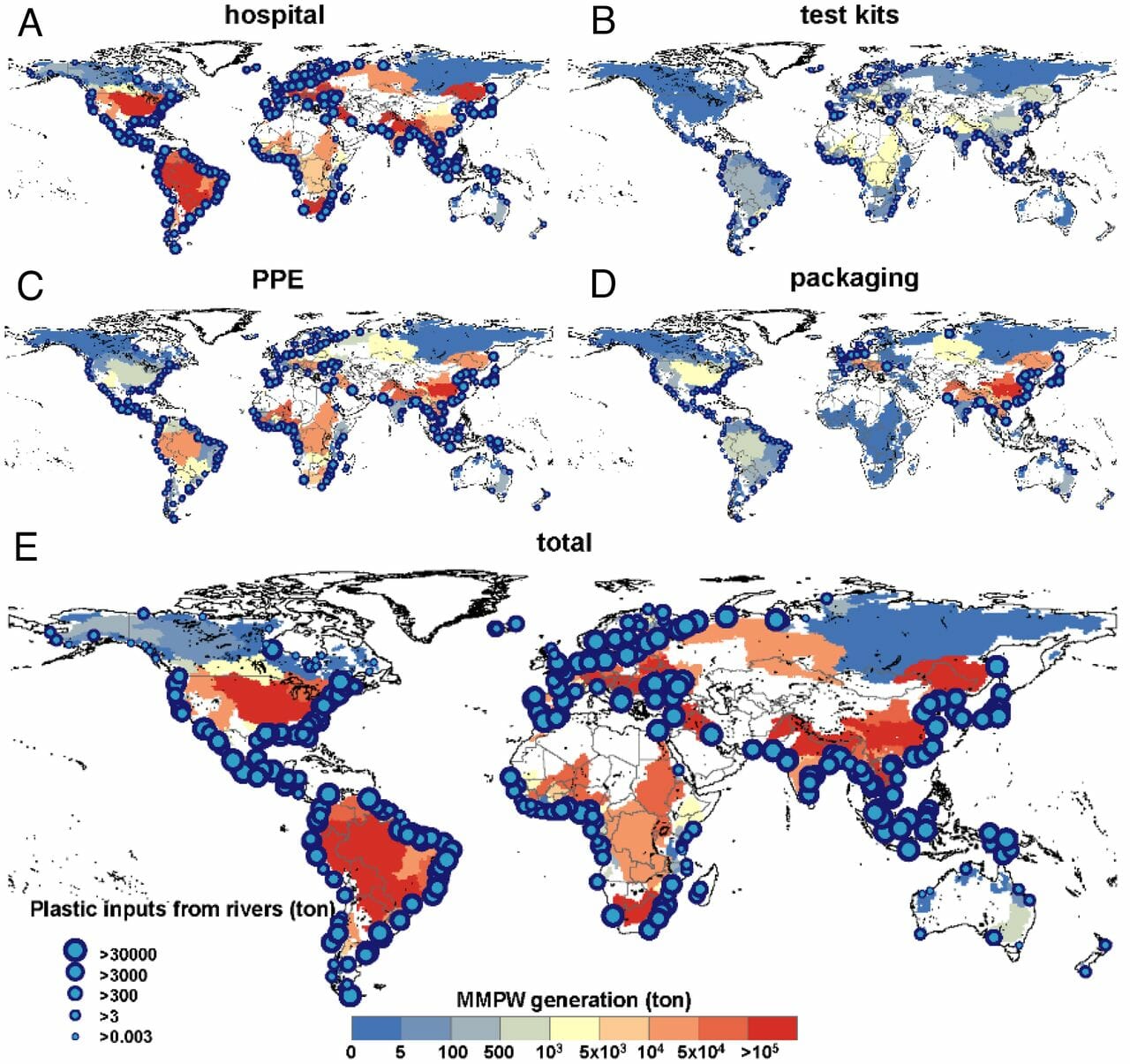
A diagram to show accumulated riverine discharge of pandemic-associated mismanaged plastics to the global ocean. Source: Peng et al. Plastic waste release caused by Covid-19 and its fate in the global ocean.
Indeed, the top 10 “hotspot” rivers have been found to account for 79% of pandemic plastic ocean discharge. The authors say that “these findings highlight the hotspot rivers and watersheds that require special attention in plastic waste management”.
The study demonstrates the need for urgent structural changes to take place in waste management. Innovative technologies need to be “promoted for better plastic waste collection, classification, treatment, and recycling”, and PPE equipment made from more environmentally friendly materials must be developed.
#PandemicPlastic & @Precisi0nHealth are collaborating with @NeshajuE, an e-waste & solid waste management startup working on innovative ways to manage PPE waste & predict #COVID infection clusters. It's these cutting-edge collabs that help our communities #BounceForward. pic.twitter.com/Y7kTM3Tu4k
— Community Action Collab (@CommActCollab) November 12, 2021
It is hugely important that developing countries are given the funding and assistance they need to make these changes as they are disproportionately contributing to this problem and will also be the first to suffer as a result of ocean waste.
This new research offers insights into exactly where all pandemic-related waste ends and therefore offers the basis for better, evidence-based management of plastic waste in the oceans.
As we may expect many more pandemics in future – including waves of the present one as a result of virus mutations of which the Delta variant engulfing Europe is the latest example – it becomes urgent to understand – and measure – the environmental impact of disposing of medical equipment and PPEs in order to better address the challenge and reverse the damage before it is too late.
Editor’s Note: The opinions expressed here by Impakter.com columnists are their own, not those of Impakter.com. — In the Featured Photo: Mask Under Sea Water. Featured Photo Credit: Lucas Meneses