Impakter
  • Environment
    • Biodiversity
    • Climate Change
    • Circular Economy
    • Energy
  • FINANCE
    • ESG News
    • Sustainable Finance
    • Business
  • TECH
    • Start-up
    • AI & Machine Learning
    • Green Tech
  • Industry News
    • Entertainment
    • Food and Agriculture
    • Health
    • Politics & Foreign Affairs
    • Philanthropy
    • Science
    • Sport
  • Editorial Series
    • SDGs Series
    • Shape Your Future
    • Sustainable Cities
      • Copenhagen
      • San Francisco
      • Seattle
      • Sydney
  • About us
    • Company
    • Team
    • Global Leaders
    • Partners
    • Write for Impakter
    • Contact Us
    • Privacy Policy
No Result
View All Result
Impakter logo
No Result
View All Result
climate change cholera

Cholera and Climate Change: What’s the Link?

After years of regular reduction in the number of cases and deaths, cholera is on the rise again — and climate change is contributing to the increase

Elisa FurlanbyElisa Furlan
August 4, 2023
in Climate Change, Society
0

As climate change’s effects intensify, cholera cases are spiking. The number of people annually affected by the disease is estimated to be between 1.3 and 4 million. However, if we look at specific data from the last year, we can clearly see a sharp escalation of cases in most countries.

“The situation is quite unprecedented, for not only we are seeing more outbreaks, but these outbreaks are larger and more deadly than the ones we have seen in past years,” Dr. Barboza, the World Health Organization (WHO) Team Lead for Cholera and Epidemic Diarrhoeal Diseases, said in December 2022, adding that these outbreaks are “occurring after several years of regular reduction in the number of cases and deaths.”

According to European Centre for Disease Prevention and Control’s monthly update, as of July 2023 the countries with the highest cholera cases are Afghanistan, Democratic Republic of the Congo, Haiti, Ethiopia, and Cameroon. 
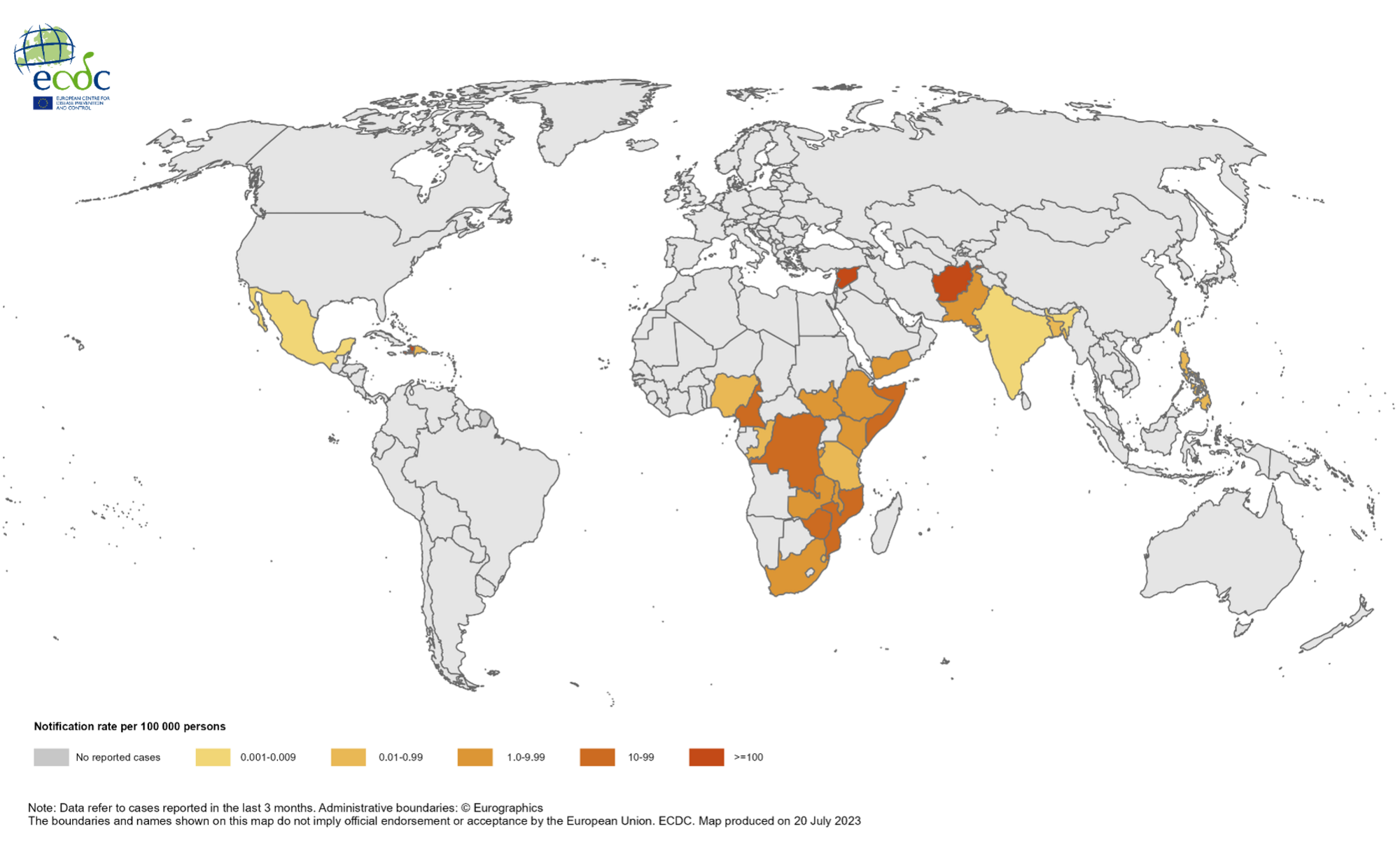
Geographical distribution of cholera cases reported worldwide from May to July 2023

In all these countries — save Cameroon — the number of cases has grown over the last years. In Afghanistan, for example, the number of cholera cases reported so far is nine times higher than last year.

“Most of these larger outbreaks and the fact that they are simultaneously occurring — which makes the situation much more complex — is a direct impact of the increase in adverse climate troubles,” Dr. Barboza explains.

How so? Well, the extreme weather conditions we are witnessing today amplify the spread of the virus: floods, rainfall, and drought are all factors that contribute to the rising number of cholera cases.

Before diving into the specifics, let’s take a look at how this virus came to exist.

Cholera: A Brief History

Cholera is a highly contagious acute infection caused by Vibrio cholerae, a bacterium that multiplies inside the intestine.

The first cholera case dates back to the 1800s: From 1817 to 1824, cholera spread from India to the African shores. The exact number of victims remains unknown. 

In the following century, the world witnessed five more pandemics, accounting for millions of deaths. Three decades later, the current pandemic (the seventh) broke out. Starting in South Asia in 1961, it reached the Americas thirty years later.

Due to the way the virus spreads, the people more likely to be infected are those who live in poor and unsanitary conditions. In fact, people can get cholera after drinking or eating contaminated food or water. 

For this reason, cholera is also known as “the disease of poverty.”


Related Articles: The Impact of Conflict on Climate Change Adaptation in Yemen | The One Health Story: It’s More Than Infectious Diseases | Global Warming Puts Us on the Verge of Virus Spillover | Our Emissions Are Aggravating Almost 60% of All Infectious Diseases

People infected with cholera might get acute watery diarrhea. If untreated, the virus can kill within hours.

Countries where cholera cases were reported in the previous three years with evidence of local transmission are called endemic. The disease can then witness an outbreak, or epidemic. However, an outbreak can occur even in non-endemic countries.

Countries that had been free from cholera for years are now witnessing cholera cases again. In 2022, Lebanon was an example.

"In recent weeks, we have spoken about a surge in #cholera outbreaks around the world. The latest country to be affected is #Lebanon, which is now suffering a severe outbreak after nearly 30 years without cholera"-@DrTedros

— World Health Organization (WHO) (@WHO) November 9, 2022

So how exactly is climate change contributing to the increase in cholera cases?

Climate Change: Its Connection to Cholera Cases

Cholera can be transmitted in various ways. Extreme weather events, made more frequent and severe by climate change, help the virus spread more rapidly. 

For example, both heavy and low rainfall negatively affects cholera outbreaks. Heavy rainfall can contaminate clean water, low rainfall can increase the concentration of the virus in the water. Climate change makes both cases more frequent and extreme.

The heavy rainfall associated with Cyclone Gabrielle, which formed in the Pacific Ocean in February 2023, is estimated to have been made four times more common by climate change and to have poured 30% more rain.

Similarly, at the beginning of 2022, the tropical storm Ana brought destruction in Madagascar, Mozambique, Malawi, and Zimbabwe. 

Soon after the episode, a deputy representative for health programs in Malawi for UNICEF reported the rising cases of cholera in Malawi, an endemic country usually affected by the virus during the rainy season, from November to May. 

That year, cholera spread throughout August and into the dry season, too.

The situation is getting out of hand. According to the WHO, billions of people are currently at risk of cholera. Even though in the majority of cases cholera can be treated — if actions are taken immediately — this disease mainly affects people in poorer regions. 

Due to a shortage of cholera vaccines and supplies, not everyone is able to get vaccinated.

Once again, we are witnessing how the actions of the richer countries — those mostly responsible for climate change — negatively impact innocent lives.


Editor’s Note: The opinions expressed here by the authors are their own, not those of Impakter.com — In the Featured Photo: Heavy monsoon rains caused floods and landslides across Pakistan in August 2022, affecting 360,000 people. Balochistan & Sindh provinces, Pakistan. Featured Photo Credit: © OCHA/Pierre Peron.

Tags: CholeraClimate Changeinfectious diseasesvirus outbreak
Previous Post

Is Targeting Politicians’ Private Homes the Right Strategy for Climate Activists?

Next Post

Climate Change? No Worries, It’s ‘Just Natural.’ Or is it?

Related Posts

The Era of ‘Global Water Bankruptcy’ Has Begun
Climate Change

The Era of ‘Global Water Bankruptcy’ Has Begun

Humanity’s long-term water usage and damage have exceeded nature's renewal and safe limits, a situation scientists and the media have...

byNmesoma Ezetu
January 30, 2026
Food Waste in India
Climate Change

India’s Food Waste Is Turning Into an Environmental Time Bomb

India, a key player in this fight, is currently battling a confluence of climate-driven disasters. Last year’s punishing extreme heatwave,...

byPranjali Chowdhary - Research and Policy Associate at the Institute for Governance and Sustainable Development, Indiaand1 others
January 30, 2026
One Health Education Is Essential for Pandemic Preparedness and Global Security
Education

One Health Education Is Essential for Pandemic Preparedness and Global Security

The One Health concept/approach offers a powerful tool for public health and biomedical research globally. The combined integration of human medicine,...

byDr. Bruce Kaplan - Epidemiologist formerly at the CDC/EIS and USDA-FSIS Office of Public Health and Science & Co-Founder of the One Health Initiativeand2 others
January 29, 2026
Three sponsors for the 2026 Winter Olympics in Italy could generate 1.3 million tons of CO2
Climate Change

Winter Olympics Sponsorship Emissions: Who Are the Main Offenders?

The 2026 Winter Olympic Games are set to begin in Italy next month. Scattered across towns in northern Italy, from...

bySarah Perras
January 28, 2026
WEF Report Ranks Environmental Challenges as Greatest Long-Term Threat to Global Stability
Business

WEF Report Ranks Environmental Challenges as Greatest Long-Term Threat to Global Stability

The World Economic Forum’s Global Risks Report 2025 found that environmental risks are deteriorating faster than other threats and challenges.  ...

byBenjamin Clabault
January 28, 2026
ESG News regarding Clean energy is Europe's only path to prosperity; 2150 raises €210 million to back sustainable cities; EcoCeres’ new Malaysian plant is operating at 95% capacity; New study suggests the world is not ready for rise in extreme heat.
Business

Clean Energy Is Europe’s Only Route to Prosperity

Today’s ESG Updates: Clean Energy is Vital for Europe's Autonomy: UK Energy Secretary Ed Miliband and EU Energy Commissioner Dan...

byFedor Sukhoi
January 27, 2026
ESG news regarding: a push for wind power in Europe, possible massive metal fraud, wind power in Western Australia, and Citi layoffs.
Business

Europe’s Answer to Trump: More Wind Power

Today’s ESG Updates New Draft Reveals Europe’s Massive Wind Power Push: Nine European nations are defying U.S. criticism by signing...

byEge Can Alparslan
January 23, 2026
Climate Change Charities
Business

Beyond Carbon Offsets: 7 Climate Change Charities Tackling Root Causes in 2026

Philanthropy is surging again. U.S. charitable giving reached a record $592.50 billion in 2024, and, for the first time since...

byHannah Fischer-Lauder
January 23, 2026
Next Post
Climate Change? No Worries, It’s ‘Just Natural.’ Or is it?

Climate Change? No Worries, It’s 'Just Natural.' Or is it?

Recent News

The Era of ‘Global Water Bankruptcy’ Has Begun

The Era of ‘Global Water Bankruptcy’ Has Begun

January 30, 2026
ESG news regarding: New Report Urges Urgent Action to Halt PFAS Contamination Across EU, US Proposes New Rule to Force Greater Transparency in Pharmacy Benefit Manager Fees, EU and Brazil Seal Landmark Deal Creating World’s Largest Free Data Flow Zone, Beijing Suspends Import and Use of Sun Pharma Alzheimer’s Treatment

Without Regulation, ‘Forever Chemicals’ Will Cost Europe €440 billion by Mid Century

January 30, 2026
Food Waste in India

India’s Food Waste Is Turning Into an Environmental Time Bomb

January 30, 2026
  • ESG News
  • Sustainable Finance
  • Business

© 2025 Impakter.com owned by Klimado GmbH

No Result
View All Result
  • Environment
    • Biodiversity
    • Climate Change
    • Circular Economy
    • Energy
  • FINANCE
    • ESG News
    • Sustainable Finance
    • Business
  • TECH
    • Start-up
    • AI & Machine Learning
    • Green Tech
  • Industry News
    • Entertainment
    • Food and Agriculture
    • Health
    • Politics & Foreign Affairs
    • Philanthropy
    • Science
    • Sport
  • Editorial Series
    • SDGs Series
    • Shape Your Future
    • Sustainable Cities
      • Copenhagen
      • San Francisco
      • Seattle
      • Sydney
  • About us
    • Company
    • Team
    • Global Leaders
    • Partners
    • Write for Impakter
    • Contact Us
    • Privacy Policy

© 2025 Impakter.com owned by Klimado GmbH