Impakter
  • Environment
    • Biodiversity
    • Climate Change
    • Circular Economy
    • Energy
  • FINANCE
    • ESG News
    • Sustainable Finance
    • Business
  • TECH
    • Start-up
    • AI & Machine Learning
    • Green Tech
  • Industry News
    • Entertainment
    • Food and Agriculture
    • Health
    • Politics & Foreign Affairs
    • Philanthropy
    • Science
    • Sport
  • Editorial Series
    • SDGs Series
    • Shape Your Future
    • Sustainable Cities
      • Copenhagen
      • San Francisco
      • Seattle
      • Sydney
  • About us
    • Company
    • Team
    • Global Leaders
    • Partners
    • Write for Impakter
    • Contact Us
    • Privacy Policy
No Result
View All Result
Impakter logo
No Result
View All Result
Bolsonaro’s Proposed Ferrograo Railway Threatens the Amazon

Bolsonaro’s Proposed Ferrograo Railway Threatens the Amazon

Will PotterbyWill Potter
August 3, 2021
in Climate Change, Environment, Food and Agriculture
0

Since taking office in 2019, Brazilian President Jair Bolsonaro’s deforestation policies have led to the systematic destruction of forests to expand agricultural lands in the name of bolstering the national economy. His latest measure, a proposed railway system named Ferrograo, will construct a 1,000km train line directly through the heart of the Amazon rainforest. 

Originally developed by a business consortium in 2012, the Ferrograo railway system is currently incorporated into the Brazilian National Logistics Plan to be constructed by 2025. The railway has been promoted by Bolsonaro as a solution for Brazil’s agricultural industry issues — currently, grains produced in the nation’s midwest region such as soybeans must travel over 2,000km to reach populated seaport areas including Sao Paulo. 

The Ferrograo, or “grain railway,” has a $4.12 billion budget, and would increase the competitiveness of these goods in international and Brazilian markets by 8%, whilst also reducing transportation costs. 

The Amazon is ours… no country in the world has the moral right to talk about the Amazon. You destroyed your own ecosystems.

— Brazilian President Jair Bolsonaro, 2019

However, these measures entail huge amounts of deforestation and add to the rainforest’s already rising emissions production. In conjunction with the railway, construction projects will also be encouraged to be developed on land around the proposed train line. According to research conducted by the Climate Policy Initiative, construction of Ferrograo will result in up to 2,043 square ft (around 285,000 football pitches) of deforestation, whilst producing over 75 million tonnes of carbon emissions. 

The planned railway line will pass within 500 metres of 726 official environmentally protected areas. The proposal’s environmental impact study found that Ferrograo construction would cause fragmentation of habitats and ecosystems and contaminate water. The deforestation would also directly impact areas that host 14 species at risk of extinction, as well as affecting indiegnous peoples in the Amazon rainforest. 


Related Articles: 10 Major Companies Responsible for Deforestation | The War Against Deforestation | Five Steps To Save The Amazon From Deadly Investments

The Ferrograo railway system is a continuation of Bolsonaro’s deforestation policies. The president has previously claimed that deforestation claims made by his own government’s satellite monitoring agency were “lies”. Yet in 2019, Bolsonaro’s inaugural year as President, deforestation of the Amazon rainforest grew by 85%. 

The destruction that the railway plans will bring to the Amazon rainforest comes at a dire time for the future of the world’s largest rainforest. A study led by the National Institute for Space Research in Brazil revealed earlier this year that, for the first recorded time, the Amazon rainforest is emitting more carbon emissions into the atmosphere than it is able to absorb. 

The forest is no longer growing faster than it’s dying. This is bad – having the most productive carbon absorber on the planet switch from a sink to a source means we have to eliminate fossil fuels faster than we thought.

— Professor Scott Dening, Colorado State University

One of the causes for the rise in emissions stems from deliberate fire setting, intended to clear land for beef and soy production. Warmer temperatures and increased droughts in the region have further exacerbated the issue.

The Amazon’s shift away from being a sink to a source of emissions is a stark warning on the urgency of global climate action. The Amazon has experienced up to 15% deforestation, and research suggests that a 20-25% loss could result in a decisive collapse of the Amazon’s ecosystem. The proposed construction of the Ferrograo railway serves to illustrate the backwards direction that Brazil appears to be taking on sustainability in the Amazon rainforest, prioritising economic gains over aiding biodiversity and climate action. 


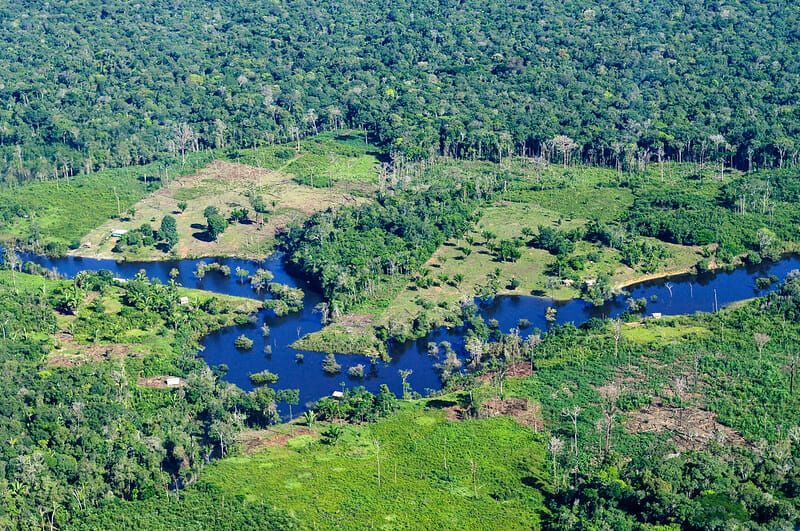
Editor’s Note: The opinions expressed here by Impakter.com columnists are their own, not those of Impakter.com. — In the Featured Photo: Amazon Rainforest Deforestation. Featured Photo Credit: Neil Palmer/CIAT.


Tags: AgricultureAmazon rainforestbiodiversityBrazil
Previous Post

Is Microsoft’s Sustainability Approach Enough?

Next Post

US Infrastructure Bill: Climate Focus Badly Blunted in Negotiations

Related Posts

soil
Biodiversity

To Prevent Ecological Collapse, We Must Start With the Soil

Soil is the single most biodiverse habitat on Earth, home to at least 59% of all species, including over 80%...

byMarcela Quintero - Associate Director General of Research Strategy and Innovation at the Alliance of Bioversity International and CIATand1 others
January 8, 2026
Impakter’s Most-Read Stories of 2025
Society

Impakter’s Most-Read Stories of 2025

In 2025, as in previous years, Impakter readers turned in large numbers to stories examining climate change and pollution, environmental...

byImpakter Editorial Board
December 31, 2025
How Climate Change Could Help Foster Peace in Yemen
Climate Change

How Climate Change Could Help Foster Peace in Yemen

Yemen's tragedy is traditionally depicted through the limited perspective of humanitarian need and political divisiveness, but there is a greater...

byTareq Hassan - Executive Director of the Sustainable Development Network Canada (SDNC)
December 17, 2025
Animal Health
Biodiversity

Better Animal Health Is the Low-Risk, High-Reward Climate Investment We Need

Imagine if there was a way to reduce emissions from the meat, egg and dairy sector by nearly a quarter,...

byCarel du Marchie Sarvaas
November 26, 2025
One Health: Silo Barriers to Implementation and How to Overcome Them
Biodiversity

One Health: Silo Barriers to Implementation and How to Overcome Them

The One Health concept/approach must be central for governments to adopt collaborative, cross-sector policies in order to safeguard public health,...

byOne Health Initiative
November 26, 2025
A Sacred Duty
Biodiversity

A Sacred Duty

As dawn breaks over the Ororubá Mountains in Pernambuco, Brazil, a group of Indigenous youth of the Xukuru do Ororubá...

byThe Food and Agriculture Organization of the United Nations (FAO)
November 25, 2025
ESG News regarding Cop30’s disappointing end, the G20 summit without the US, China’s Unipec fuel deal with Lufthansa, and Singapore’s Sembcorp IPO in India
Business

‘COP of Truth’ Highlights Glaring Differences in Global Climate Perspective

Today’s ESG Updates COP30 Delivers Weak Climate Deal: Global talks in Brazil ended without a plan to phase out fossil...

bySarah Perras
November 24, 2025
Turkey to Host COP31, Australia to Lead Negotiations
ESG News

Turkey to Host COP31, Australia to Lead Negotiations

Today’s ESG Updates COP31 Host Deal: Turkey to host next year’s UN climate summit, with Australia to lead negotiations. COP30...

byLena McDonough
November 20, 2025
Next Post
US Senate

US Infrastructure Bill: Climate Focus Badly Blunted in Negotiations

Recent News

ESG News regarding Economic Collapse Fuelling Iran Protests Amid Rising Death Toll, U.S. Pressure on Iran Tests Beijing as Tariffs Could Push China Duties Above 70%, EU Offers China Price Pledge Option to Avoid EV Tariffs, Atmosphere Emerges as Major Pathway for Plastic Pollution

Iran Acknowledges 2,000 Deaths as Protests Enter Third Week

January 13, 2026
Five Keys to Understanding Venezuela’s Oil History

Five Keys to Understanding Venezuela’s Oil History

January 13, 2026
First of Its Kind One Health Book: A Review

First of Its Kind One Health Book: A Review

January 13, 2026
  • ESG News
  • Sustainable Finance
  • Business

© 2025 Impakter.com owned by Klimado GmbH

No Result
View All Result
  • Environment
    • Biodiversity
    • Climate Change
    • Circular Economy
    • Energy
  • FINANCE
    • ESG News
    • Sustainable Finance
    • Business
  • TECH
    • Start-up
    • AI & Machine Learning
    • Green Tech
  • Industry News
    • Entertainment
    • Food and Agriculture
    • Health
    • Politics & Foreign Affairs
    • Philanthropy
    • Science
    • Sport
  • Editorial Series
    • SDGs Series
    • Shape Your Future
    • Sustainable Cities
      • Copenhagen
      • San Francisco
      • Seattle
      • Sydney
  • About us
    • Company
    • Team
    • Global Leaders
    • Partners
    • Write for Impakter
    • Contact Us
    • Privacy Policy

© 2025 Impakter.com owned by Klimado GmbH