The ocean is key to global food security, the livelihoods of over 600 million people, and essential to transforming agrifood systems, according to Manuel Barange, Director of the Fisheries and Aquaculture Division at the Food and Agriculture Organization of the United Nations (FAO).
Barange, a top marine scientist, is currently bringing all his expertise, among other initiatives, to help countries lead a Blue Transformation to sustainably expand aquatic food systems to benefit both people and planet, leaving no one behind.
On World Oceans Day, he explains what the Blue Transformation entails, why is the ocean important and how aquatic foods are one of the biggest opportunities to fight hunger, and even climate change.
The Ocean as a solution
As a scientist, the expert highlights that the ocean is essential for a stable climate, as it absorbs a quarter of the carbon emissions that we emit, and 90% of the heat that we produce. It also occupies three-quarters of the planet and 90% of the habitable space for any animals or plants.
“Frankly, I can say that there is not a single problem that we have nowadays, whether it is climate change, whether it is food security, or whether it is poverty that can be solved without considering the ocean as part of the solution”, Barange underscores.
He says he wants people to understand that the ocean is not an aquarium, meaning that it is not only there to be admired, but it is also the place where we humans obtain our food, and our livelihoods.
“We are part of the ocean; we are not apart from the ocean. Ocean’s Day becomes our day, Human’s Day. The day that we look for solutions”, he adds.
For him, the consideration of humans as part of the ocean is a fundamental conceptual change, obvious to ocean-dependent communities but not so obvious to all ocean advocates.
‘’Because if we see ourselves as part of the ocean, then we are not just part of the problem but also part of the necessary solution. We are not external to either’’.
Aquatic foods as an opportunity
To understand the dimension of the challenge of feeding the world, the expert reminds us that FAO was created at a time when 70% of the world was living in poverty, and where scientific opinion was that it was not possible to feed three billion people. The world now has a population of seven and a half billion, and it will grow to ten billion in just a few decades.
“Anything that addresses this challenge is an opportunity. And aquatic foods are a huge opportunity. Not just because of the volume of production, but also because the nutritional composition of aquatic foods, essential particularly for children and women of reproductive age’’.
The term aquatic foods refers to the 3,000 different species of fish, mollusks, crustaceans and algae that we catch, and over 650 species that we culture. According to the expert, it is a huge biodiversity that offers exceptional long-term food opportunities and renewable solutions, if managed properly. Furthermore, growing many of them has a much lower environmental impact than growing land-based animal production systems.
Barange clarifies that while the demand for aquatic foods has been growing globally, at twice the rate of population growth, it is wrong to think that the pressure on the oceans and thus capture fisheries has been growing as well.
“That is not the case. Global fisheries have been incredibly stable at a global level for the last 30 years. So how do we feed this extra demand? Aquaculture. Aquaculture has been the fastest growing food production system in the last five decades, from virtually zero three or four decades ago to now virtually the same productivity as capture fisheries,” he explains.
A new challenge
For Barange, while overfishing continues to be a big challenge to our ocean and its aquatic foods, there is significant progress in many countries, and there are now more tools, information and policies to face it compared to the past.
However, climate change has brought on a whole new issue, and the world must be ready to adapt. But how does this challenge affect our ability to feed the world with aquatic foods?
“Contrary to most of the resources that we grow for food, fish move freely. They have no boundaries. They carry no passports. And climate change is causing changes in their distribution, making them move towards the poles. They are also changing their productivity. They are changing the seasonality. And that has important implications throughout the value chain,” the FAO Fisheries and Aquaculture chief underscores.
For example, he says, if a fisherman that is used to a particular fish starts catching a different species, then their gear might not be effective, they may not have specific permits, and they may encounter issues finding buyers and consumers.
‘’So, in terms of addressing climate change in the context of food security, we need to make sure that we adapt, and that we make our adaptations more than a coping mechanism but part of the long-term solution,” he underlines.
Adaptation must apply both to fisheries and aquaculture. This includes changing how institutions work, how fishermen, the markets, and the consumers operate, and being ready with technological innovations in cases where this is feasible.
The expert also warns against a “spiral of maladaptation,” or finding just short-term solutions that might reduce the adaptation potential of others.
“I feel very strongly that climate change is the biggest challenge that we have when it comes to fisheries in terms of providing food for a growing population.”
A Blue Transformation already on its way
The FAO Blue Transformation is a vision for the transformation of aquatic food systems for better production, better nutrition, a better environment, and a better life for all.
‘’It has two big principles. The first is to accept that aquatic foods are part of the solution to hunger and malnutrition. The second is a recognition that a transformation has been happening without our targeted intervention,” the expert explains.
Related Articles: Massive Pacific Ocean Garbage Patch: Can It Be Contained? | Plastic Waste Is Creating New Communities on the Ocean’s Surface
Barange underscores that the exponential growth of aquaculture is an example of the huge transformation that has happened in the sector, driven by private sector innovation.
“So, the theory of change behind Blue Transformation is that if we have seen these changes without us really directing them, what targeted interventions can we implement to make sure that future transformation is more effective and impactful?’’
The next step, he explains, is identifying what are those interventions.
‘’The first one is to continue to sustainably develop aquaculture. We expect aquaculture to grow by about 22% between now and the end of this decade. But even that will not be enough to feed a growing population. So, we need to support countries to develop aquaculture more effectively.”
The second objective, he adds, is to make sure that all fisheries are placed under effective management.
‘’This might seem simple to understand, but 50% of the fish in the markets comes from species that are scientifically managed, the other 50% do not have that level. The 50% that are managed are increasingly rebuilding and they are sustainable, the others are not. So if we say to put everything under effective management is because we know that makes fisheries sustainable in the long term.”
The third objective of the Blue Transformation vision of FAO is to develop the value chains of aquatic foods, which means reducing loss and waste; facilitating the products’ access to regional and global markets; raising awareness among consumers about the value of aquatic foods; and bringing aquatic foods as part of national nutritional strategies.
‘’All these processes, combining more production, better production and better use is what the Blue Transformation is about.” he underscores.
FAO works very intensively with countries to implement this transformation. For example, regarding aquaculture, an agreement on guidelines for the sustainable development of aquaculture was reached recently with FAO members, providing a normative context for aquaculture growth that is sustainable and lasting.
Humans are the only solution
Finally, the expert underscores that consumers also have a significant role to play in ensuring Blue Transformation is implemented and that as a result aquatic resources are more sustainable and effective.
“We need to make sure that we educate the consumer, because there is a lot of misinformation and misunderstanding when it comes to issues of fisheries and aquaculture. We are not very good at communicating the good stories, only the bad stories. So, educating the consumer is important.”
He adds that the consumer also needs to demand that what they consume is healthy and sustainable, and for that, there must be more emphasis on transparency in the value chain of aquatic foods.
‘’It is also important for the consumer to realize that as climate change starts really biting and changing aquatic foods systems, we need to be prepared for those changes. I always say that we need to eat the fish of the day, not the fish of yesterday’’.
People are part of the ocean environment, Barange emphasizes, reminding us that globally about 600 million people depend on fisheries and aquaculture. About 90% of them live in the global south, and many in communities where they have very few alternatives for their livelihoods and for their food than the ocean, the rivers, and the lakes. They are not just ocean users, they are part of the ocean environment, another species with a life cycle that relies on the ocean.
‘’We also need to find solutions that work at scale. And to make these solutions work you have to bring the players onto the table to become the stewards that we need. Without the ocean, the rivers, and the lakes, we will not address the issues of poverty, malnutrition, food security, and climate change, effectively. We need ocean dependent communities around the table’’, he concludes.
— —
This article was originally published by the Food and Agriculture Organization of the United Nations (FAO) and is republished here as part of an editorial collaboration with FAO.
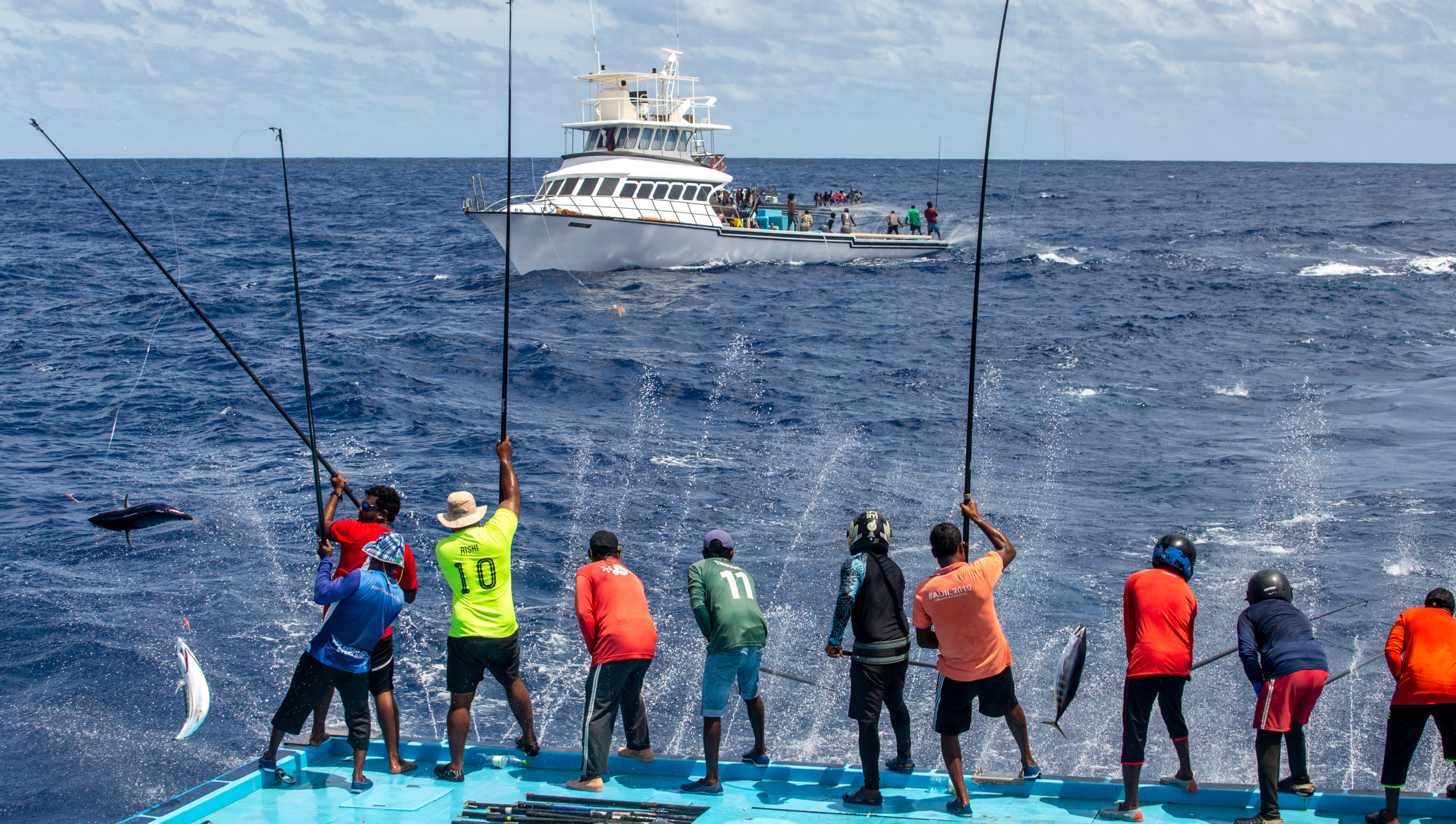
Editor’s Note: The opinions expressed here by the authors are their own, not those of Impakter.com — In the Featured Photo: Fishermen fish for tuna with the traditional method one-by-one Pole-and-Line, Indian Ocean, Maldives, May 31, 2022. Featured Photo Credit: FAO.