Most days for most of the world and the media, the country of Georgia is far from headline news, with intensive focus on the Iran War, the Middle East, oil, and economic competition. But such disinterest is a mistake.
Georgia, with a population of less than four million people, is nevertheless at the crossroads of geography and geopolitics. Further, political events outside its borders ripple inside this crossroads country. Thus, the defeat of Orban in Hungary, seen as a loss of Russian influence in Europe, may affect the Georgian-Russian relationship.
It is possible to consider historic Georgian parallels to the Hungarian ousting of a corrupt Orban government and Georgia’s 2003 “Rose Revolution,” when civic protest ousted the Soviet-era corrupt government and replaced it with one more democratic and engaged with the West. It is far too early to tell what Georgia’s future will be, but Georgia’s history, geography, and culture suggest it will be of its own making.
Georgia of the South Caucasus Region
Georgia lies at the intersection of Eastern Europe and Western Asia, with borders on the Black Sea and with Russia, Turkey, Armenia, and Azerbaijan. It has a special history of religious tolerance, and while the majority of Georgians are Eastern Orthodox Christians, it is also home to Muslim and Jewish communities, as well as Armenian Apostolic Christians.
The Georgian constitution explicitly promotes the free exercise of religion and has allowed different religious practices to coexistence. (The fact that Israelis, who in 2025 were the largest single foreign apartment buyers in the capital, Tbilisi, accounting for roughly 11% of all sales by major developers, is testimony to this feature.)
Critical Events in Georgia’s Recent Past
After the 1921 invasion by the Soviet Union, Georgia became part of the USSR, with many Georgians angered with the suppression of cultural expression, economic control, and political repression, and deepening resistance to the corrupt government. In 1991, with the collapse of the Soviet Union, Georgia became an independent state recognized by the United Nations, but one still largely de facto controlled by the Russian Federation.
With heightened frustrations and largely through peaceful demonstration, the Georgian 2003 “Rose Revolution,” largely recognized as the first “color revolutions,” distanced the country from Russian influence, and created a new independent “Georgian” government, which came with the hopes for widespread reform, and a pivot towards the West. Indeed, over an extended period, a wide range of domestic reforms was enacted to consolidate democracy, and closer ties were developed with the European Union, including the signing in 2014 of an EU Association Agreement.
Related Articles
Here is a list of articles selected by our Editorial Board that have gained significant interest from the public:
That said, those positions were discarded over time, with the governing Georgian Dream party still in power, increasingly authoritarian, passing Russian-style laws targeting media and non-government groups that receive foreign funding. Media and non-governmental organizations receiving over 20% of their funding from abroad must register as “organizations acting in the interest of a foreign power” and submit to stringent audits or face punitive fines.
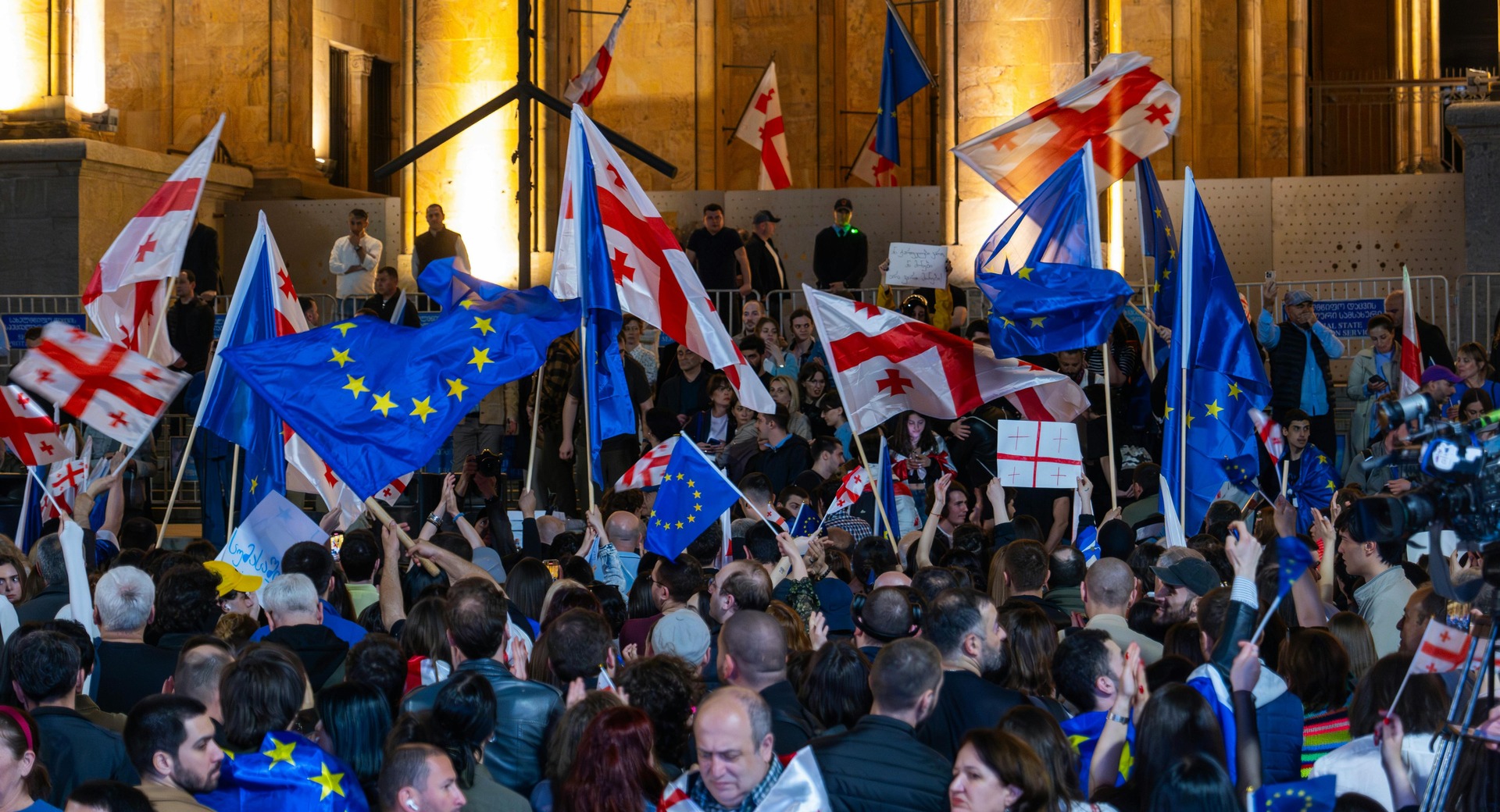
Public demonstrations are constrained with new laws designed to neutralize dissent, which make wearing face coverings, blocking traffic, and “obstructing people’s movement” criminal offenses with possible imprisonment. The application to join the European Union has essentially ended both because of the government’s lack of interest and because EU members determined Georgia no longer qualified for consideration.
What of the Future?
Georgia has a long history of national identity, independence, resistance and resilience. Its people have proven, when sufficiently dissatisfied, that they will take their governance into their own hands. At this juncture, what will happen next, given the changing geopolitical environment that swirls around them, would only be speculation. But if the past is any indication, they will find what is best for the Georgian people.
Editor’s Note: The opinions expressed here by the authors are their own, not those of Impakter.com — In the Cover Photo: Protest in Tbilisi, Georgia, April 17, 2024. Cover Photo Credit: Ramaz Bluashvili.