As the conflict involving Iran, Israel and the United States deepens, there’s increasing clarity on the manner in which Iran has continued to retaliate and, more importantly, hold its ground for far longer than expected.
In a world saturated with surveillance, layered intelligence systems, and highly digitised strategic monitoring, it is difficult to believe that the broad contours of Iran’s capabilities, facilities, or infrastructure were unknown to Western intelligence and policy establishments.
The question, then, is not simply what Iran possesses, but how its political and strategic systems have continued to function through multiple distributed centres of command even in the absence of key leaders.
Going by conventional expectations, such systems ought to have shown signs of collapse much earlier.
This is what makes the present moment analytically significant. What appears to have been underestimated by much of the mainstream strategic and policy discourse is not merely Iran’s military capability in the narrow sense, but the resilience of a system to decentralise and sustain operational continuity through layered command structures, regional networks, and semi-autonomous strategic units, rather than depending entirely on a single central command structure. This approach resembles what is described as a mosaic defense strategy.
But a system does not endure in this way through structure alone.
Decentralisation is never merely a technical arrangement; it is equally a human one. Put simply, it is what allows a system to continue functioning even when one part is disrupted. To make this more concrete, one may think of everyday systems that rely on such distributed functioning: a hospital network where local clinics continue providing care even if the central administration is temporarily affected, or a disaster-response system where district teams act without waiting for instructions from the capital.
Such systems work not only because roles are formally distributed, but because actors trust the larger purpose of the system and are able to act within it.
For decentralised units to continue acting without waiting for instruction at every stage, individuals within the system must be motivated differently. They must feel connected to something larger than immediate self-interest — a shared political vision, a collective sense of identity, historical memory, or a larger moral purpose. It is this sense of purpose and meaning that allows action to continue even when the risks are high and the outcomes uncertain.
It is perhaps here that the larger difficulty for the West — or what one may call the mainstream strategic imagination — becomes visible, as much of contemporary analysis of the ongoing Iran–Israel conflict remains deeply oriented toward infrastructures, technologies, capabilities, and formal command structures.
What it often struggles to fully reconcile with is the force that emerges when human motivation itself is organised around shared meaning, purpose, and collective continuity. This is not simply a question of resources or strategy. It is a question of how systems mobilise people to think, care, persist, and act under prolonged uncertainty.
That underlying motivational structure is often harder to anticipate than physical capability.
Iran, in this sense, serves as an illustration of a larger point. Whatever the historical and institutional processes through which this larger purpose has been built, the more analytically observable outcome is a form of decentralised resilience that has allowed political and strategic systems to continue functioning under sustained stress.
The point here is less about inferring people’s motivations directly — which are often difficult to judge or quantify — and more about recognising the visible continuity of distributed structures, layered command, and collective institutional response under pressure.
One is not justifying the process of building motivation. Indeed, there are substantial and deeply contested questions around the historical, political, institutional, and religio-ideological processes through which such purpose and meaning are created and sustained. Those questions cannot be ignored.
And yet, if one looks at the outcome analytically, it is difficult not to recognise that some form of larger collective orientation has been successfully embedded.
This opens up a broader question that goes well beyond the present conflict. Decentralisation in governance, institutions, and even development discourse has long been treated as a desirable principle.
Related Articles
Here is a list of articles selected by our Editorial Board that have gained significant interest from the public:
India’s own experience with local governance, from Panchayati Raj institutions to community-based resource management, repeatedly shows that formal decentralisation does not automatically translate into functioning decentralised action.
Structures can be put in place, responsibilities can be devolved, and institutions can be carefully designed, yet collective processes often struggle to sustain themselves over time.
What frequently weakens them is not only administrative capacity but the absence of a shared purpose that people feel meaningfully connected to.
This is perhaps where the comparison with many contemporary liberal democracies also becomes relevant. In the legitimate and necessary pursuit of individual freedom, mobility, and personal autonomy, larger shared purposes have often become difficult to sustain. Individuals are encouraged to pursue their own aspirations, careers, and forms of self-realisation, which has brought enormous gains in freedom and opportunity.
But it has also made it harder to hold on to collective meanings that can sustain decentralised action over time. When participation in collective spaces is not tied to a larger sense of meaning, it often becomes conditional upon visible returns or immediate benefits. The collective, in such circumstances, can begin to appear secondary to the individual trajectory.
At the same time, the answer cannot be a rigid or closed collective purpose. History repeatedly shows — from nationalist movements that hardened into exclusionary ideologies to revolutionary projects that left little room for dissent — that larger purposes, when left unquestioned, can ossify. They can harden into doctrines, identities, or ideological scripts that leave little room for reflection or dissent.
This is precisely where the challenge lies.
The issue is not simply whether a society has purpose and meaning, but whether that purpose remains open to constant discussion, reinterpretation, and dialogue.
As Austrian neurologist and philosopher Viktor Frankl and American cultural anthropologist Ernest Becker both remind us in different ways, human beings seek meanings that outlast immediate life — whether through nation, faith, institution, or collective identity — because such meanings give continuity and coherence to existence.
This can be deeply sustaining, but it can also become defensive when it ceases to be questioned and hardens into certainty.
This, perhaps, is the most difficult task for modern societies. A decentralised system can function only when individuals feel both free and embedded. They must have the freedom to question, reinterpret, and choose, while at the same time finding the larger collective purpose meaningful enough to remain invested in it.
What is needed, then, is not merely purpose, but a living purpose — a sense of meaning continually renewed through public dialogue, disagreement, and reinterpretation.
In this sense, Carl Jung’s insight that the self is formed in relation to shared symbols and narratives helps clarify why collective meanings matter. Yet precisely for that reason, such meanings must remain open and revisable if they are to sustain rather than restrict human action.
This is where the present example becomes important as a reflection on governance and collective life more broadly. What Iran’s resilience seems to reveal is that decentralised systems can endure only when they are sustained by a larger sense of meaning.
But the larger lesson is that meaning itself must remain alive through debate, discussion, and the possibility of disagreement. Only then can decentralised operations — whether in conflict, governance, or democratic institutions — remain durable without becoming coercive.
** **
This article was originally published under Creative Commons by 360info™.
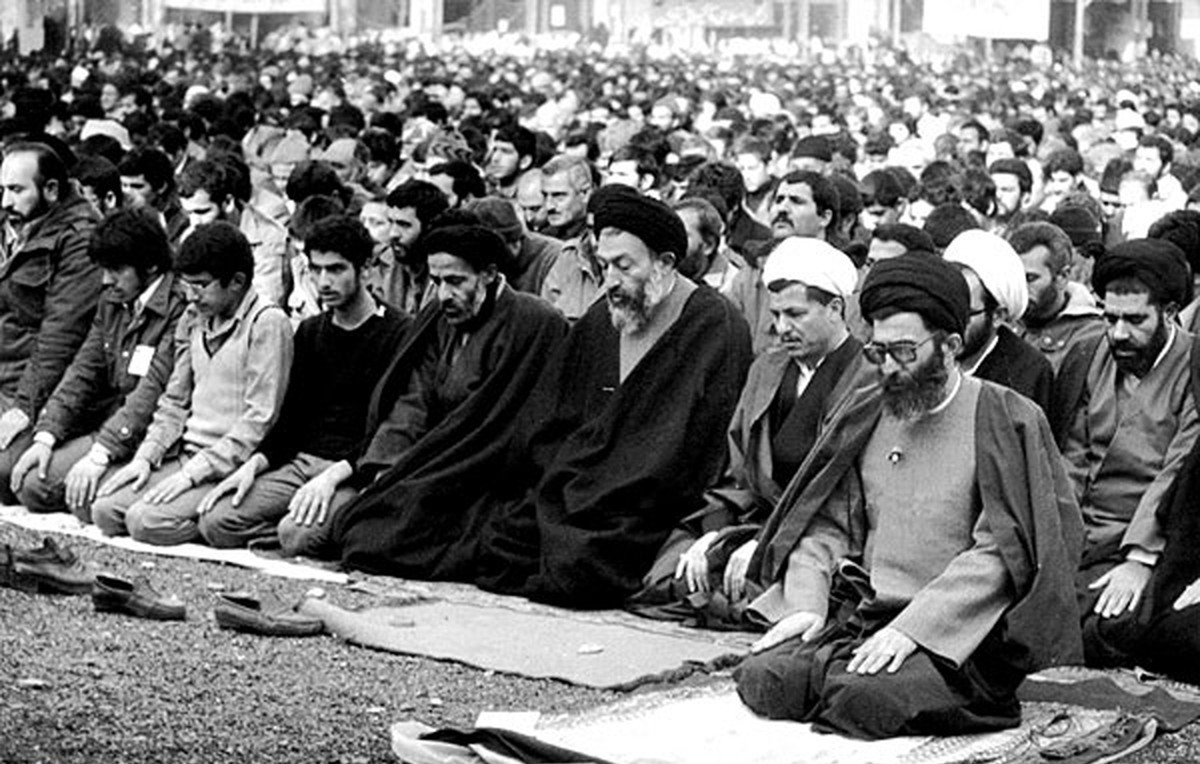
Editor’s Note: The opinions expressed here by the authors are their own, not those of impakter.com — In the Cover Photo: Senior Iranian leaders including the late supreme leader Ayatollah Ali Khamenei at a Friday prayer, somewhere in the 1980s. Iran’s position in the current conflict is an example of decentralised resilience that has allowed political and strategic systems to continue functioning under sustained stress. Cover Photo Credit: Wikimedia Commons/Khamenei.ir/CC 4.0.