A total of eleven major international organizations, including Oxfam, Action Against Hunger, and Save the Children, recently raised the alarm in a joint press release as latest data show that the number of West Africans in need of emergency food assistance has nearly quadrupled over the past decade.
27 million people are already going hungry, and the convergence of environmental crises, local conflicts, the economic consequences of COVID-19, and the Ukraine war could push another 11 million to hunger over the next three months. This would represent a historical 40% increase compared to the same period last year, with Nigeria, Burkina Faso, Niger, Chad, and Mali counting amongst the most severely affected countries.
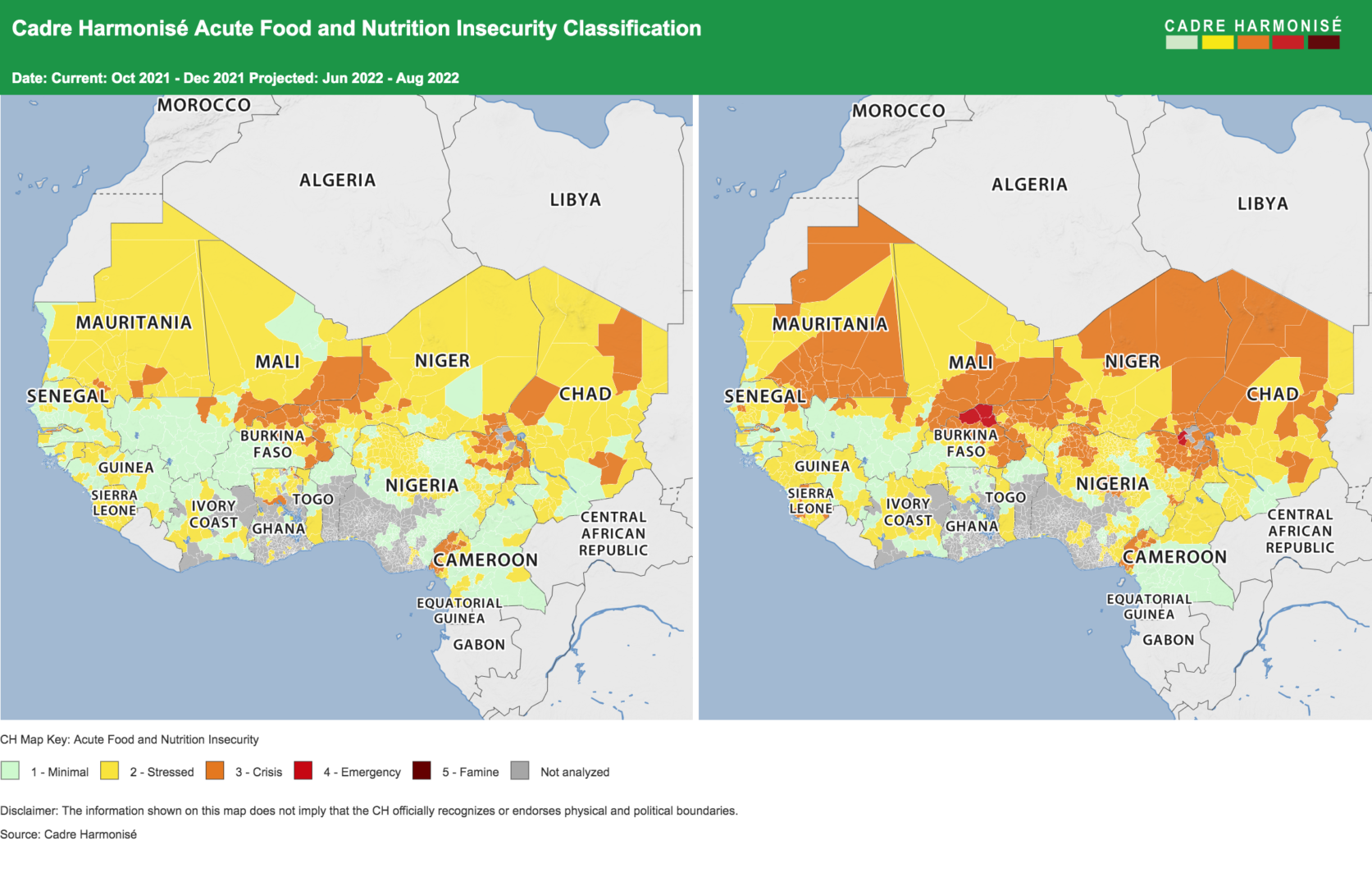 Chart compairing Food and Nutrition Insecurity levels in October-December 2021 with projections for June-August 2022. Source: https://www.ipcinfo.org/cadre-harmonise
These alarming figures are the results of new analyses conducted in March 2022 by Cadre Harmonisé (CH) which identified the areas and populations impacted by the crisis in anticipation of the international conference on the Food and Nutrition Crises in the Sahel and Lake Ched region, organized by the European Union and the Sahel and West Africa Club.
Humanitarian organisations are calling governments and donors to action as the Russian invasion of Ukraine threatens to worsen the situation by limiting access not only to food, but to financial and humanitarian aid as well.
A combination of negative factors: Climate change, Covid and the Ukraine war
West Africa’s critical situation results from a combination of aggravating circumstances that drastically limit West Africans’ access to food sources. “In some parts of the Sahel, cereal production has dropped by about a third compared to last year,” explains Assalama Dawalack Sidi, Oxfam’s regional director for West and Central Africa. “Family food supplies are running out. Drought, floods, conflict, and the economic impacts of COVID-19 have forced millions of people off their land, pushing them to the brink.”
Bad environmental conditions such as drought and uneven rainfall distribution – a clear result of accelerating climate change and worsening global warming -, political instability, and ensuing violence play an equally important role in the depletion of food resources as not only does it directly jeopardize crops and cattle, but it also compels people to abandon their homes: according to the UNHCR, the number of people currently displaced or refugees in Central Sahel (Burkina Faso, Mali, Niger), Chad, and Mauritania have increased by 2 million since 2020.
Philippe Adapoe, Save the Children’s director for West and Central Africa makes the point clear: “The situation is forcing hundreds of thousands of people to move to different communities and to live with host families who are already living in difficult conditions themselves.”
Dire consequences for children as hunger crisis puts their health, education, and security at risk
Philippe Adapoe adds: “There is not enough food, let alone food that is nutritious enough for children. We must help them urgently because their health, their future and even their lives are at risk.”
Children under the age of five are at the heart of humanitarian concern as the United Nations estimated that 6.3 million will be suffering from acute malnourishment in 2022, compared to 4.9 million in 2021. Safiatou, a Burkinabe mother who had to flee from local conflicts, describes the gravity of the situation: “I have almost no milk left so I gave my baby other food. He often refused to take it and lost weight. In addition, he had diarrhea, which worsened his condition.’
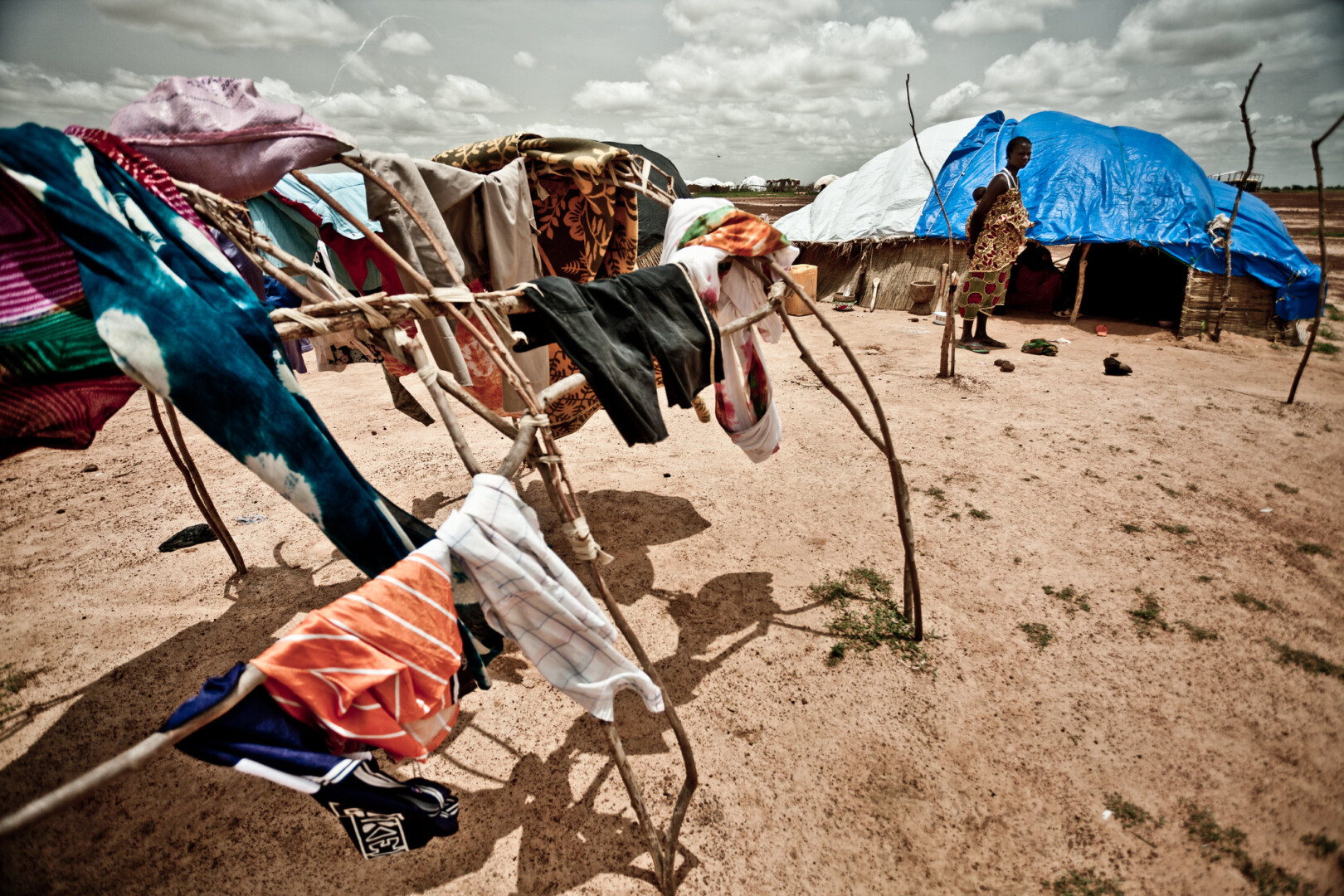
As the food crisis worsens, many families are left with no other solution but to sell their assets. “I used to have twelve sheep, but now I only have one left,” says Ramata Sanfo, a Burkinabe herder. “I would like to have my cattle back so that I have enough money and my children can go back to school.”
On top of jeopardizing children’s health and access to education, the food crisis could trigger a rise in gender-based violence as young girls may be forced into early marriage and subsequent situations of sexual, physical, and emotional violence.
War in Ukraine is a catalyst, expected to rapidly worsen the situation
The war in Ukraine is threatening to trigger a 20% rise in food prices around the world, which would considerably worsen West Africa’s food crisis as those prices have already increased by 18 to 30% in the region over the past five years. And, as we wrote in a previous Impakter article, with the war acting as a catalyst, Africa (as well as other regions) are on the brink of a food crisis.
According to the Food and Agriculture Organisation (FAO), Russia and Ukraine together make for more than one-third of global cereal exports, but as the war drags on it has become unclear whether these countries will have the capacity to continue their exports in the coming year. Wheat is particularly at risk of going scarce as countries like Senegal, Liberia, Benin and Mauritania import more than 50% of their wheat from Russia and Ukraine, and others, like Burkina Faso and Togo, at least 30%.
The crisis in Ukraine has also sparked a sudden shift in donor priorities, raising concern as to whether this will generate further decrease in international aid to Africa.
As mentioned in the Oxfam press release, already in 2021, only 48% of the humanitarian response plan in West Africa was funded.
Now that a war has started in Europe, governments and other financial donors are considering making cuts to existing aid budgets to fund Ukrainian assistance. Denmark has recently confirmed that they will postpone parts of their development assistance to Burkina Faso and Mali to fund the reception of Ukrainian refugees instead.
Such turnarounds not only compromise West Africa’s prospects in averting a food crisis of historical proportions but also raise ethical concerns over Europe’s proclaimed commitment to universal humanitarian values:
“There should be no competition between humanitarian crises,” says Mamadou Diop, regional representative of Action Against Hunger. “The Sahel crisis is one of the worst humanitarian crises on a global scale and, at the same time, one of the least funded. We fear that by redirecting humanitarian budgets to the Ukrainian crisis, we risk dangerously aggravating one crisis to respond to another.”
As Oxfam’s regional director Assalama Dawalack Sidi says: “The conference on the Sahel crisis […] is a unique opportunity to mobilize the necessary emergency food and nutrition assistance and to prove that the lives of people in Africa are not worth less than those in Europe.”
The food crisis currently hitting West Africa is rapidly deteriorating, and the addition of a global pandemic, climate change, and consequences due to a new European conflict will make it worse — unless emergency action is taken.
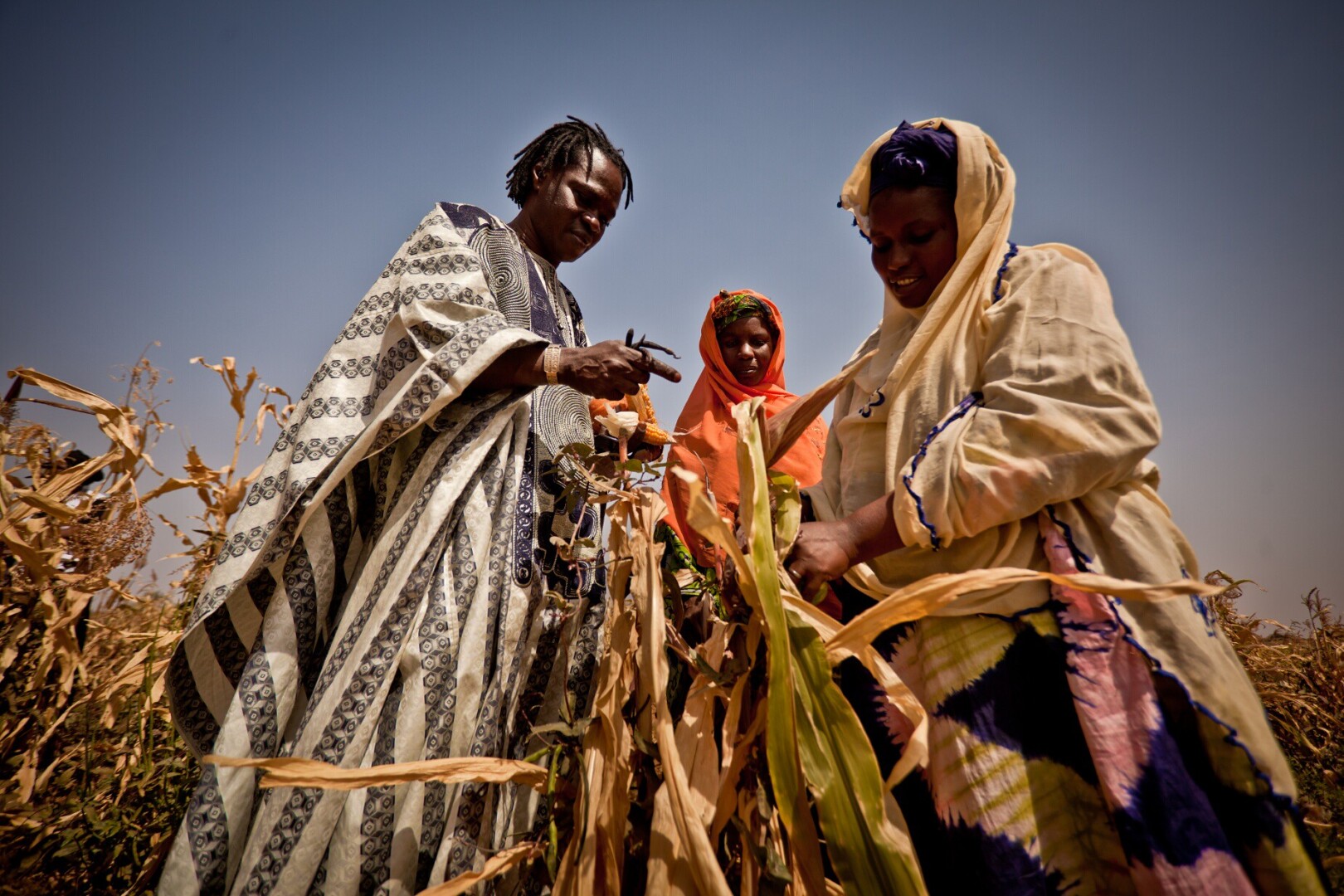
Editor’s Note: The opinions expressed here by Impakter.com columnists are their own, not those of Impakter.com — In the Featured Photo: Aissat Abduljub and Habiba Wellba show Senegalese singer Baaba Maal their corn crops, which have become inedible because of the drought. Featured Photo Credit: Pablo Tosco/Oxfam/Flickr.