Impakter
  • Environment
    • Biodiversity
    • Climate Change
    • Circular Economy
    • Energy
  • FINANCE
    • ESG News
    • Sustainable Finance
    • Business
  • TECH
    • Start-up
    • AI & Machine Learning
    • Green Tech
  • Industry News
    • Entertainment
    • Food and Agriculture
    • Health
    • Politics & Foreign Affairs
    • Philanthropy
    • Science
    • Sport
  • Editorial Series
    • SDGs Series
    • Shape Your Future
    • Sustainable Cities
      • Copenhagen
      • San Francisco
      • Seattle
      • Sydney
  • About us
    • Company
    • Team
    • Partners
    • Write for Impakter
    • Contact Us
    • Privacy Policy
No Result
View All Result
Impakter logo
No Result
View All Result
WEF Report Ranks Environmental Challenges as Greatest Long-Term Threat to Global Stability

WEF Report Ranks Environmental Challenges as Greatest Long-Term Threat to Global Stability

According to a survey of over 900 experts, extreme weather represents the world’s greatest long-term threat

Benjamin ClabaultbyBenjamin Clabault
February 2, 2026
in Business, Climate Change, Environment, Society
0

The World Economic Forum’s Global Risks Report 2025 found that environmental risks are deteriorating faster than other threats and challenges.  

The report, published this month, draws on the opinions of key stakeholders across academia, business, government, international organizations, and civil society. In the aggregate, these experts see worsening extreme weather as the most severe long-term threat. 

Along with environmental risks, the report highlights misinformation, rising geopolitical tensions, and increased social fragmentation. These challenges might do more than distract from the collaborative work of environmental protection. They could also actively hamper it. 

According to the 900 experts surveyed, the four most severe long-term risks are all related to the environment. Photo Credit: World Economic Forum, Global Risks Perception Survey 2024-2025

What Is the Global Risks Report?

The Global Risks Report is an annual study released by the World Economic Forum (WEF), an international organization that promotes global collaboration on economic and geopolitical issues. 

The report provides insights into the threats and challenges that humanity faces in the years ahead. The Global Risks Report 2025 was derived largely from the Global Risks Perception Survey 2024-2025 (GRPS), which gathers insights from over 900 experts. 

According to Saadia Zahidi, the WEF’s managing director, the report focuses on “multi-decade structural forces,” including “technological acceleration, geostrategic shifts, climate change, and demographic bifurcation.” 

The WEF is an important stakeholder in global affairs. The 2026 iteration of its annual meeting in Davos, for example, saw world leaders wrangling on Greenland, tariffs, and other consequential issues. 

The WEF’s prominence and reputation make its Global Risk Report an impactful resource for business and political leaders. 

Experts See Environmental Risks as Most Severe

Drawing on data from the GRPS, the WEF measured the severity of 33 different risks. Those in the “environmental” category appear as the most severe over a 10-year time horizon.

The most severe risk of all, according to the report, is “Extreme weather events,” followed by “Biodiversity loss and ecosystem collapse,” “Critical change to Earth systems,” and “Natural resource shortages.” All of these environmental risks are considered more severe than the most concerning non-environmental risk, which is “Misinformation and disinformation.”

This is the second successive GRPS in which “Extreme weather events” ranks as the most severe long-term risk. 

“Extreme weather events” was ranked as the most severe long-term risk and the second-most severe short-term risk. Photo Credit: World Economic Forum, Global Risks Perception Survey 2024-2025

The Private Sector’s Lack of Concern for Pollution 

In addition to aggregating survey responses, the Global Risks Report shows how different categories of experts ranked the risks. 

On the issue of pollution, experts from the private sector expressed far less concern than experts from civil society, academia, and government. 

The WEF notes in the report that pollution “is the world’s largest environmental risk factor for disease and premature deaths, and its impacts are unequal, with 92% of pollution-related deaths and the greatest burden of related economic losses occurring in low- and middle-income countries.”  

Despite these harms, private sector experts did not rank pollution as one of the 10 largest threats over a 10-year time horizon. Experts from academia, meanwhile, considered pollution the fifth-most-severe risk.

Related Articles

Here is a list of articles selected by our Editorial Board that have gained significant interest from the public:

  • Climate Change’s Catch-22
  • The 2°C Target Is ‘Dead,’ Says Top Climate Scientist
  • Deadly Heatwaves and Freezing Blizzards – Global Warming Causes Both

Environmental Degradation in a Turbulent World

The environmental risks in the Global Risks Report 2025 sit alongside a number of other short- and long-term threats, all of which are expected to increase in severity over the next 10 years.

Across risk categories, experts expressed a pessimistic outlook in their survey responses. Just 8% of respondents expect the world to be “calm” in 2034, while 62% expect it to be “turbulent” or “stormy.”
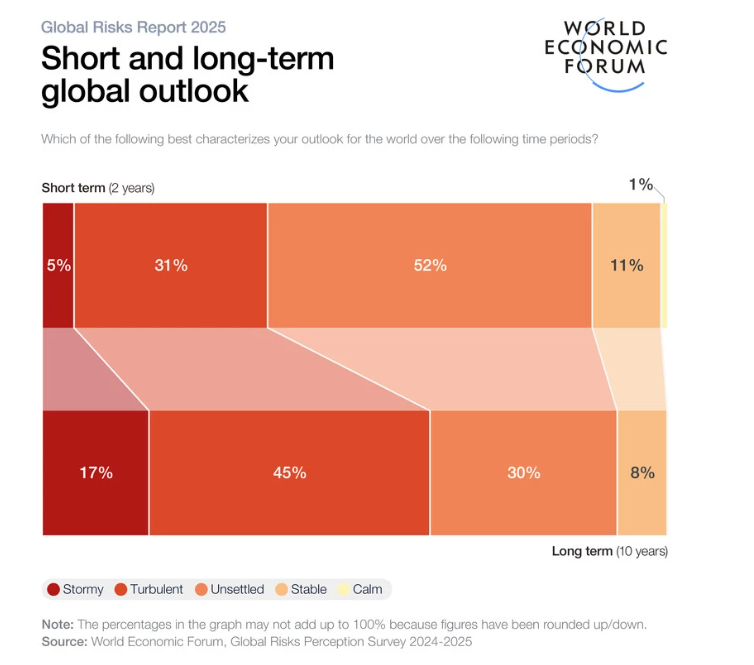
According to the Global Risks Report 2025, only 8% of experts expect the world to be “stable” in 10 years. Photo Credit: World Economic Forum, Global Risks Perception Survey 2024-2025

The report also reflects a deepening of geopolitical and geoeconomic tensions. Twenty-three percent of experts rank “State-based armed conflict” as the No. 1 short-term risk for humanity.

Meanwhile, social fragmentation — defined by risks like “Inequality,” “Societal polarization,” and “Involuntary migration or displacement” — is considered especially threatening. According to the WEF, these social ills tend to exacerbate other risks. For example, inequality can weaken public infrastructure, which in turn worsens natural resource shortages.
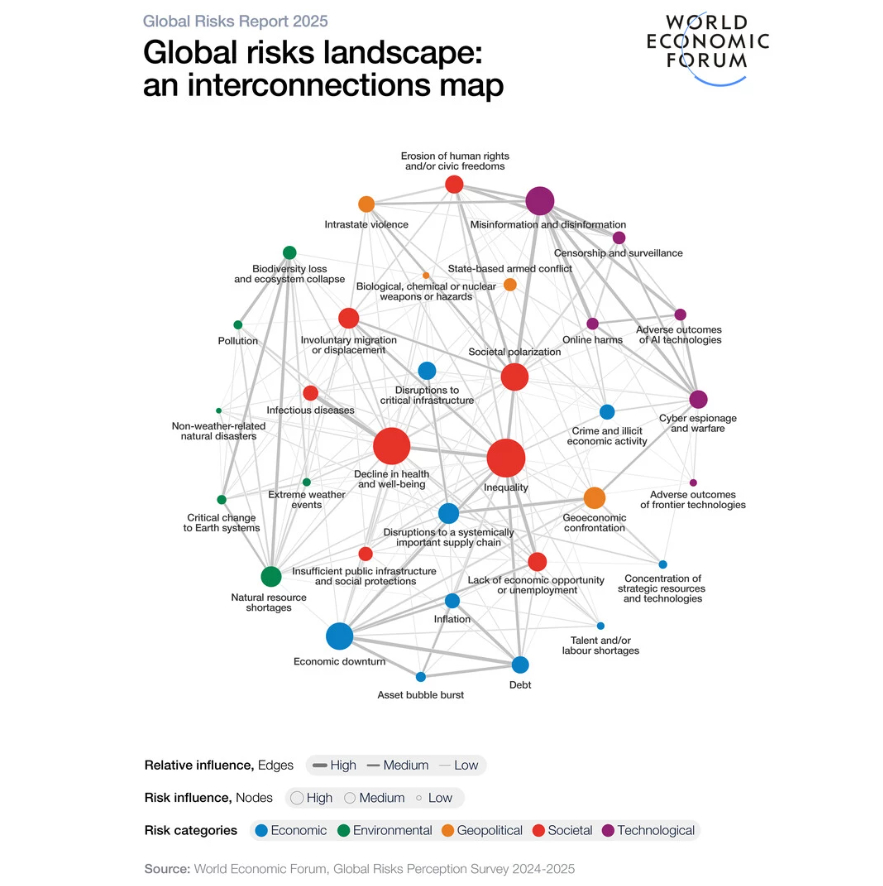
An infographic from the World Economic Forum shows how global risks are interconnected. Photo Credit: World Economic Forum, Global Risks Perception Survey 2024-2025

For policymakers, it seems, separating environmental objectives from other risks is impossible. The only way forward is to address environmental issues from within the social, political, and economic contexts in which they arise.


Editor’s Note: The opinions expressed here by the authors are their own, not those of Impakter.com — In the Cover Photo: A flooded village. Cover Photo Credit: Pok Rie.

Tags: Climate ChangeEnvironmental degradationenvironmental risksExtreme Weathergeopolitical tensionsGlobal Risks Perception SurveyGlobal Risks Report 2025Global warmingGRPSmisinformationsocial fragmentationWEFWEF Global Risks Report 2025World Economic Forum
Previous Post

Thames Water Closes in on £16bn Rescue Deal

Next Post

Winter Olympics Sponsorship Emissions: Who Are the Main Offenders?

Related Posts

News about grey-headed flying foxes dying due to heatwaves caused by climate change.
Climate Change

Climate Change Brings Another Species Closer to Extinction

In January 2026, a series of extreme heatwaves across South-Eastern Australia caused one of the worst mass mortality events for...

byAnastasiia Barmotina
February 11, 2026
Underwater Wall to Protect the ‘Doomsday Glacier’: Necessary Intervention or Costly Distraction?
Climate Change

Underwater Wall to Protect the ‘Doomsday Glacier’: Necessary Intervention or Costly Distraction?

Thwaites Glacier in Antarctica earned its dramatic nickname, the “Doomsday Glacier,” because its collapse could trigger a catastrophic rise in...

byBenjamin Clabault
February 11, 2026
The Era of ‘Global Water Bankruptcy’ Has Begun
Climate Change

The Era of ‘Global Water Bankruptcy’ Has Begun

Humanity’s long-term water usage and damage have exceeded nature's renewal and safe limits, a situation scientists and the media have...

byNmesoma Ezetu
February 10, 2026
How Climate Change Is Driving Evolution
Climate Change

How Climate Change Is Driving Evolution

As global temperatures continue to rise at alarming rates, climate change threatens to wipe out entire groups of animal species....

byYuxi Lim
February 10, 2026
biodiversity loss
Biodiversity

The Economics of Biodiversity Loss

In the 1990s, India’s vulture population collapsed due to the unintended knock-on effect of a veterinary drug for cattle, with...

byStefano Giglio - Professor at Yale Universityand2 others
February 9, 2026
A picture with a wind power generator
Society

Emissions and Economic Growth: Is There Still a Link?

In prior decades, economic growth and emissions co-existed. As countries grew richer, they produced more and emitted more. This relationship...

byFedor Sukhoi
February 3, 2026
Three sponsors for the 2026 Winter Olympics in Italy could generate 1.3 million tons of CO2
Climate Change

Winter Olympics Sponsorship Emissions: Who Are the Main Offenders?

The 2026 Winter Olympic Games are set to begin in Italy next month. Scattered across towns in northern Italy, from...

bySarah Perras
February 2, 2026
Thames Water closes in on rescue deal;
Environment

Thames Water Closes in on £16bn Rescue Deal

Today’s ESG Updates: Thames Water Closes in on £16bn Rescue Deal: Thames Water is edging closer to a multibillion-pound rescue...

byAriq Haidar
February 2, 2026
Next Post
Three sponsors for the 2026 Winter Olympics in Italy could generate 1.3 million tons of CO2

Winter Olympics Sponsorship Emissions: Who Are the Main Offenders?

Recent News

ESG News regarding EU’s competitiveness summit, Trump’s endangerment finding repeal, Trump’s coal push, and Deutsche Bank’s first European Green Bond

European Union Summit For Competitiveness

February 13, 2026
Career and automation: Automation Matters for Education Careers

Future Careers in Education: Why Automation Awareness Matters for Degree Seekers

February 12, 2026
REAIM speaker stands in front of an image that reads "Real or fake?"

Deepfake Fraud Goes Mainstream

February 12, 2026
  • ESG News
  • Sustainable Finance
  • Business

© 2025 Impakter.com owned by Klimado GmbH

No Result
View All Result
  • Environment
    • Biodiversity
    • Climate Change
    • Circular Economy
    • Energy
  • FINANCE
    • ESG News
    • Sustainable Finance
    • Business
  • TECH
    • Start-up
    • AI & Machine Learning
    • Green Tech
  • Industry News
    • Entertainment
    • Food and Agriculture
    • Health
    • Politics & Foreign Affairs
    • Philanthropy
    • Science
    • Sport
  • Editorial Series
    • SDGs Series
    • Shape Your Future
    • Sustainable Cities
      • Copenhagen
      • San Francisco
      • Seattle
      • Sydney
  • About us
    • Company
    • Team
    • Partners
    • Write for Impakter
    • Contact Us
    • Privacy Policy

© 2025 Impakter.com owned by Klimado GmbH