

The year is 2016. You walk into a restaurant with an obscure name containing an “and” symbol, like “Silver & Spoon” or “Oak & Barrel.” You sit down at a thick wooden table with mismatched chairs and mason-jar candles. The server comes over and proudly describes the restaurant as farm-to-table, sourcing only the best local ingredients.
Farm-to-table dining has been trending in the United States since the 1970s. In 1971, Chef Alice Waters opened Chez Panisse in Berkeley, California, a restaurant widely credited with starting the movement. From there, the trend expanded in the U.S. In 2007, the New Oxford American Dictionary’s “Word of the Year” was locavore, defined as someone who tries to eat locally grown or produced food. In 2009, the U.S. Department of Agriculture launched the “Know Your Farmer” initiative to promote local food systems.
It entered mainstream Europe in July 1986, when Carlo Petrini founded Slow Food Italia (originally Arcigola) and advocated for a fair, sustainable food system in Italy. His influence grew, and three years later, in December 1989, 20 global delegations signed the Slow Food Manifesto in Paris. Petrini served as president of the movement until 2022.
Fast forward to today, and the trend remains strong in Italy. One chef in Sardinia, Chef Pasquale D’Ambrosio, has taken the concept to another level.
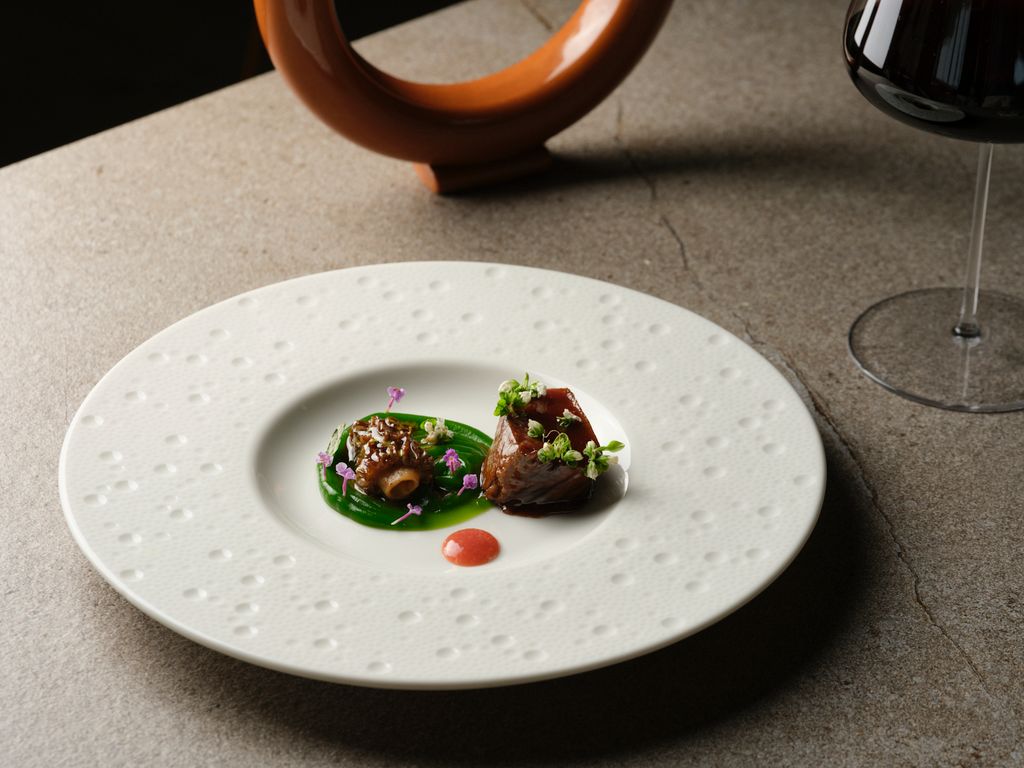
At his restaurant Capogiro at the 7Pines Resort in Sardinia, Chef D’Ambrosio sources 95% of his restaurant’s ingredients from the island. Last year, the restaurant earned a Michelin star. Impakter had the opportunity to speak with Chef D’Ambrosio about his methodology and how other aspiring chefs can implement a similar model in their restaurants.
Fresh, local ingredients
Speaking about how he sources 95% of ingredients locally, Chef D’Ambrosio told Impakter: “I would love to use 100%, but as we all know, you can find good products here, even excellent ones, but sometimes not in large quantities. As for the other 5%, I would of course love to find those in Sardinia too, but some ingredients are part of my culture and my history, and they often belong to that 5%, so they have to come from outside the island.”
“Another rule is to always follow time and the seasons: they are two fundamental elements when sourcing local products.”
Unlike other parts of the world where you can eat out-of-season vegetables whenever you want, Italy prides itself on seasonality. If artichokes aren’t in season, you can forget about ordering Carciofi alla Romana. If it’s not summer, you definitely won’t be enjoying some prosciutto and melon.
At his restaurant, Chef D’Ambrosio maintains this tradition. Yet he highlights the importance of ensuring guests recognize this reality, stating, “It is also important to help guests understand that some ingredients are only available at certain times of the year. So, besides having the courage to carry a model like this forward, we must educate our guests.”
His business model is good for the environment and good for the local economy of Sardinia.
“We gave an opportunity to people who, living on this island, struggled to place their products and their work in a world of consumerism, where prices must be competitive, everything must arrive immediately, and everything must be the same as everyone else’s.”
“We made a different choice. Price matters, of course, because we are a business, but it is not my first question. I don’t ask how much a product costs. I look at the products of these artisans, fishermen and farmers, and I recognize them as the best. I never put them on the spot by demanding a price.”
“As a company, we gave them the opportunity to build their own micro-business, and to pursue their goals and their dreams. We did this with all our suppliers because they aren’t large companies that produce and then export abroad. They are small businesses, some of them built together with us when we opened in 2022. I truly remember how we worked everything out together, from transport methods to how to store the products, and with some of them even invoicing and how to get a VAT number. That was a beautiful thing.”
Food tells a story
Not only is Chef D’Ambrosio’s food local, seasonal, and sustainable, but it has a story and an identity. He spent years building relationships with Sardinian farmers, fishermen, and artisans, asking questions and understanding the true identity of Sardinia.
“I spent a lot of time building a dialogue with these people. And not just any dialogue, but one that would create a relationship of trust, because I discovered that Sardinian farmers, fishermen, artisans, all of them, guard what they produce, harvest, and build. Entrusting it to someone is like handing over something deeply personal, so, first of all, I had to build trust.”
“Then I had to help them understand that everything placed in my hands would, above all, tell their story and the story of the place. I wouldn’t use their ingredients to put myself at the centre, but as something that represents a territory. So, it was a day-by-day construction, which lasted almost a year and a half, until we were all pursuing one single goal.”
“Once I began to understand the emotions that they felt when they entrusted me with a product, I began to feel it myself and to fall in love with it, until finally I put all of this on the plate.”
This time spent working closely with the people that grow, catch, and cultivate the food inspired Chef D’Ambrosio to bring their stories into his dishes. “Sourcing locally is, of course, a sustainable choice, but it is also a choice of identity. For me, telling the story of this place, my own identity and personal history, along with the concept of ‘tailor-made’ that I keep coming back to, is fundamental.”
“After dining at Capogiro, I would like every guest to understand that Sardinia, in culinary terms, is not just three ingredients, the ones built up over time: maialino (the little pig), myrtle and carasau bread. For me, Sardinia is so much more. It sits in the Mediterranean, and it is an island that has everything.”
“I would like guests to take home with them the whole world of Sardinia, which is made of many things: people, places, small areas and small communities that produce together. It is made of skilled craftspeople, artisans, innovative farmers and fishermen. It is also made of the innovation that the new generations are bringing, and of people who put the protection of the land first.”
“So I don’t want guests to take away just those three ingredients, maialino, carasau and myrtle; and that is why they are not on the menu. I want guests to take home the memory of development, innovation, protection and preservation of this island’s traditions. I want them to remember the knowledge, the understanding and the practice of these traditions. This is what I would like guests to take away, and it is something a guidebook could never convey.”
Related Articles
Here is a list of articles selected by our Editorial Board that have gained significant interest from the public:
Chef D’Ambrosio is redefining luxury dining with his focus on fresh, local ingredients. “Bringing in prestige ingredients for a luxury property like 7Pines Resort Sardinia, such as caviar, champagne or foie gras, is no longer true luxury, in my view,” explains Chef D’Ambrosio.
“True luxury is taking an ingredient from the territory, even a humble one, and making it luxurious within the guest’s overall experience. A slice of bread, for example: an ancient grain grown locally, from which we develop flours, biscuits, bread, and more. That is true luxury. It is the soul of a place, expressed through the highest form of cooking. We can do it without importing certain products and instead elevate the ones grown right here, making them luxurious.”
For resorts and restaurants that want to follow Chef D’Ambrosio’s lead, he has this advice: “If you want to build and support a local identity, one that talks about zero waste, local products and zero-kilometer sourcing, it can truly be done. You just must want it, and have the courage to do it. Some restaurants and resorts use products that arrive from all over the world. But if the idea is to build an identity of your own, you can use the territory to its fullest expression.”
Editor’s Note: The opinions expressed here by the authors are their own, not those of impakter.com — Cover Photo Credit: 7Pines Resort Sardinia.