It hits me now in my sleepless nights that history may move in widening circles ending in a final sixth mass extinction of most of life on our planet, this time man-made. And now, 65 million years after an asteroid hit the Mexican Gulf, our world begins to fall apart as regional wars flare up, pulling in the big powers ever more into them.
Recall that World War I started in Serbia and World War II in Poland — but where would a nuclear World War III start? Will it be intentionally started in Ukraine, in Taiwan or by accident in the Sub-Saharan stretch of Africa, the origin of a mass migration toward the North, causing a rise in right-wing nationalism in the Western countries? Is “Global injustice” the underlying cause? Looking at the 17 Sustainable Development Goals (SDG) declared by the United Nations in 2015 and targeted for 2030, it is obvious that the poor Third World countries in Africa and South-East Asia will never make it.
My family history, which spans 350 years, and my own journey over more than eight decades, from the early days of WWII to today, are a case study of how geopolitical upheavals, seismic shifts of power, and — since the turn of the century — new technologies shape our lives.
When I was a child, I did not know what had happened or what was coming. Born in the third year of the war, I hardly remember our six-week trek by foot in May/June 1945 from Trutnov (Trautenau), our evacuation destination in Eastern Chechia, back to our home in Berlin-Spandau. A few weeks before, my father had been killed in action near Torgau at the river Elbe, where the Allied forces had met with the Russians at the end of April.
But we did not know. We did not know what to expect — perhaps just survival? In 1955, when the West-German Chancellor Konrad Adenauer traveled to Moscow and obtained the return of the last German prisoners of war, I listened each night to the doorbell hoping for the return of my father.
Well after the blockade of West Berlin by Stalin in 1948, my mother told me about the years up to the forties when they were afraid that her father, my grandfather, would be taken away from them because of his alleged Jewish origin. He died in 1943, before the catastrophes ending the war.
Decades later, while living near Belgrade in Serbia, I began to dig into our family history with surprising results. But who am I? I have come around a lot in my life as a public health physician with global interests. One of my grandchildren drew a map and colored more than sixty countries I have visited in my life, devoted to issues of global health. The same restlessness characterizes my younger brother.
Life has always seemed to me like the proverbial ride across Lake Constance in Southeastern Germany: will the ice hold up? Fear that doesn’t call for caution but to ride faster and faster, even to flee — though what’s behind me is also in front of me: thin ice!
What tied me to life? It is the little cross that my mother drew on my forehead when I left as a youngster for Turkey in 1966. I didn’t yet know that this kind of initiation journey would eventually lead me to a Kibbutz near the Lebanese border and hard rural work with the Kibbutzniks.
Also: It is the railway sleepers that my mother laid with her group of protestant women at the city train station in Berlin-Grunewald, now the memorial of track 17. The Jewish families of Berlin, including — as I found out in Yad Vashem — far distant relatives with my grandfather’s name, were transported from there towards the East, in the mornings at four o’clock. I kept circling around these memories all my life and fascinated by the hidden secrets of my family history I started exploring the available documents.
The oldest known ancestors arrived in Berlin from different sides: The Laaser, my father’s family, originally from Tirol, came from the Eastern Prussian region South of Gdansk, after WW I, the so-called “Polish corridor” to the Baltic Sea. The Weimar family, the maternal line, came from the Western Palatine. In 1718 they bought the Kreuzberg (cross-mountain) — today a central district of the city of Berlin, at that time a vineyard.
The third branch of the family reports an almost unbelievable story. The oldest known ancestor according to official documents, Asher Abraham Heilbron, came in 1837 alone to the central Prussian province, named Brandenburg. He became inspector of the estate of the later Prussian Prime Minister Otto Theodor von Manteuffel in Bärwalde. His alleged son, however, came only at the age of ten but strangely two years before his so-called father to Bärwalde. Probably, this boy was an illegitimate child of the owner of the estate which would explain his highly-attended baptism 1853, his baptismal name Julius Otto, and his study of law in Berlin.
So, do I have Jewish origins, in addition to Prussian, Palatinean, and Tirolean? My feelings go with the first although today’s State of Israel moves to right-wing dominance, occupying step by step the territories of the West Bank and East Jerusalem and killing in revenge the civilian population of Gaza, including thousands of children, which the massacre of October 7/23 cannot justify.
In 1869 Julius Otto married at his second marriage Berta Emilie Luise Weimar, resulting in 19 children, almost half-half from both marriages, one of them my grandfather Lothar (1880-1943). After some years as a cowboy in Argentina, he married in 1913 my grandmother Charlotte Volland (1892-1976), whom he met in Berlin at a tennis court. The younger one of two daughters is my mother Ingeborg (1919-2008).
Related Articles: How to Save our Common Future: The Global One Health One Welfare Approach | All SDGs ‘Seriously Off Track,’ UN Report Finds | A Short History Of The SDGs | Maximizing Progress on the 2030 Agenda |
My mother, after the declaration of death of my father in January 1947, never married again but uncle Friedrich, called Fritz, older brother of my grandfather Lothar, became my spiritual father for the short period up to 1954 when he died after having lost his wife and his daughter during the last years of the war. Appointed by Kaiser Wilhelm II, he worked for the government’s press office during World War I and led it as “Reichspressechef” between 1920 and 1923. During these years, he also helped Theobald von Bethmann-Hollweg (Chancellor of the Reich until 1917) write his memoirs. Weimaraner President Hindenburg sent him as General Consul to Zürich in Switzerland but in 1934 he was dismissed from all functions by the new national-socialist regime.
Uncle Fritz introduced me to ancient Greek literature, the Iliad and Odyssey, and to the German socialist writer of the late 19th century Wilhelm Raabe. I remember his main room full of bookshelves and a rolling ladder to climb up to the higher rows. To reach his home, I had to travel by tram almost fifteen kilometers from Spandau to the center of West Berlin where he lived near the destroyed Kaiser Wilhelm Memorial Church.
He invited me to attend to him in his last days of life — as a fourteen-year-old boy. A formative experience to learn that all life is ending. I’d like to quote here a poem from his daughter Brigitte Heilbron, mirroring the feelings of the war-time:
Oh, why did you create this world of dying
All these things that belong to death
All these torments in wild choirs
Calling for an end to doom?
World soul, you were lonely in the rooms
And infinitely lost in the times
you were dizzy with your eternities,
Before your being’s unknown seams
You were everything. But the desire blossomed
Up to nothingness for your dark reasons
And he became the world, and in the world he became death.
What does this eventful not to say chaotic family history tell me, tell us? Is it not a mirror of the hubris of the emerging Germany in the 19th and early 20th centuries and yet, at the same time, it is linked to the intricate role of the Jewish element in German society, ending in the destruction of World War II.
If it were possible, I would like to meet all my ancestors and ask them about our future — not mine but the fate to be expected for my children and grandchildren. Will it be a united world or disintegrated remnants of life strewn across the planet after a nuclear devastation? I did not know as a child what was going to happen, I do not know today what to expect for my children and grandchildren.
But a candle of light is shining. All my experience and that of my ancestors tell me: We have to find a way to each other, and we have to accept each other! The present conflicts aim at pushing borders and are based, therefore, on the outdated model of a national society. My family history demonstrates a mixture of very different influences, integrating into a multicultural international profile that thirsts for new patterns of living together.
We shall develop step by step an acknowledged and obligatory rule system based on the United Nations’s 17 Sustainable Development Goals that integrates the environment, our neighbors, plants, and animals. We cannot destroy our own home. Where should we stay, then?
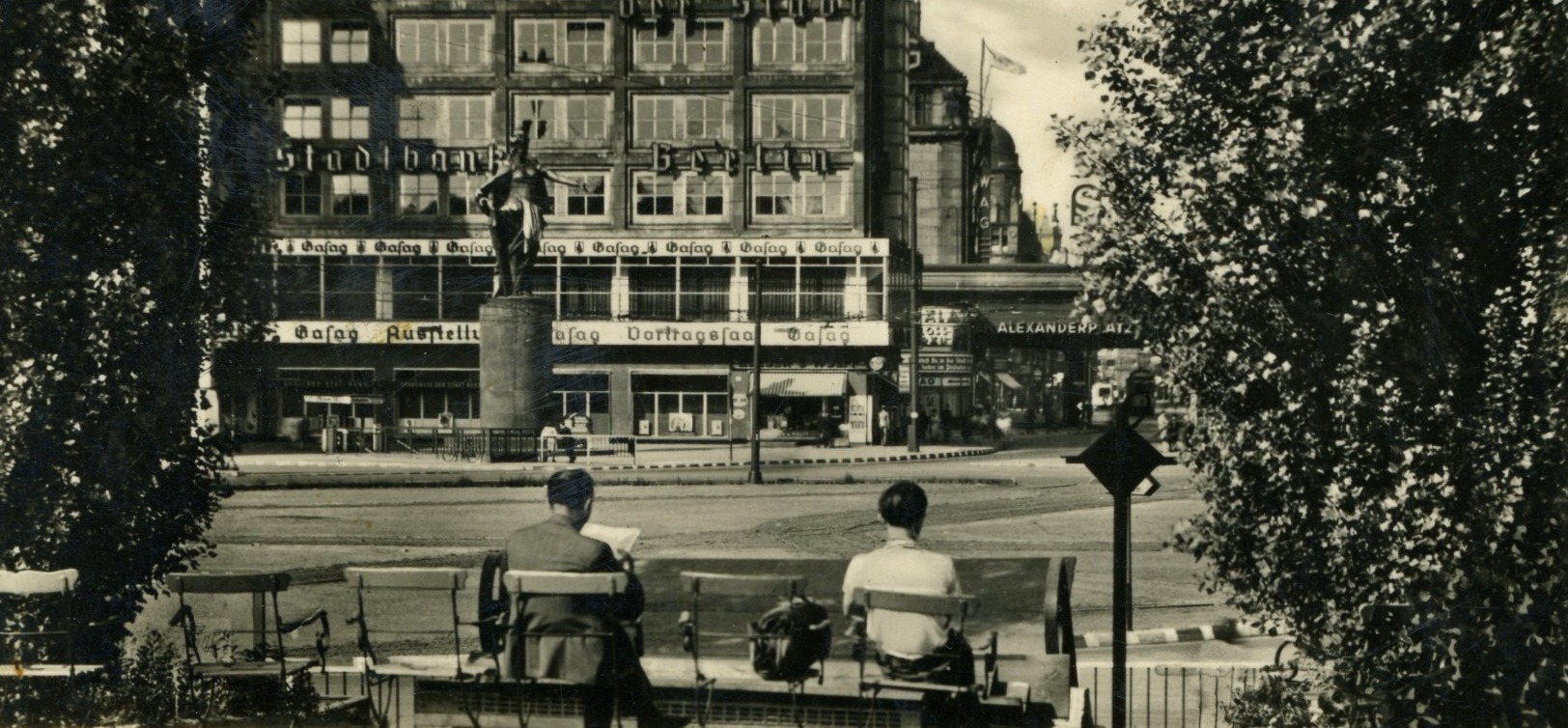
Editor’s Note: The opinions expressed here by the authors are their own, not those of Impakter.com — In the Featured Photo: Berlin Alexanderplatz in the 1930s. Featured Photo Credit: Wikimedia Commons.