Impakter
  • Environment
    • Biodiversity
    • Climate Change
    • Circular Economy
    • Energy
  • FINANCE
    • ESG News
    • Sustainable Finance
    • Business
  • TECH
    • Start-up
    • AI & Machine Learning
    • Green Tech
  • Industry News
    • Entertainment
    • Food and Agriculture
    • Health
    • Politics & Foreign Affairs
    • Philanthropy
    • Science
    • Sport
  • Editorial Series
    • SDGs Series
    • Shape Your Future
    • Sustainable Cities
      • Copenhagen
      • San Francisco
      • Seattle
      • Sydney
  • About us
    • Company
    • Team
    • Global Leaders
    • Partners
    • Write for Impakter
    • Contact Us
    • Privacy Policy
No Result
View All Result
Impakter logo
No Result
View All Result
Migration, Conflicts and Climate Change: A New Turn?

Migration, Conflicts and Climate Change: A New Turn?

Claude Forthomme - Senior EditorbyClaude Forthomme - Senior Editor
October 17, 2017
in Health, NGO & Charities, Philanthropy, Politics & Foreign Affairs, Society, Uncategorized, United Nations
1

World Food Day held yesterday at UN-FAO headquarters in Rome was full of surprises. An event organized since 1979 by FAO every year on October 16 to celebrate the founding of the organization in 1945, World Food Day is the occasion to draw the international community’s attention to a pressing issue in agriculture and rural development. This rarely excites the world’s attention, but this year’s theme was particularly well chosen: The focus was on what is undoubtedly the number one problem of our times, migration.

Pope Francis FAO

In the photo: His Holiness Pope Francis greeting FAO staff during the World Food Day Ceremony, FAO Headquarters (Atrium).Photo credit: ©FAO/Cristiano Minichiello.

The numbers are staggering: UN figures show there are roughly 244 million international migrants – that’s more than the whole population of Brazil –  while 763 million are migrants within their own country. Taking the two numbers together, that’s about one billion people, as much as India.

As the video FAO made for the occasion shows, the problem with migration is the lack of choice. And the solution to the migration crisis, is investment in the rural sector to give people a livelihood, so that they are not forced to migrate. Why the rural sector? Because that is where the problem starts, 75% of the world’s poor and food insecure live in rural areas.

In 2015 alone, 65.3 million people were forcibly displaced by conflict worldwide, and more than 19 million people were internally displaced because of natural disasters – many triggered by climate change.

First, Pope Francis is different from other Popes in that he attends more readily UN events. He has come before to FAO and gave a notable address to the ICN2.  Food security is clearly one of his major concerns.


RELATED ARTICLE: ICN2: WHERE A POPE, A QUEEN, A KING, A PRINCESS AND MELINDA GATES COME TOGETHER 


The 2017 WFD theme attracted not only the Pope who agreed to give the keynote address but also the President of Madagascar and the agriculture ministers of the G7: Italy, Canada, USA, France, Germany, the UK and Japan intervened, in that order. The meeting, lasting three hours, was opened by the FAO Director General Graziano da Silva and closed with interventions from the EU Commissioner for Agriculture and Rural Development, Phil Hogan, IFAD’s President, Gilbert F. Houngbo and WFP’s Executive Director, David Beasley.

The Pope’s address got a standing ovation and every orator that followed mentioned him, manifesting their support – including the US Secretary of Agriculture.
Papa alla FAO (3)
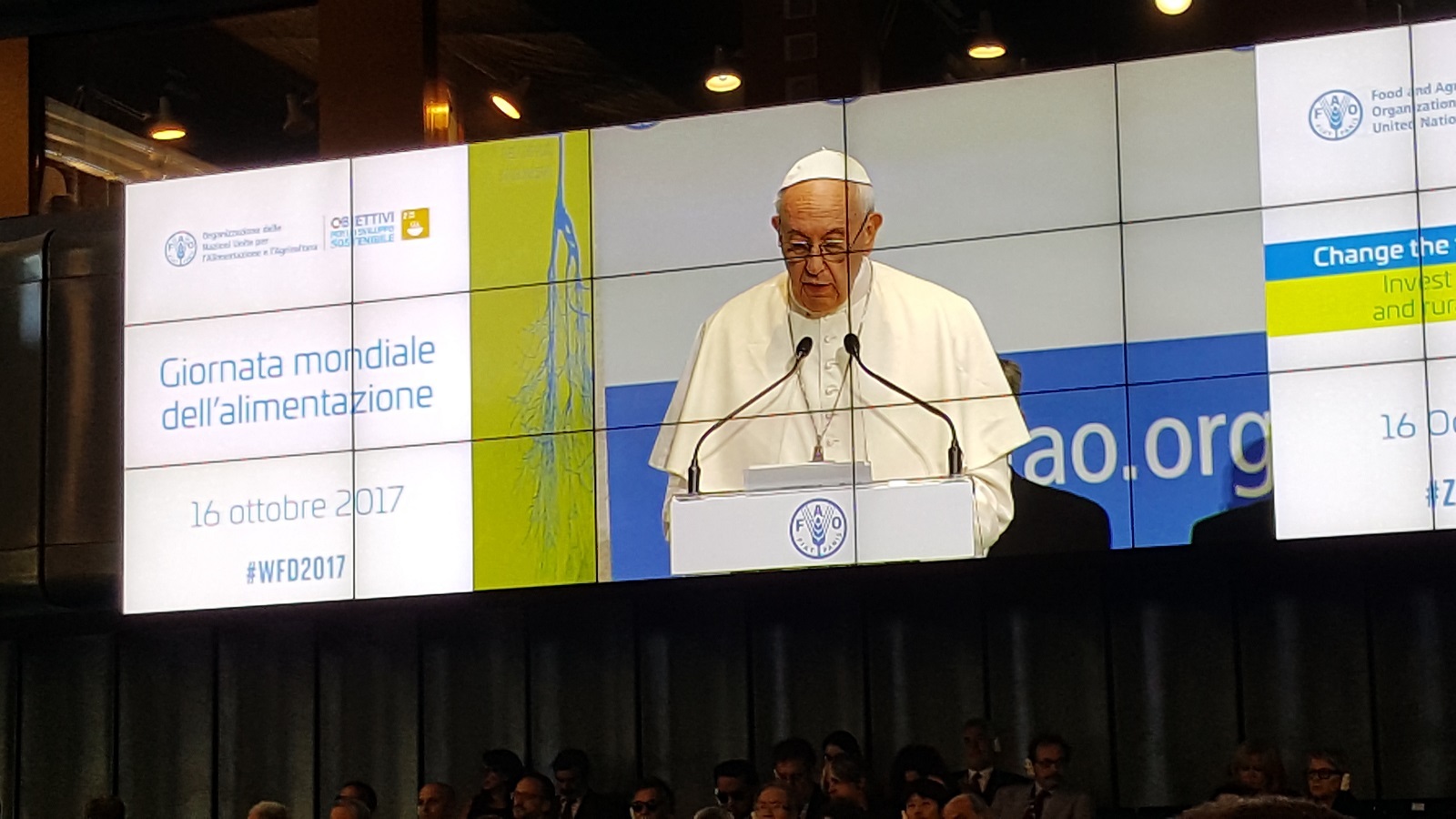
In the Photo: The Pope addressing the FAO Plenary on 16 October 2017, on the occasion of World Food Day (this is one of the two screens in the Plenary Hall). Source: Claude Forthomme

Yet the Pope’s message was, for anyone who is conservative and a climate denier, disturbingly radical. There are, he said, two main obstacles to solving the migration problem: (1) Conflicts, and (2) Climate change. Hunger casts a deep shadow on the migration issue, and he, as well as the other orators after him, all mentioned the new UN report that hunger is again on the rise, with 815 million hungry people.


RELATED ARTICLE: GLOBAL HUNGER IS ON THE RISE AGAIN: DOES ANYONE CARE?


He squarely supported the right to food and initiatives to develop the rural sector and fight hunger, but he said they were “not enough”.

He chided the US (without mentioning it by name) for withdrawing from the Paris Climate Accord, he accused the international community of “nonchalance” and “greed”. He called for a new model in international relations based on “love”.  He introduced this notion with an arresting question: “is it too much to think of introducing into the language of international cooperation the category of love, understood as gratuitousness, parity in negotiation, solidarity, the culture of giving, fraternity, mercy?”

He reflected that in fact, this category was already included in humanitarian assistance: “this is a Gospel principle that is found in many cultures and religions, and becomes the principle of humanity in the language of international relations.” He sees that “principle of humanity” as foundational in the concert of nations.

The World Food Programme Executive Director, David Beasley, a Republican politician and former governor of South Carolina, called the Pope’s address a “message of hope” and made it very clear that he agrees with the Pope in seeing conflicts as the problem, that investment in rural development is the “best bet” to stabilize the world.
Sonny Perdue

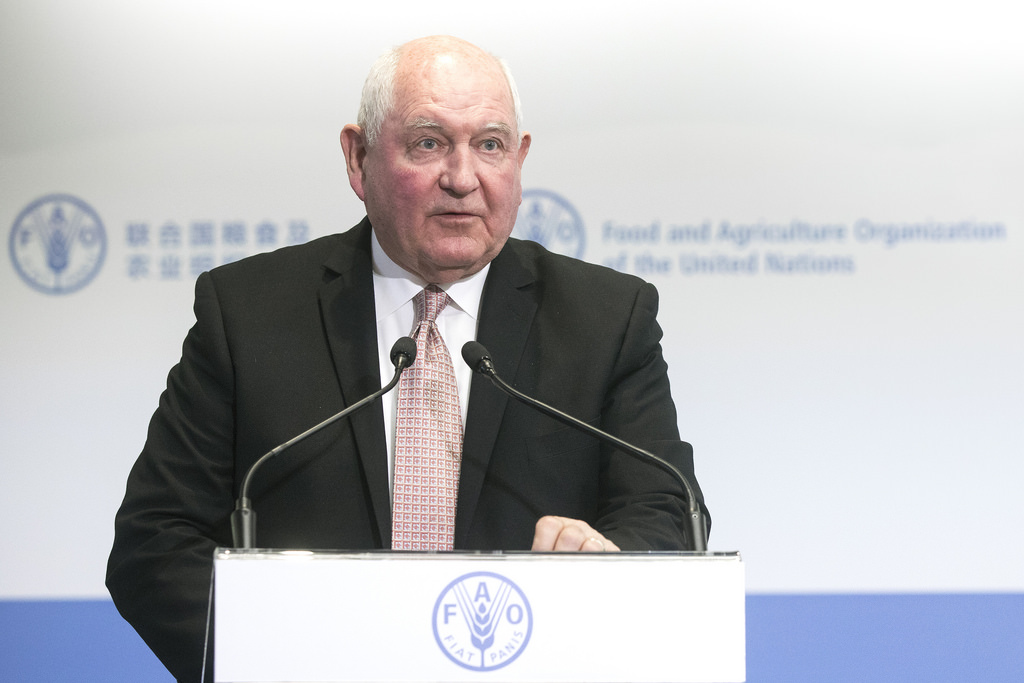
In the photo: Sonny Perdue, Secretary of Agriculture of the United States of America, delivering his speech during the World Food Day Ceremony, FAO Headquarters (Plenary hall). Photo credit: ©FAO/Alessandra Benedetti.

But the biggest surprise came from the American Secretary of Agriculture, Sonny Perdue, who indicated that the “US is firmly committed” to fighting hunger and supporting food security, expanding food supplies and bettering lives, and “working closely” with developing countries. He noted approvingly that FAO’s work is “critical” to combat malnutrition and the US stands ready to work together with FAO and the UN system.

After America’s abrupt withdrawal from UNESCO announced by the Trump Administration last week, this was remarkable, a totally different message coming from the US. Let us hope that it wasn’t a blip or a mistake and that America really means what it says.


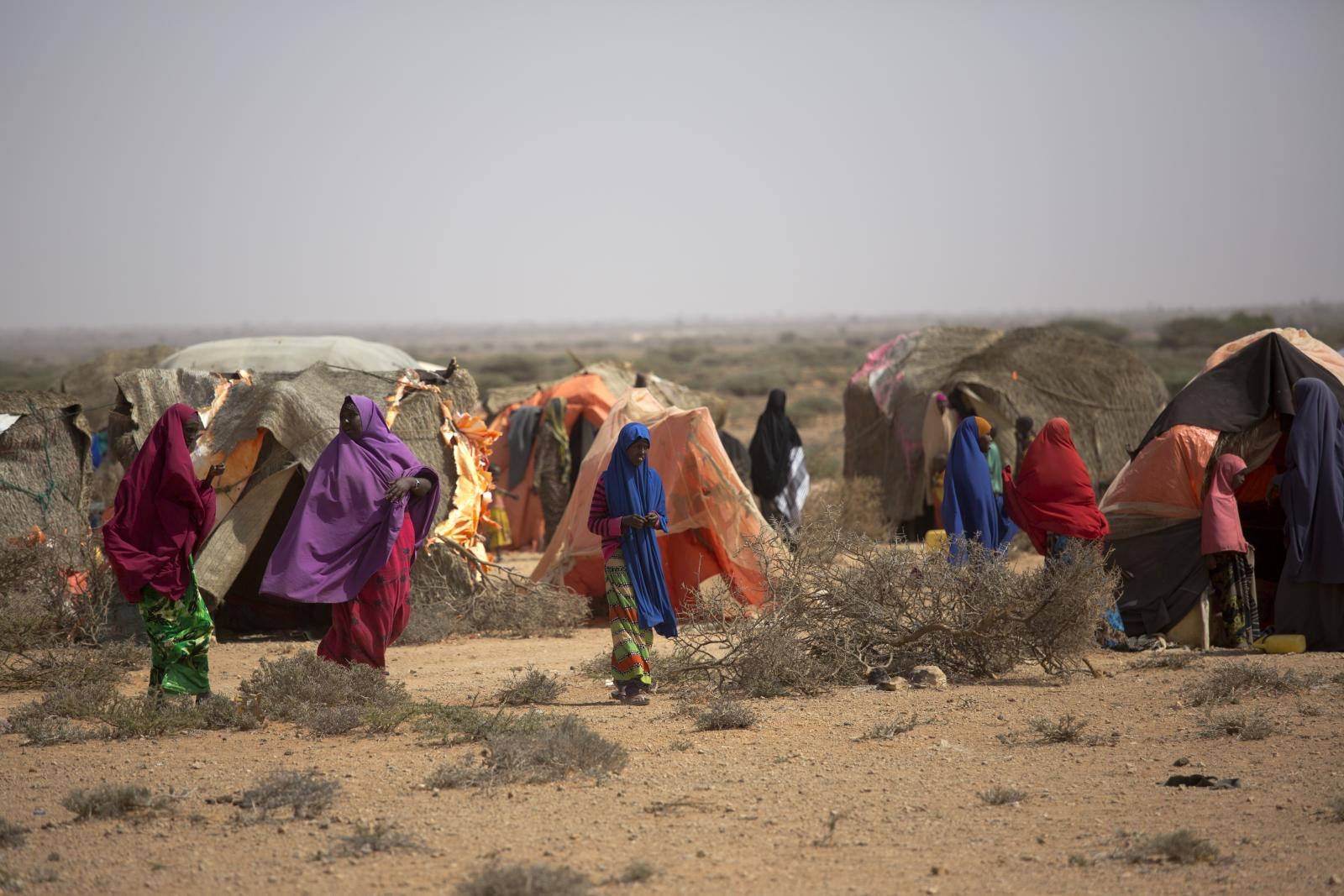
Cover Image: Temporary huts at a camp for internally displaced people.Women walk in a camp for internally displaced people in Uusgure village, Puntland, Somalia. The IDP’s in Uusgure village are pastorals who moved there after they lost their livelihood due to the current drought. They lost almost all their livestock, camels and goats, on which they depend on to survive. Photo: ©FAO/Karel Prinsloo


Tags: Climate ChangeconflictsFood securityMigrationPope Francisrural developmentWorld Food Day
Previous Post

Exposing Corruption: the Heart of Sustainable Development

Next Post

The Mekong Agricultural Maize

Related Posts

ESG news regarding Deforestation Mandate Being Pushed; EUs Acceleration on Hydrogen and Net Zero Revolution; AT&T Will End All DEI; UK Watchdog Blocks Nike and Lacoste Ads Over Green Claims.
Business

U-Turn in Europe: Deforestation Mandate Pushed Back Again

Today’s ESG Updates EU Lawmakers Agree to Delay Deforestation Rules: The EU has delayed and simplified its Deforestation Regulation until...

byEge Can Alparslan
December 5, 2025
ESG News regarding Flooding in Indonesia; Glencore promises copper production boost; Trump proposes slashing fuel efficiency standards, and Vulcan Energy receives $2.57bn of funding for lithium project
Business

Indonesians Blame Deforestation for Recent Floodings

Today’s ESG Updates: More than 700 Lives Lost in Recent Indonesian Floods: A combination of mass deforestation and heavy rainfall...

byAriq Haidar
December 4, 2025
How a Framework Convention Could Address Climate and Socio-Economic Displacement
Politics & Foreign Affairs

How a Framework Convention Could Address Climate and Socio-Economic Displacement

The unprecedented shift in human (im)mobility has seen over 120 million forced to flee their homes due to war, violence,...

byDr. Shepherd Mutsvara - Research Fellow at the University of Münster, Germany
December 3, 2025
Transboundary Animal Diseases Pose Urgent Threat to Global Food Security
Biodiversity

Transboundary Animal Diseases Pose Urgent Threat to Global Food Security

The Director-General of the Food and Agriculture Organization of the United Nations (FAO), QU Dongyu, urged Member Countries to reinforce...

byThe Food and Agriculture Organization of the United Nations (FAO)
December 1, 2025
fossil fuel subsidies
Business

How G20 Nations Can Make Progress After the Group Stalls on Fossil Fuel Subsidy Reform

The 2025 G20 Leaders’ Summit in South Africa sent mixed signals on climate action. In this year’s Leaders’ Declaration, climate change...

byInternational Institute for Sustainable Development (IISD)
November 28, 2025
Animal Health
Biodiversity

Better Animal Health Is the Low-Risk, High-Reward Climate Investment We Need

Imagine if there was a way to reduce emissions from the meat, egg and dairy sector by nearly a quarter,...

byCarel du Marchie Sarvaas
November 26, 2025
ESG news covering the EU’s delay of deforestation rules, rising U.S. housing risks from climate impacts, IFC’s $100M clean-energy investment in emerging markets, and ABN AMRO’s appointment of a new Chief Sustainability Officer.
Business

EU Delays Deforestation Regulation Again

Today’s ESG Updates EU Delays Deforestation Law: Europe postpones the EUDR by one year and loosens compliance rules, raising concerns...

byEge Can Alparslan
November 21, 2025
COP30: Countries’ Climate Agrifood Ambitions Undermined by Funding Gaps, Report Finds
Biodiversity

COP30: Countries’ Climate Agrifood Ambitions Undermined by Funding Gaps, Report Finds

Developing countries recognize the urgent need to adapt agrifood systems to climate change, but most National Adaptation Plans (NAPs) are...

byThe Food and Agriculture Organization of the United Nations (FAO)
November 19, 2025
Next Post

The Mekong Agricultural Maize

Please login to join discussion

Recent News

PRA cuts 37 reporting templates for UK banks; EU Lawmakers Agree to Slash Sustainability Reporting and Due Diligence Requirements; Projects in fast paced sectors could receive exemptions from environmental impact assessments.

Ease of Reporting Standards for UK Banks

December 12, 2025
Discovery of a carbon sponge under the ocean; HSBC survey shines positive acceptance of climate transition; New catalyst for clean hydrogen production; Google signs deal with Ebb for carbon removal.

Cores of lava breccia cemented with calcium carbonate

December 12, 2025
WordPress Hosting - How to do it right.

5 Best Budget WordPress Hosting Providers That Punch Above Their Price

December 11, 2025
  • ESG News
  • Sustainable Finance
  • Business

© 2025 Impakter.com owned by Klimado GmbH

No Result
View All Result
  • Environment
    • Biodiversity
    • Climate Change
    • Circular Economy
    • Energy
  • FINANCE
    • ESG News
    • Sustainable Finance
    • Business
  • TECH
    • Start-up
    • AI & Machine Learning
    • Green Tech
  • Industry News
    • Entertainment
    • Food and Agriculture
    • Health
    • Politics & Foreign Affairs
    • Philanthropy
    • Science
    • Sport
  • Editorial Series
    • SDGs Series
    • Shape Your Future
    • Sustainable Cities
      • Copenhagen
      • San Francisco
      • Seattle
      • Sydney
  • About us
    • Company
    • Team
    • Global Leaders
    • Partners
    • Write for Impakter
    • Contact Us
    • Privacy Policy

© 2025 Impakter.com owned by Klimado GmbH