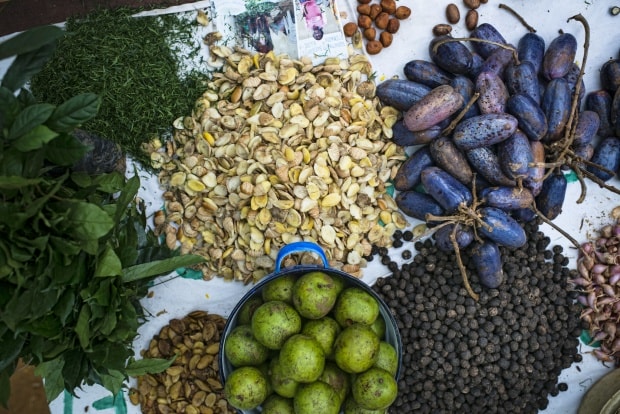

Do you ever think about the environmental impact of the food you eat?

The recently concluded 5th Global Science Conference on Climate-Smart Agriculture was not a usual science conference. Besides participatory activities such as a networking competition and a quiz on the conference app, we made our lunches a little unconventional too.
Related topics: Increasing Diet Diversity in Low-Income Communities – In Defense of Cows – Food Waste and All the Symptoms of Unsustainable Food System
By providing lunch menus that shifted from a traditional conference buffet through a healthy, sustainable reference diet to a vegan diet (with meat substitutes), we inspired participants to explore ways to transform food systems under climate change. In addition, we also measured the participants’ total food waste during the conference.
Learning about the carbon footprint of our lunches
Wageningen University and Research (WUR), the Climate Food and Farming Global Research Alliance Development Scholarships (CLIFF-GRADS) research fellows, the CGIAR Research Program on Climate Change, Agriculture and Food Security (CCAFS), and the Ayana Resort restaurant worked together to present the conference participants with climate-smart lunches.
CLIFF-GRADS students used a new calculator developed at WUR to estimate the carbon footprint of the food served at the conference. They combined specific data from the hotel regarding the ingredients used, the sources of those ingredients and the food preparation techniques, together with global data sets regarding food production, food loss, and food waste.
From these estimated emissions, WUR students concluded, for example, that the greenhouse gas emissions per serving Rendang, an Indonesian spicy beef dish, could be ten times larger than a serving Rendang with ‘alternative’ meat. They also concluded that, besides the ingredients, the transportation distance of the ingredients also had significant effects on the total greenhouse gas emission estimation.
.@global_csa unusual conference indeed! We are measuring the #climateimpact of our lunch! Keep it locked for updates. #transformfoodsystems #CSA#food #foodie pic.twitter.com/Z6mkC6oQim
— Catherine Mungai (@catmungai) October 10, 2019
Measuring food loss
After each lunch, the students measured the food waste produced by the conference participants. On the first day, they concluded that about 60% of the food prepared was consumed and 40% was wasted. From the waste, only 3% was leftover from plates and 37% was surplus food. The results encouraged the kitchen team to rethink the amount of food they prepared, and they decreased it the next day.
Pictures from the food waste measurements:

To put the total food waste-related emission of the conference in perspective, Jan Broeze, CCAFS food loss and waste project leader, who coordinated both the meal and food waste emissions calculations, showed that the food waste-related emissions (550 kg CO2 eq.) was more than three times as much as all the hotel shuttle rides during the conference (171 kg CO2 eq.).
This indicates that changing our diets could be one key strategy to reduce global emissions. In his presentation at the closing session of the conference, Jan Broeze reflected on the results: “These calculations support our hypothesis that consumer behavior is key so we all should think about our dietary choices.”
Presentation by Jan Broeze about the experiment results:
https://www.slideshare.net/cgiarclimate/climatesmart-lunches-conclusions-on-food-waste-and-associated-ghg-emissions-at-the-5th-global-csa-conference
Reflections by the chef
These measurements were also shared with the kitchen staff, including the hotel’s chef. Based on this experiment, he said that next time he might pay more attention to the volume of food waste and might suggest to other conference organizers to reduce the amount of food if there is significant waste.
The chef was also quite interested in how participants would react to meat alternatives and said that if it turns out to be successful, he might try it again in the future. We were glad to report back that the majority of the conference participants voted for the vegan lunch as their favorite.
We want to walk the talk when it comes to #ChangingDiets. Each day of the @global_csa conference we reduced the amount of meat in the lunches served, removing red meat first for Day 2, and ending with a totally vegan lunch on Day 3. And this is how participants felt: pic.twitter.com/S7pyEXOHd1
— CSA Global Science Conference 2019 (@global_csa) October 10, 2019
This experiment has shown that it can be quite easy to reduce our ‘food footprint’ by making changes in our diets and reducing our food waste; it illustrates the importance of our diet choices for transforming food systems under climate change.
Funding for CLIFF-GRADS research in food loss and waste is supported by USAID.
We thank Jan Broeze, CCAFS food loss and waste project leader and the CLIFF-GRADS students who participated in the activities: Daniele Eckert Matzembacher (Brazil), Li Xue (China), Tabitha Nindi (USA), Xia Liang (China) and Norah Titiya Machinjiri (Ethiopia).
About the author: Lili Szilagyi is the Communications Consultant for the CCAFS Flagship on Low Emissions Development.
EDITOR’S NOTE: The opinions expressed here by Impakter.com columnists are their own, not those of Impakter.com. Photo Credit: O. Girard (CIFOR)