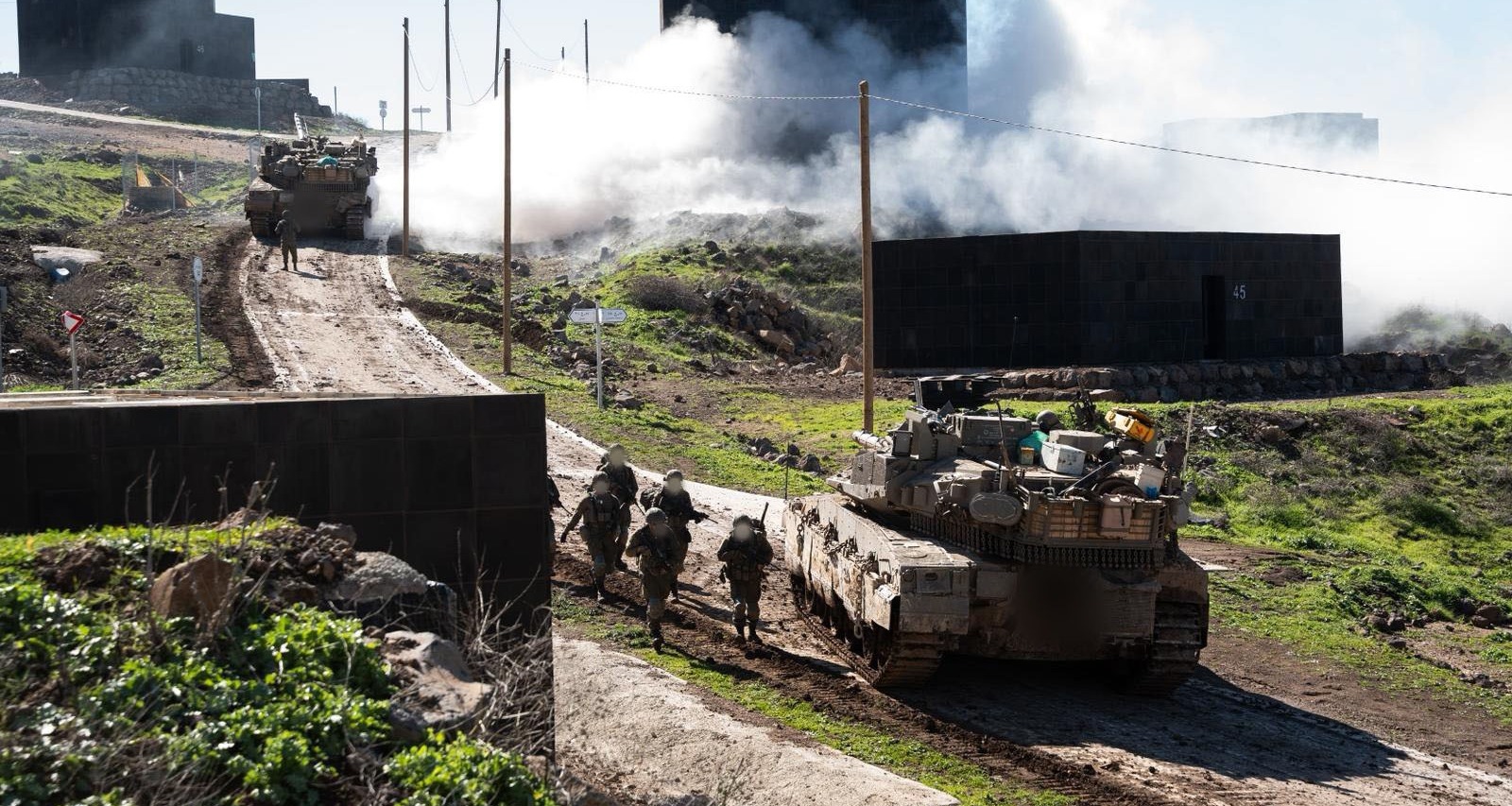
The undulating hills of southern Lebanon — once defined by villages nestled among citrus orchards and ancient olive groves — have been transformed into a landscape of white rubble and scorched earth.
On April 19, 2026, the Israeli military outlined the parameters of an “advanced security zone” to be imposed prior to any permanent cease-fire. The plan effectively bars residents from returning to a 602-square-kilometer area — roughly 5.8% of Lebanon’s territory — encompassing 62 towns and villages.
View this post on Instagram
By May 3, a New York Times investigation utilized satellite imagery to confirm the scope of this erasure. At least two dozen border towns have been virtually removed from the map.
Civilian infrastructure — homes, schools, mosques, irrigation systems, and even solar panels — has been systematically dismantled. While the Israeli Defense Forces (IDF) frame this as a tactical necessity, the methodology — publicly dubbed the “Gaza model” by Defense Minister Israel Katz — suggests a much more permanent and ambitious objective.
The Anatomy of the Gaza Model
In military terms, the “Gaza model” is synonymous with the total leveling of civilian infrastructure to create a “no-go” zone. However, legal and human rights experts describe these actions in far more reaching terms. Francesca Albanese, the UN Special Rapporteur, characterizes this as “eliminatory settler-colonialism.”
By destroying the “conditions of life,” the military is accused of committing domicide (the deliberate destruction of the home) and ecocide (the destruction of the natural environment). This conflict, which escalated significantly in early 2026, has now reached a critical phase.
Despite a purported cease-fire framework involving the Trump administration and Iran, the section concerning Southern Lebanon remains unobserved by Israel. Fighting has already been reported north of the Litani River (on May 4), signaling a conflict that is expanding rather than contracting.
The Human and Economic Cost
The numbers associated with this “scorched earth” policy are staggering. As of mid-April 2026, the Lebanese Ministry of Public Health reported at least 2,124 fatalities, including hundreds of children and women, alongside the deaths of four UNIFIL peacekeepers. Over 1.2 million people are displaced, including 350,000 children.
The economic erasure has been amply documented:
- Destruction of Farmland: Over 540 hectares of Lebanese farmland became unusable because the Israeli military bulldozed the land and applied herbicides like glyphosate.
- Infrastructure Isolation: The destruction of the Qasmiyeh Bridge and other crossings over the Litani River effectively cut off southern Lebanon from the rest of the country.
- Permanent displacement: Israeli Defense Minister Katz stated that 600,000 residents will be forbidden from returning until “security is guaranteed” — a condition with no defined expiration date.
The humanitarian response remains woefully underfunded: A UN “Flash Appeal” called for 308.3 million intended to assist up to 1 million people for three months (March to May 2026), but as of 14 April, only 22% had been funded ($67 million).
Sectarian Engineering and “Racist Violence”
Satellite analysis, as shown in the New York Times article, reveals that this destruction is not random; it is concentrated on the very “vitals” of society: the civilian physical structures and spaces for economic, political, artistic, and religious life.
Most chilling is the sectarian selectivity of the bombardment. In a region defined by religious diversity, the “Gaza model” is being applied with surgical precision. Imagery of majority-Shiite villages like Aita al-Shaab and Hanine shows total erasure — pulverized concrete as far as the lens can see.
In contrast, nearby predominantly Christian villages like Rmeish remain largely intact. Ground reports suggest a “Faustian bargain” offered by the IDF: certain Christian and Druze communities may remain, provided they facilitate the expulsion of their Shiite neighbors.
This is not merely military strategy; it is sectarian engineering. As Sari Hanafi, a professor of sociology at the American University of Beirut, observes, this is “spatio-cide” — the rendering of civilian space unusable for a specific identity group. It is the modern iteration of a founding myth: acquiring the most land with the fewest people.
The “Poisoned Chalice” of Collaboration
Thus far, this “divide and conquer” tactic has failed to fracture the Lebanese national fabric. Rather than turning on their neighbors, many communities have opened their doors to displaced Shiites. Local leaders and the Maronite Patriarchate have characterized the Israeli offer as a “poisoned chalice” — a reference to the late Prime Minister Rafiq Hariri’s famous 1998 response in a similar circumstance to Israel when it offered to withdraw on condition that the Lebanese army act as a security buffer, effectively turning it into a version of the South Lebanon Army (SLA).
The memory of the South Lebanon Army (SLA) remains a potent deterrent. The local population has not forgotten May 2000, when Israel abruptly withdrew and left its SLA collaborators to face trial for treason or permanent exile. For the residents of the south, the lesson is clear: those who join the occupier’s “security buffer” are eventually exiled.
The Geopolitical Fog: Trump and Iran
This campaign is unfolding under the cover of a massive regional distraction: Trump’s war on Iran. Operation Epic Fury has created a “geopolitical fog” that shields Israeli actions in Lebanon from global scrutiny.
As the international community remains transfixed by the brinkmanship in the Strait of Hormuz and Iran’s threats on its Arab neighbors, a media silence has shrouded Southern Lebanon. The Iran war is not a secondary theater; it has created a “black hole” that allows the “Gaza model” to thrive without intervention from the UN or the EU.
The duration and depth of this occupation in Southern Lebanon now appear to depend entirely on the internal momentum of Israeli politics.
Related Articles
Here is a list of articles selected by our Editorial Board that have gained significant interest from the public:
The Blueprint for “Greater Israel”
What began as a “temporary buffer zone” has been reclaimed by an increasingly mainstream Israeli movement as the “Northern Galilee” — the next frontier of a Greater Israel. This is no longer a fringe messianic fantasy but a state-backed project spearheaded by organizations like Uri Tzafon (“Awaken, O North”), operating on the triad of “Occupation, expulsion, settlement.”
By the spring of 2026, the political landscape has shifted decisively:
- Public Support: A widely-cited poll reported by Maya Rosen (Jewish Currents) indicates that 62% of the Israeli public supports the permanent occupation of territory south of the Litani River.
- Political Capture: In early April 2026, a coalition of 18 Knesset members (from Likud, Otzma Yehudit, and Religious Zionism) petitioned the security cabinet for the full displacement of the Lebanese population (“evacuation of locals”) to make way for Jewish settlement.
- The Syrian Front: This logic extends to the Pioneers of Bashan, a group crossing into southwest Syria to lay foundation stones for new outposts. Simultaneously, the Israeli government approved a $334 million plan to transfer thousands of civilians into the occupied Syrian Golan Heights — a move Human Rights Watch describes as a “clear statement of intent to commit war crimes.”
The foot soldiers of this movement are ideological settlers who have spent decades perfecting the architecture of occupation in the West Bank. They are prepared to cross the border into Lebanon not as soldiers, but as colonists. For them, the destruction of Shiite villages is the “clearing of ground” for a theological empire.
Can Extremists Redraw the Map?
If the Israeli military permanently holds and colonizes the 6% to 10% of Lebanon it has seized, it will represent the successful realization of a settler-colonial project that views the destruction of its neighbors as a prerequisite for expansion.
However, the final map is not yet drawn. Lebanon’s identity as a state is under existential threat, and history suggests that such threats often produce a resilience that military strength alone cannot break. As seen in Vietnam and Ukraine, when a country’s core identity is at stake, the result is rarely a clean victory for the invader — no matter how complete the initial destruction appears on a satellite map.
Editor’s Note: The opinions expressed here by the authors are their own, not those of impakter.com — In the Cover Photo: IDF 162nd Division on the Israeli–Lebanese border, March 21, 2026. Cover Photo Credit: Wikimedia Commons.