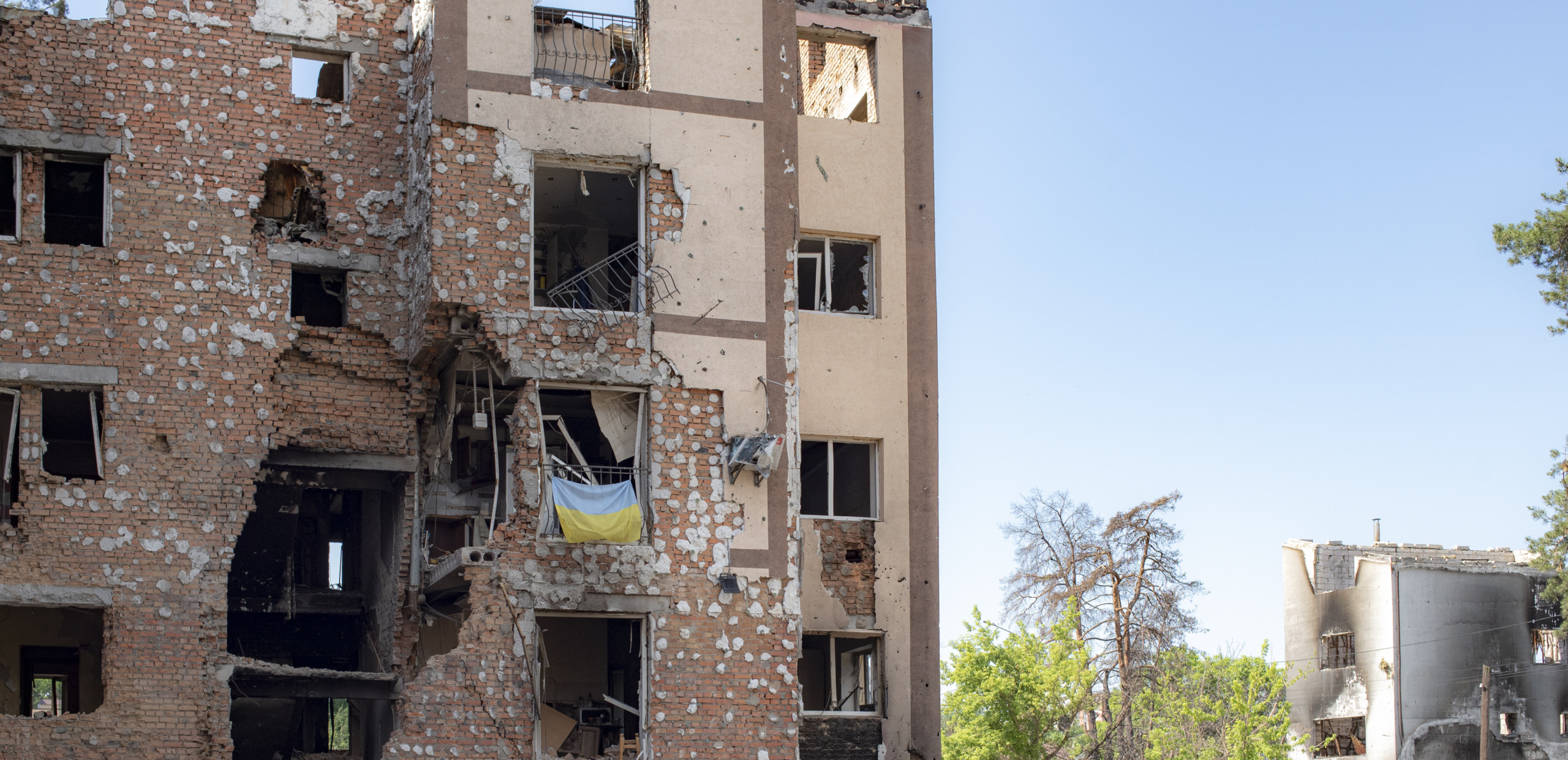
One year after Russia’s full-scale invasion of Ukraine, the country’s infrastructure has sustained extensive damage. Thousands of schools and health care facilities have been destroyed, the energy infrastructure has suffered severe harm, and the total value of infrastructure loss reached an estimated USD 138 billion as of December 2022. In September 2022, the World Bank estimated the cost of reconstruction and recovery at a minimum of USD 349 billion — a number that is slated to rise as the war continues.
The total value of infrastructure loss has reached an estimated USD 138 billion.
— Kyiv School of Economics, December 2022.
While no large reconstruction projects are planned until the end of the war, planning for recovery has already begun. To ensure that this recovery is sustainable, many stakeholders are now starting to underscore the importance of foregrounding gender equality and women’s empowerment in these efforts. This means recognizing that the damage caused by war is impacting women and girls differently than men and boys, and it means acknowledging and reflecting their differing needs and priorities from the outset of reconstruction planning and implementation.
The Gendered Impacts of War and Infrastructure Loss
Research to date across different international settings shows that in conflict and post-conflict situations, women often make up the majority of the population. They are also frequently the primary earners and caretakers for their families. In Ukraine, several reports have already confirmed the strain of the ongoing war on women, many of whom are having to care for children, the elderly, and other family members with disabilities or reduced mobility. This effort is further complicated by the difficulty they face in accessing food, water, drugs, diapers, formula, and other hygiene items.
The double burden of care work is real: with the destruction and closing of infrastructure such as health care facilities, schools, childcare, and eldercare centres, women’s care burden is increasing. Simultaneously, women are also facing growing unemployment, especially in occupations often dominated by women, such as nursing and teaching. The lack of access to stable electricity supplies also has gendered implications, including having a severe impact on household activities, thus further increasing the strain of care work on women.
Women face the additional risk to their safety and the threat of gender-based violence to access those items necessary for their household’s survival or for trying to secure earnings to afford them. This comes in addition to women’s active role as agents of resistance in a conflict, where they may be participating directly in the defense of their country through military operations. Women may also be taking part indirectly by providing support to military forces, engaging in humanitarian assistance, or fundraising for aid.
Of the 5.4 million internally displaced persons from the war in Ukraine, 55% were women and girls.
— International Organization for Migration, January 2023.
As of January 2023, the International Organization for Migration (IOM) estimated that of the 5.4 million internally displaced persons (IDPs) from the war in Ukraine, 55% were women and girls. The biggest group of IDPs were adult women aged 19 to 59, representing one third of all IDPs. In the same IOM displacement report, 47% of IDP respondents indicated that they were caring for a child, 41% indicated that they were caring for an older person, and 36% indicated that they were caring for a chronically ill person. Additionally, IDP women and girls are known to be at a greater risk of suffering sexual and gender-based violence including trafficking, sexual exploitation and abuse, sexual assault, and domestic violence, due to their displacement and socio-economic status.
Involving Women at All Levels of Reconstruction
The use of infrastructure is also gendered. As stated above, women and girls of different socio-economic groups will likely have varying security needs and livelihood priorities. They will also use infrastructure in different ways depending on their own economic priorities, mobility, and social roles. Their infrastructure needs will further be contingent on their involvement in peacebuilding and security efforts both during and after the war.
The infrastructure life cycle must adopt gender-responsive decision making.
These infrastructure needs will also vary within these groups. Such needs will change, for instance, as a result of a person’s sociocultural background, age, economic class, sexuality, education, and disability, to name a few factors. Sustainable reconstruction should therefore be based on thorough gender-based analyses of the needs, priorities, and knowledge of different gender and age groups. These analyses must also consider women’s capacity and desire to take action for themselves as they enact a vision for an inclusive post-war society in Ukraine.
For gender considerations to be integrated into all aspects of project design, appraisal, and budgeting in the reconstruction efforts, the different stages of the infrastructure life cycle must adopt gender-responsive decision making. This requires recognizing that men often dominate decision-making processes when it comes to infrastructure and construction. The many stakeholders involved in reconstruction need to ensure women’s participation in decision making at all levels, from the subnational to the international, so that their needs and priorities are represented and reflected appropriately in each instance.
Related Articles: Ukraine Reconstruction: IMF To Give Support | What Are the GDP and Innovation Costs of Excluding Women From the Digital World?
Reconstruction will mobilize different sectors, some of which are also historically male-dominated, such as the energy sector or the construction sector. For instance, estimates indicate that women only account for 9% of the construction workforce worldwide and approximately 27% of the energy workforce in Ukraine.
Women only account for 9% of the construction workforce worldwide and approximately 27% of the energy workforce in Ukraine.
Involving women at all levels and in all economic sectors that will be implicated in the reconstruction effort means considering them as an active part of the labour force. For example, ensuring favourable working conditions and environments will be essential so that women can benefit from employment in the planning, construction, and operation of new energy infrastructure. Specific skills-building programs, on-the-job training, or projects targeting the recruitment of women from communities where energy and other infrastructure projects will be developed could have a transformative impact, helping break down some of the barriers preventing women’s access to employment.
Involving women at all levels and in all economic sectors that will be implicated in the reconstruction effort means considering them as an active part of the labour force.
Procurement is another key area that fosters socio-economic benefits for women and men. Equality and inclusion criteria can support more inclusive procurement systems and practices that can contribute to gender equality. Likewise, decision-makers can rethink procurement processes to include, in a meaningful way, Ukrainian women business owners, suppliers, and contractors in recovery plans. This is important to help ensure that women are given equal opportunity to access and benefit from the procurement of those goods and services needed for the country’s economic recovery.
Sustainable Reconstruction as a Driver for Equality
Equal access to and use of infrastructure in the short and long terms rely on taking into account several key factors. These include the different livelihoods of women and men, their differing mobility and use of infrastructure, and the environmental and social impacts of infrastructure projects on varying social groups.
Given that a large proportion of women spend more time managing a household’s well-being, they will likely have specific views on household needs. This could include the design and placement of the home as well as concerns over affordability, accessibility, and physical safety. Women might also prioritize access to safe transportation, affordable energy, quality childcare, and health facilities and schools, which can lead to greater socio-economic opportunities for the household.
For Ukraine’s reconstruction, it is therefore crucial that decision-makers factor in the needs of different groups of women, such as women-headed households, women IDPs, and women with disabilities. Doing so will ensure that decision-makers can develop a complete portrait of the variety of ways reconstruction can support women’s safety and livelihoods. Examples of how decision-makers might incorporate these considerations include designing accessible public transportation for people with disabilities or setting up appropriate education facilities and livelihood programmes for IDP women and girls during their return, resettlement, and reintegration.
It is therefore crucial that decision-makers factor in the needs of different groups of women.
These are all indications of what could be prioritized based on existing guidance, case studies, and previous recovery and reconstruction programs from other contexts. Only Ukrainian women and girls can determine what is of greatest priority to them in the reconstruction effort, what measures and projects would respond best to their most urgent needs, and where they see the most opportunity for active participation and transformation.
Conclusion
To ensure that post-war reconstruction is truly sustainable, it must consider and address the needs of all Ukrainians, with specific attention to those disproportionately affected by the war. This means incorporating the gendered dimensions of recovery and reconstruction in relevant frameworks, programs, projects, and funding platforms that are developed or revised, and for this to take place across all sectors concerned.
This is the only way reconstruction can be sustainable, just, and equitable. It also has the potential to become a driver for greater inclusion and equality for all Ukrainians in post-war recovery.
— —
This article was originally published by the International Institute for Sustainable Development (IISD), and is republished here as part of an editorial collaboration with IISD.
Editor’s Note: The opinions expressed here by the authors are their own, not those of Impakter.com — In the Featured Photo: Lypky is an area in Irpeni, Kyiv that was destroyed by the Russian invasion of Ukraine. Featured Photo Credit: © European Union/Ramin Mazur.