
A new working paper offers a chance to understand challenges and lessons learned in project implementation over the past five years.

Key challenges and opportunities to create impact are revealed through interviews with project leads around the world from the CGIAR Research Program on Climate Change, Agriculture and Food Security’s Flagship (CCAFS) Flagship on Climate Services and Safety Nets. Challenges of climate services (CS) projects include the tension of conducting agricultural research for development that builds knowledge while impacting livelihoods, the breadth of metrics that can be used to measure the impact of CS, and the lack of evaluations quantifying how CS impact livelihoods in different agricultural systems. Lessons learned include adopting an adaptative management approach, conducting context-establishing activities early in project implementation and communicating the uncertainty of forecasts to end-users.
CLIMATE SERVICES 101

Climate services (CS) in an agricultural context encompass agro-advisories and weather services and involve the generation, translation and communication of legitimate and relevant climate information to next-users use in decision-making. CS are intended to aid farmers in their decision-making, helping to manage climate risk in ‘bad’ years and capitalize on opportunities in ‘good’ years. CS projects experience challenges in implementation that range across the value chain, from generation and translation to transfer and communication.
The CCAFS Flagship on Climate Services and Safety Nets incorporates this work and provides the basis of this analysis. Thirteen project leads from the Flagship were interviewed for their experiences around implementing CS projects in Latin America, South and Southeast Asia, and Africa. Interviewees identified several challenges and lessons learned and three of each are summarized below.
CHALLENGES OF IMPLEMENTING CLIMATE SERVICES
A theme that recurred in many interviews was the idea that conventional methods of measuring the impact of climate services may overlook some of the impacts outside of the scope of project monitoring. Impact is often measured as the number of end-users reached with climate information. Although reach is useful as an estimate of potential impact, there are several other ways that impact can be experienced by end-users. For example, a project lead in South Asia identified school attendance by farmers’ children and diversification of farmer incomes as outcomes of a climate services project.
Another often-cited problem with climate services is the lack of evaluations assessing how climate forecasts impact farmers’ production and livelihoods. This is generally applicable to all regions and crop systems. Evaluations tend to be based on simulations of crop yield and ex-post interviews with farmers, as opposed to studies that monitor farmers’ use of forecasts throughout the season to establish impact.
This may be due to the cost and time associated with such granular monitoring and evaluation. An effort towards incorporating evaluations into project design would allow for a more nuanced understanding of the value of climate information and also contribute to the literature on climate services.
Related Articles: Social Farming for Sustainable Development | Sustainable Agriculture in an Age of Commercial Farming | Bringing Climate Action to Farming Communities
A third challenge is that of agricultural research-for-development (AR4D). AR4D aims to use scientific research to improve the livelihoods, resilience and food security of small-scale farmers. The tension between contributing to development outcomes and simultaneously building knowledge is an obstacle that project leads must negotiate in climate services projects.
There is a balance to be had in advancing forecasting methods and co-production approaches with on-the-ground impacts experienced by end-users. One CCAFS project lead suggested that scientists in AR4D must accept that development is a far less linear process than typical scientific research and that it requires a flexible approach. Development impacts are often slow to materialize, particularly considering the millions of farmers and countless organizations involved.
LESSONS LEARNED THROUGH IMPLEMENTATION
Adaptive management is the “intentional approach to making decisions and adjustments in response to new information and changes in context” according to USAID. The path used to achieve impact is where adjustments should be made when new information comes to light. Given the challenges around implementing impactful climate services, project leads are encouraged to adopt an adaptive management approach. Leads have to manage evolving contexts, theories of change and goals of project partners. At times, this requires adjusting or redesigning project proposals and activities. Flexibility on the part of project leaders is essential as projects progress, partners join or leave, and budgets change.
One particular lesson learned in climate services projects is to establish the context in which end-users of forecasts operate. While it is time-consuming and resource-intensive, such an activity can determine the long-term impact of interventions. One project lead reported the process of context-setting as taking a year to complete, but that ultimately, it was invaluable to ensuring that the project produced impacts in the four different countries in which it was implemented. Context-setting ties in with the evaluation of interventions in that it is a key step in the process of understanding the value of climate services.
The third lesson concerns the inherent uncertainty of climate forecasts. Climate services involve communicating weather and climate forecasts to end-users; however, more attention needs to be paid to communicating the uncertain nature of forecasts and how this may influence climate-sensitive decisions. End-users should be aware of the limitations of forecasts in their decision-making. For example, seasonal forecasts are typically presented as probabilistic. This presents somewhat of an obstacle to end-users who must turn a chance of dry or wet conditions into agricultural management decisions. With a clear effort to engage end-users in improving their understanding of uncertainty in climate forecasts, climate services may be more impactful.
Five years of climate services implementation in Phase II of CCAFS allows for reflection on the challenges and opportunities for impactful projects. Increased efforts to assess climate information use amongst farmers offer a promising path to improving livelihoods that experience climate risk.
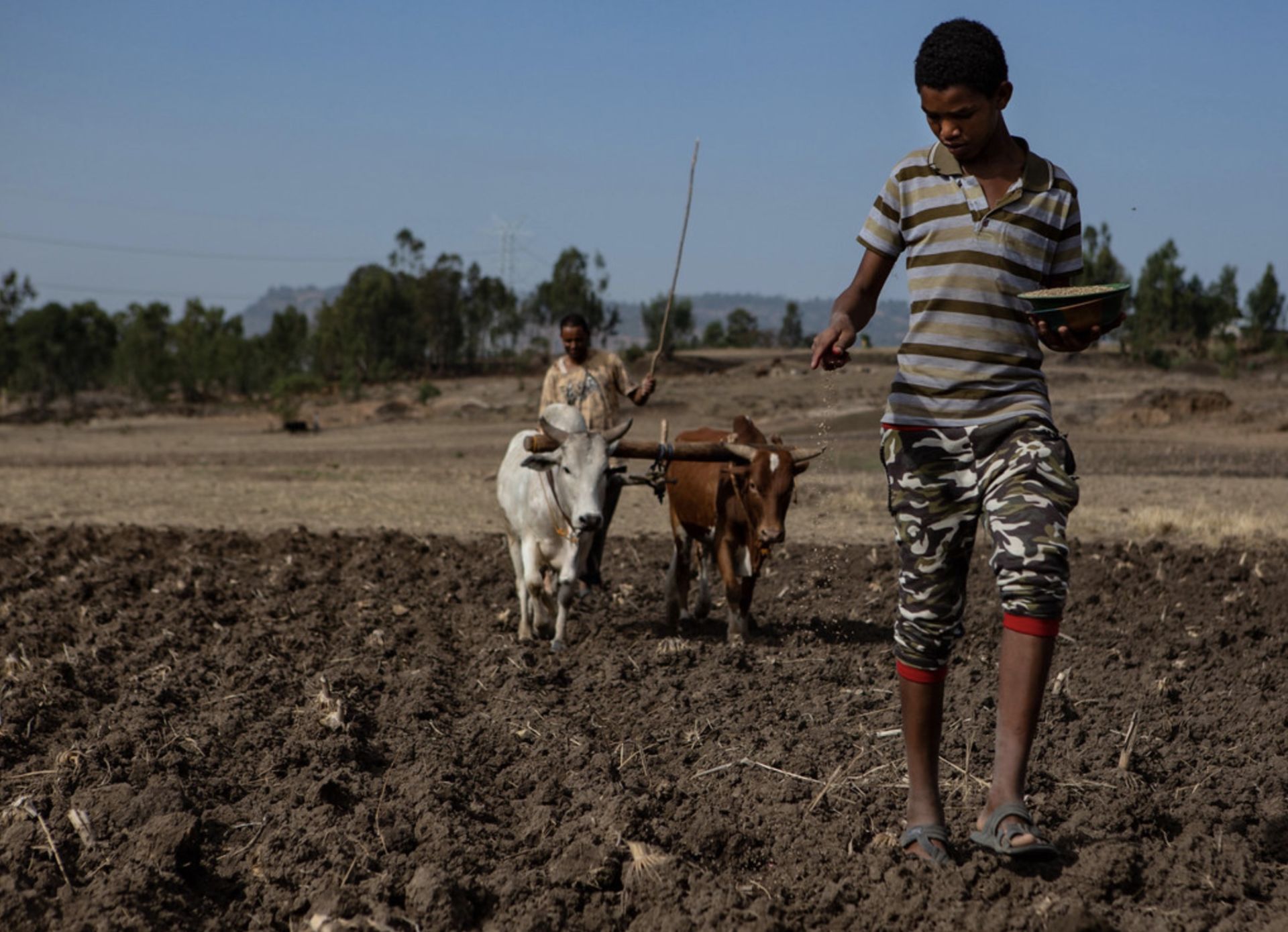
Editor’s Note: The opinions expressed here by Impakter.com columnists are their own, not those of Impakter.com. — In the Featured Photo: A boy sows the field before the plow, outside of Addis Ababa, Ethiopia. Featured Photo Credit: J. Turner (IRI Columbia University/CCAFS).