When Category 5 Hurricane Otis roared through Acapulco, Mexico, in October 2023, the city was left in ruins. Winds stripped facades from beachfront buildings and storm surge flooded lobbies. The storm killed at least 50 people and damaged 80% of hotels in the once-glittering resort town. Six months later, a Bloomberg reporter described “a grim scene,” with many buildings left abandoned and “swimming pools full of muck.”
And residents were still working to bring tourists back.
“If there’s no tourism, nothing happens,” Juan Carlos Díaz, a 59-year-old laborer, told an AP reporter. “It’s like a little chain, it generates (money) for everyone.”
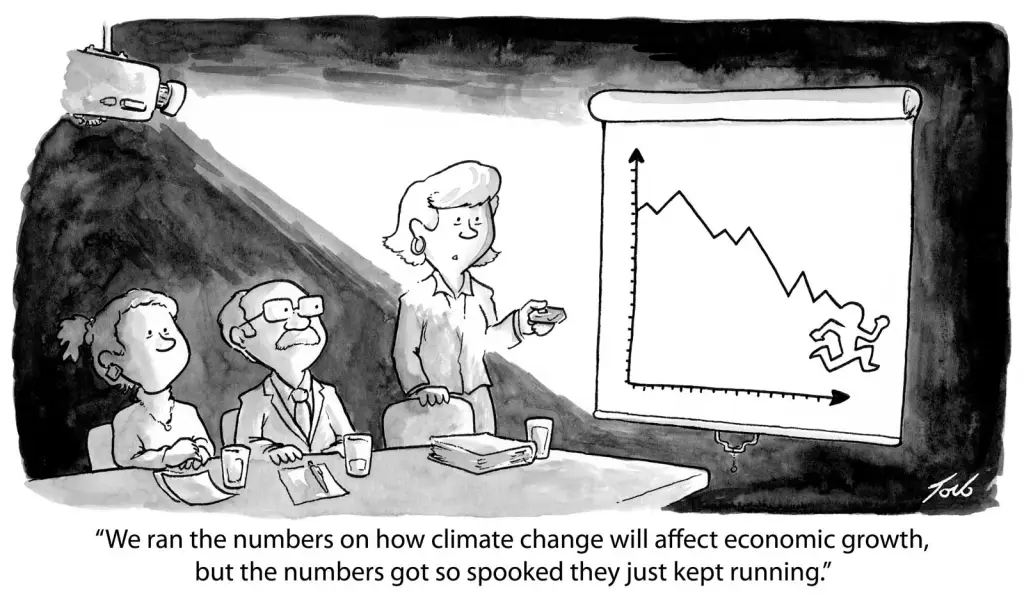
As the climate warms and the weather grows more extreme, similar events could unfold in placeas worldwide, with the potential to devastate — or at least drag — the economy. Economists agree that climate change will cause severe damages and costs, but teasing out exactly how and how much it’s likely to affect the world’s economic engines is a matter of fierce debate in the academic literature. For example, will an extreme weather event impose one-time costs from which governments can quickly rebound, or will it create a persistent drag on the economy? About three-quarters of climate economists think the latter scenario is likely.
The debate is crucial because the costs of slowed economic growth compound over time. For a large economy like that of the United States or the world, just slightly stunting economic growth can add up to tens or even hundreds of trillions of dollars in lost wealth by the end of the century — making climate solutions look like an absolute bargain.
An April 2024 study in the journal Nature led by Potsdam Institute climate economist Maximilian Kotz estimated that climate damage costs by 2050 will be six times larger than the cost of reducing carbon pollution consistent with world’s targets under the Paris climate agreement over the same time frame.
And climate economists risk underestimating the potential price of inaction because they can only account for the costs of extreme weather events and impacts for which data are available.
“Climate damages are always going to be underestimated,” said Columbia climate economist Gernot Wagner in a phone interview. “Some things we just can’t quantify. For most of those uncertain climate damages, we have precisely and incorrectly estimated their cost at zero.”
It’s also critical to remember that economic metrics like gross domestic product, or GDP, don’t account for important factors like the stress, trauma, and lost cultural and natural resources that climate change also costs us. The true costs of climate damages go well beyond simply estimating how much GDP will be lost.
How does climate change impact the economy?
The worsening extreme weather events that come with climate change could affect the economy in a few different ways.
Perhaps they will just cause one-time resource losses — like flooded cities or burned homes — from which economies can rebound through government spending. Or perhaps higher temperatures will push many countries — including the United States — into sub-optimally hot climates, permanently slowing their economic growth.
That’s a possible outcome suggested by this 2015 paper, which concludes that there may be a sweet spot for economic activity at an average annual temperature of around 13 degrees Celsius (55 degrees Fahrenheit). One reason is that high temperatures can reduce labor productivity. For example, a 2014 paper found that Americans work about an hour less on days that exceed 100°F compared to those around a more comfortable 80°F.
Related Articles: Connections That Matter: Climate Change and Gender Equality | How Climate Change Affects Health and How Countries Can Respond | The Climate Debate Has Turned Explosive: From Apocalypse Doom-sayers to Climate Fixers | Big Oil Testifies in Court for Decades-Long Climate Denialism | Is $100 Billion in Climate Finance Enough to Offset Climate Damage? | How Does Climate Change Affect Agriculture?
An increasing number of studies have considered something between these two possibilities — that changes in temperature and precipitation and other climatic factors have persistent but perhaps not permanent effects on economic growth.
There are a number of key underlying questions here. What types of changes in climate and weather impact economies and their growth? Will these damages largely be concentrated in more vulnerable hotter and poorer countries, or will wealthier countries with cooler climates also struggle to adapt to more extreme weather? And will these challenges only be a problem for outdoor industries, or could climate change also hamper the productivity of even indoor workers?
Climate change could affect every aspect of the economy
Many studies examining the question of whether climate change impacts economic growth only consider a single variable — like temperature — as the 2015 study did. But Kotz’s 2024 paper accounted for five variables related to regional temperature and precipitation changes, finding very large threats to the economy. Similarly, other studies have found that hurricanes and river floods and El Niño intensity can also cause significant harmful economic effects.
And though we might expect industries operating primarily in indoor air-conditioned facilities to be largely protected from climate change, some research suggests that may not be the case. For example, a 2012 study of American car assembly plants found that “within a week, six or more days with a high temperature of 90ºF or one additional day of heavy winds reduces that week’s production by approximately 8%, and six or more days of rain within a week reduces production relative to no rain by 6%.”
The study notes that bad weather could delay supply chain deliveries and influence workers’ moods and productivity. A 2021 study estimated that lost wages in the United States resulting from an increase in days exceeding 90°F could grow to tens of billions of dollars per year within a few decades.
Just how expansive and expensive will these climate damages be?
Estimates of the effects of these economic climate impacts vary greatly. A working paper led by the University of California at Davis and recent Council of Economic Advisers climate economist Frances Moore suggests that the persistence of climate damages and their impact on economic growth is one of the most important factors.
“It’s clear that any negative effects of higher temperatures on growth, compounded over long periods of time implied by climate change, add up to very large numbers and are essential to account for in any analysis of the benefits of climate policy,” Moore wrote via email.
Another 2021 study concluded that among all the different variables and considerations that go into climate economics modeling, the question of whether climate damages affect economic growth is far and away one of the most important. That paper estimated that on our current emissions path, world economic activity in 2100 will be around 30% lower if climate change slows economic growth than if it doesn’t.
But estimates of climate damages vary greatly even among studies that include their persistence and impact on economic growth. Some studies have estimated that bad climate scenarios could reduce global GDP on the order of 5-15% by 2100 and that carbon dioxide pollution causes damages known as the “social cost of carbon” — an estimate of the dollar costs of each ton of carbon pollution — of around $100-200 per ton. The new papers from Kotz’s team and also by Adrien Bilal and Diego Känzig, who also looked at 10-year climate damage persistence, find much higher costs. Their studies estimate that by just 2050, climate damages could amount to 10-20% of GDP, with a social cost of carbon exceeding $1,000 per ton.
One potential piece of good news is emerging, though: The harm of extreme events to the economy may not linger forever.
A 2022 paper by Moore and colleagues found temperature effects persisting on the economy for perhaps a bit more than 10 years. Kotz’s recent study similarly estimated that the economic impacts of changes in precipitation persist for about four years, and temperature effects for about eight to 10 years.
“This means that once we reach net-zero emissions, climate effects on economic growth rates would subside within a decade,” Kotz wrote via email.
As a result, his team’s study found that if the world meets the Paris targets of limiting global warming to less than 2°C (3.6°F), climate damages will stabilize in the second half of the century. Several other studies have found that meeting the Paris goals would yield the best outcomes for the global economy.
Bottom line: Many studies have found that preventing future climate change is far cheaper than trying to cope with its costly damages. But very few countries are doing enough to reduce their climate pollution in line with the Paris targets. So countries need to implement much more ambitious climate policies in order to achieve the best economic outcomes, let alone the outcomes that minimize other noneconomic losses, suffering, and trauma.
** **
This article by Yale Climate Connections is published here as part of the global journalism collaboration Covering Climate Now (CCN).
About the author: Dana Nuccitelli, research coordinator for the nonprofit Citizens’ Climate Lobby, is an environmental scientist, writer, and author of ‘Climatology versus Pseudoscience,’ published in 2015. He has published 10 peer-reviewed studies related to climate change and has been writing about the subject since 2010 for outlets including Skeptical Science and The Guardian.
Editor’s Note: The opinions expressed here by Impakter.com columnists are their own, not those of Impakter.com — Cover Photo Credit: Tom Toro.