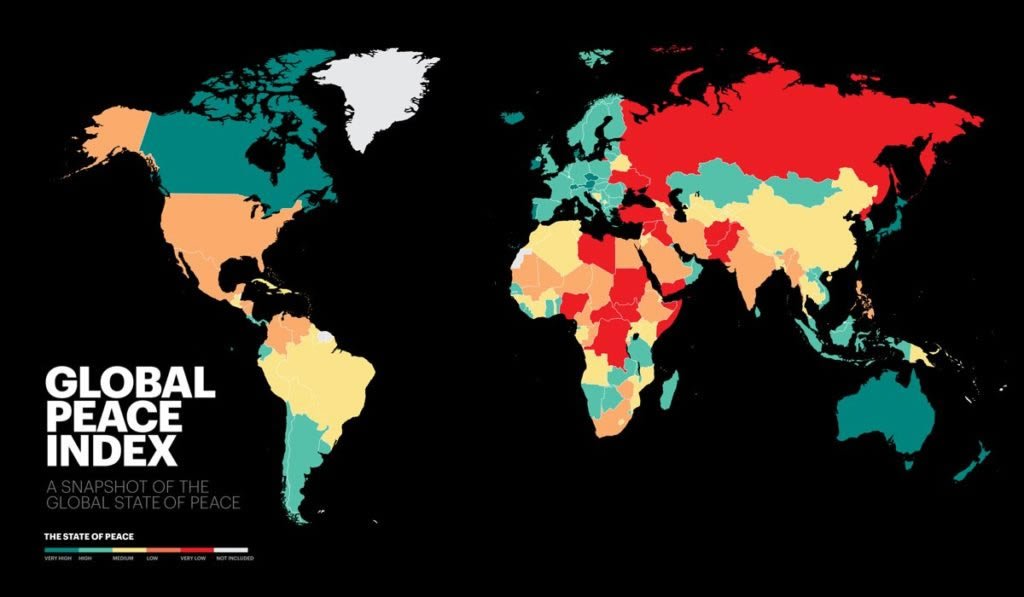
Global peacefulness has deteriorated over the past year, with this being the fourth time in the last five years that the world has seen a fall in peacefulness.
The results this year show that the level of global peacefulness deteriorated, with the average country score falling by 0.34 per cent. This is the ninth deterioration in peacefulness in the last twelve years, with 81 countries improving, and 80 recording deteriorations over the past year.
The 2020 GPI reveals a world in which the conflicts and crises that emerged in the past decade have begun to abate, only to be replaced with a new wave of tension and uncertainty as a result of the COVID-19 pandemic.
Iceland remains the most peaceful country in the world, a position it has held since 2008. It is joined at the top of the index by New Zealand, Austria, Portugal, and Denmark.
Afghanistan is the least peaceful country in the world for the second year in a row, followed by Syria, Iraq, South Sudan and Yemen. All, except Yemen, have been ranked amongst the five least peaceful since at least 2015.
Only two of the nine regions in the world became more peaceful over the past year. The greatest improvement occurred in the Russia and Eurasia region, followed by North America. North America was the only region to record improvements across all three domains, while Russia and Eurasia recorded improvements in Ongoing Conflict and Safety and Security, but a deterioration on the Militarisation domain.
Related topics: COVID-19 and Conflict: Is Peace the Cure? – The five most peaceful countries in 2019 – 2020 Gun Rally: Aiming for Peace
The world is now considerably less peaceful than it was at the inception of the index. Since 2008 the average level of country peacefulness has deteriorated 3.76 per cent. There have been year on year deteriorations in peacefulness for nine of the last 12 years. The fall in peacefulness over the past decade was caused by a wide range of factors, including increased terrorist activity, the intensification of conflicts in the Middle East, rising regional tensions in Eastern Europe and Northeast Asia, and increasing numbers of refugees and heightened political tensions in Europe and the US.

The economic impact of violence on the global economy in 2019 was $14.5 trillion in purchasing power parity (PPP) terms. This figure is equivalent to 10.6 per cent of the world’s economic activity (gross world product) or $1,909 per person. The economic impact of violence improved by 0.2 per cent from 2018 to 2019.
The biggest improvement was in armed conflict, which decreased by 29 per cent to $521 billion, owing to a fall in the intensity of conflict in the Middle East and North Africa. There was also a substantial reduction in the economic impact of terrorism, which fell by 48 per cent from 2018 to 2019.
Violence continues to have a significant impact on economic performance around the globe. In the ten countries most affected by violence, the average economic impact of violence was equivalent to 41 per cent of GDP on average, compared to under four per cent in the countries least affected by violence. Syria, South Sudan, Afghanistan and Venezuela incurred the largest proportional economic cost of violence in 2019, equivalent to 60, 57, 51 and 48 per cent of GDP, respectively.

The report’s Positive Peace research focuses on the impact of the COVID-19 pandemic on Positive Peace. Positive Peace measures a country’s ability to maintain peace. Falls in Positive Peace usually precede falls in peace. The impact of the pandemic, in particular its economic consequences, will likely have a severe impact on the way societies function. This impact could lead to deteriorations in Positive Peace and increase the risk of outbreaks of violence and conflict. Europe is likely to see an increase in civil unrest as the looming recession bites, while many countries in Africa will face famine conditions, creating further stress on many fragile countries.
Countries with strong Positive Peace have higher resilience to absorb, adapt and recover from shocks, such as COVID-19 and the ensuing recession. In particular, nations that perform well on the Well- Functioning Government and Sound Business Environment Pillars of the Positive Peace Index are more likely to recover relatively quickly from the crisis.
There is also some evidence to suggest that countries with higher levels of Positive Peace have been quicker to adapt and respond to the pandemic. Looking just at nations within the OECD, countries that perform better on the Well-Functioning Government and High Levels of Human Capital Pillars have been able to test a higher proportion of their population for the COVID-19 virus.

The 2020 GPI report also has a special focus on IEP’s newest research report – the Ecological Threat Register (ETR), which combines a confluence of ecological risks with Positive Peace and economic coping capacity to better understand what future potential risks and fragilities nations will face in the next three decades. It also extrapolates population projections to 2050 to better understand the areas which will be most impacted.

The ETR aims to show both exposure to risk and the ability of nations to deal with these ecological risks. The increase in the number of ecological threats can already be seen. The total number of natural disasters has tripled in the last four decades, while their economic impact has also increased, rising from US$50 billion in the 1980s to US$200 billion per year in the last decade. More than two billion people already live in countries experiencing high water stress. By 2050, climate change is expected to create up to 86 million additional migrants in sub-Saharan Africa, 40 million in South Asia and 17 million in Latin America.
For the complete analysis, download the Global Peace Index.
EDITOR’S NOTE: The opinions expressed here by Impakter.com columnists are their own, not those of Impakter.com. Photo credit: IEP