Impakter
  • Environment
    • Biodiversity
    • Climate Change
    • Circular Economy
    • Energy
  • FINANCE
    • ESG News
    • Sustainable Finance
    • Business
  • TECH
    • Start-up
    • AI & Machine Learning
    • Green Tech
  • Industry News
    • Entertainment
    • Food and Agriculture
    • Health
    • Politics & Foreign Affairs
    • Philanthropy
    • Science
    • Sport
  • Editorial Series
    • SDGs Series
    • Shape Your Future
    • Sustainable Cities
      • Copenhagen
      • San Francisco
      • Seattle
      • Sydney
  • About us
    • Company
    • Team
    • Global Leaders
    • Partners
    • Write for Impakter
    • Contact Us
    • Privacy Policy
No Result
View All Result
Impakter logo
No Result
View All Result
COVID-19 highlights economic sovereignty in countries

COVID-19 highlights economic sovereignty in countries

Institute for Economics & PeacebyInstitute for Economics & Peace
October 14, 2020
in Health, Society
0

A plunge in international trade during the pandemic has shown how some countries may benefit from already high levels of economic sovereignty.
The pandemic has highlighted the advantages and disadvantages of relying on international trade versus fostering economic sovereignty.

Economic sovereignty gauges a country’s ability to cater for its domestic market without depending as much on other nations. Imports plus exports, expressed as a proportion of gross domestic product (GDP), is one indication of how much a country relies on international trade to maintain its economic wellbeing.

Impact Investing Banner

This graph shows that countries such as the US, Brazil, Japan and China have large domestic activity and operate with a high degree of economic sovereignty. Similarly, the import content of exports measures the share of exports that was not produced domestically. This is also a measure of economic sovereignty. Countries whose exports come largely from reprocessing or re-shipping products from other countries are highly dependent on international trade. This is the case for Mexico, South Korea and some smaller European economies.


Related Articles: We Need Better Supply Chains in COVID-19 Era | How Fashion Could Become More Sustainable After Covid-19 | The Post-Pandemic Opportunity To Reshape Island Economies

Some governments have started to include economic sovereignty considerations in post-pandemic recovery plans, as a reliance on international trade led to major disruption. For example, Japan and India launched a program to help companies shift manufacturing from China back domestically or to other countries. In the US, the government and companies have been discussing how to bring some manufacturing back inside US borders. For example, Intel has committed to building more manufacturing plants in the US.

Traditionally, companies have sourced inputs from the cheapest foreign suppliers, which led to a decline in domestic manufacturing, especially in Organisation for Economic Cooperation and Development nations. In addition, administrative techniques to minimise inventories, for example, just-in-time or pull-through production, that modern manufacturers operate with paper-thin inventories and are therefore vulnerable even to short-lived disruptions.


About the author: The article has been written by the Vision of Humanity Editorial staff  – brought to you by the Institute for Economics & Peace (IEP). The IEP investigates the impact of COVID-19 and future trends in economics, politics, social dynamics, conflict and development.


EDITOR’S NOTE: The opinions expressed here by Impakter.com columnists are their own, not those of Impakter.com

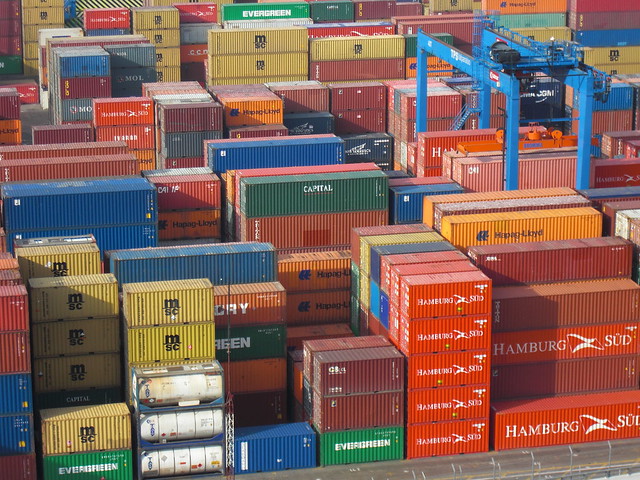
In the Featured Photo: Shipping Container Yard in Chile. Featured Photo Credit: australianpolicyonline, Jason Pearce.
Tags: Covid19domesticmarketeconomicsoverigntygdpinternationaltrade
Previous Post

David Attenborough’s Witness Statement: ‘A Life On Our Planet’

Next Post

The Publishing Industry in Support of the SDGs: Launch of the SDG Publishers Compact

Related Posts

One health US
Environment

One Health Agenda Launched in the US: What Now?

On January 13, 2025, a most welcomed announcement was made: Three major public Federal government institutions in the United States,...

byRichard Seifman - Former World Bank Senior Health Advisor and U.S. Senior Foreign Service Officerand2 others
January 16, 2025
avian flu
Health

Avian Flu Spreads to Humans: Our Next Human Epidemic or Worse?

The Big Picture and the Big Concept, “One Health” Having gone through the COVID pandemic, there is a tendency to...

byRichard Seifman - Former World Bank Senior Health Advisor and U.S. Senior Foreign Service Officer
December 27, 2024
Climate change Africa
Climate Change

How Climate Change Will Impact Developing Countries Over the Next Decade

The specter of climate change looms large over the world, posing an imminent threat to socioeconomic stability, particularly in developing...

byHannah Fischer-Lauder
February 23, 2024
Infectous disease
Health

How Do You Eliminate or Eradicate an Infectious Disease?

The COVID-19 pandemic gave the world a crash course in epidemiology and showed in real time how an infectious disease can spread...

byDr Skye McGregor - Epidemiologist & Senior Research Fellow at the Kirby Institute, UNSWand1 others
February 16, 2024
Climate change economy
Climate Change

‘Lost GDP’: What Is the Economic Cost of Climate Change?

A new study by S&P Global Ratings, "Lost GDP: Potential Impacts Of Physical Climate Risks," warns that if global temperatures...

byMatt Davies
November 28, 2023
climate change cost
Business

Almost a Third of America’s GDP Growth Connected to Climate Change

The climate crisis is costing the US $500 billion annually, an analysis by Bloomberg Intelligence (BI) shows. This represents 2%...

byElisa Furlan
October 9, 2023
Beyond GDP: Why Afrikan Countries Should Shift to Decolonized Wellbeing Economics
NGO & Charities

Beyond GDP: Why Afrikan Countries Should Shift to Decolonized Wellbeing Economics

In pursuing economic growth and development, societies have long relied on GDP (Gross Domestic Product) to measure success. However, given...

byLiepollo Pheko
October 6, 2023
Education
Education

Transforming Education to Transform the World

“Education is a fundamental human right and the bedrock of societies, economies, and every person’s potential.” This was the message UN Secretary-General...

byInternational Institute for Sustainable Development (IISD)
September 4, 2023
Next Post
The Publishing Industry in Support of the SDGs: Launch of the SDG Publishers Compact

The Publishing Industry in Support of the SDGs: Launch of the SDG Publishers Compact

Recent News

Diamond Painting Designs

7 Beautiful Diamond Painting Designs You’ll Love Working On 

January 13, 2026
ESG News regarding the DOJ’s investigation into Federal Reserve Chair Jerome Powell, Orsted’s U.S. offshore wind lawsuits, Stegra’s Non-Prime Steel Deal With thyssenkrupp, and Ghana repaid $1.47 of energy debt

US Federal Reserve Chair Under Investigation

January 12, 2026
Steakhouse in Tucson

7 Factors That Define a Premium Steakhouse Experience

January 12, 2026
  • ESG News
  • Sustainable Finance
  • Business

© 2025 Impakter.com owned by Klimado GmbH

No Result
View All Result
  • Environment
    • Biodiversity
    • Climate Change
    • Circular Economy
    • Energy
  • FINANCE
    • ESG News
    • Sustainable Finance
    • Business
  • TECH
    • Start-up
    • AI & Machine Learning
    • Green Tech
  • Industry News
    • Entertainment
    • Food and Agriculture
    • Health
    • Politics & Foreign Affairs
    • Philanthropy
    • Science
    • Sport
  • Editorial Series
    • SDGs Series
    • Shape Your Future
    • Sustainable Cities
      • Copenhagen
      • San Francisco
      • Seattle
      • Sydney
  • About us
    • Company
    • Team
    • Global Leaders
    • Partners
    • Write for Impakter
    • Contact Us
    • Privacy Policy

© 2025 Impakter.com owned by Klimado GmbH