Impakter
  • PARTNERS
  • ABOUT US
    • Our Story
    • Team
    • Write for Impakter
    • Contact Us
    • Privacy Policy
No Result
View All Result
  • Climate
  • Business
  • Energy
  • Tech
  • Politics
  • Health
  • Food & Agriculture
  • Society
  • Climate
  • Business
  • Energy
  • Tech
  • Politics
  • Health
  • Food & Agriculture
  • Society
No Result
View All Result
Impakter
No Result
View All Result

COVID-19 highlights economic sovereignty in countries

byInstitute for Economics & Peace
October 14, 2020
in Health, Society

A plunge in international trade during the pandemic has shown how some countries may benefit from already high levels of economic sovereignty.
The pandemic has highlighted the advantages and disadvantages of relying on international trade versus fostering economic sovereignty.

Economic sovereignty gauges a country’s ability to cater for its domestic market without depending as much on other nations. Imports plus exports, expressed as a proportion of gross domestic product (GDP), is one indication of how much a country relies on international trade to maintain its economic wellbeing.

Impact Investing Banner

This graph shows that countries such as the US, Brazil, Japan and China have large domestic activity and operate with a high degree of economic sovereignty. Similarly, the import content of exports measures the share of exports that was not produced domestically. This is also a measure of economic sovereignty. Countries whose exports come largely from reprocessing or re-shipping products from other countries are highly dependent on international trade. This is the case for Mexico, South Korea and some smaller European economies.


Related Articles: We Need Better Supply Chains in COVID-19 Era | How Fashion Could Become More Sustainable After Covid-19 | The Post-Pandemic Opportunity To Reshape Island Economies

Some governments have started to include economic sovereignty considerations in post-pandemic recovery plans, as a reliance on international trade led to major disruption. For example, Japan and India launched a program to help companies shift manufacturing from China back domestically or to other countries. In the US, the government and companies have been discussing how to bring some manufacturing back inside US borders. For example, Intel has committed to building more manufacturing plants in the US.

Traditionally, companies have sourced inputs from the cheapest foreign suppliers, which led to a decline in domestic manufacturing, especially in Organisation for Economic Cooperation and Development nations. In addition, administrative techniques to minimise inventories, for example, just-in-time or pull-through production, that modern manufacturers operate with paper-thin inventories and are therefore vulnerable even to short-lived disruptions.


About the author: The article has been written by the Vision of Humanity Editorial staff  – brought to you by the Institute for Economics & Peace (IEP). The IEP investigates the impact of COVID-19 and future trends in economics, politics, social dynamics, conflict and development.


EDITOR’S NOTE: The opinions expressed here by Impakter.com columnists are their own, not those of Impakter.com

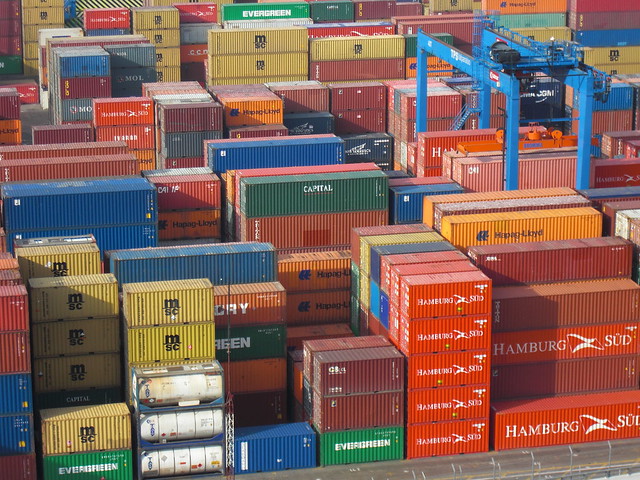
In the Featured Photo: Shipping Container Yard in Chile. Featured Photo Credit: australianpolicyonline, Jason Pearce.

Share
WhatsApp LinkedIn X Facebook
Tags: Covid19domesticmarketeconomicsoverigntygdpinternationaltrade
Previous Post

David Attenborough’s Witness Statement: ‘A Life On Our Planet’

Next Post

The Publishing Industry in Support of the SDGs: Launch of the SDG Publishers Compact

Institute for Economics & Peace

Institute for Economics & Peace

The Institute for Economics and Peace is the world’s leading think tank dedicated to developing metrics to analyse peace and to quantify its economic value. It does this by developing global and national indices, calculating the economic cost of violence, analysing country level risk and understanding positive peace. The research is used extensively by governments, academic institutions, think tanks, non-governmental organisations and by intergovernmental institutions such as the OECD, The Commonwealth Secretariat, the World Bank and the United Nations. The Institute was recently ranked in the top 15 most impactful think tanks in the world on the Global Go To Think Tank Index. Founded by IT entrepreneur and philanthropist Steve Killelea in 2007, the Institute for Economics and Peace is impacting traditional thinking on matters of security, defence, terrorism and development.

Next Post

The Publishing Industry in Support of the SDGs: Launch of the SDG Publishers Compact

Related News

A skilled woodworker carefully grades veneer by eye for its beauty and appearance.

What Japan’s Hardwood Forests Can Teach Us About the Circular Economy

September 9, 2026
100 Greenpeace activists delivered 500 solar panels with a total area of over 800 square metres to BP’s London Headquarters in St James’ Square. All six office doors around the building have been blocked with activists locked to dirty oil barrels to prevent staff from entering. Photo Credit: © Suzanne Plunkett / Greenpeace

Who Protects Environmental Defenders? Interview with UN Special Rapporteur Michel Forst

September 9, 2026

Impakter informs you through the ESG news site and empowers your business CSRD compliance and ESG compliance with its Klimado SaaS ESG assessment tool marketplace that can be found on: www.klimado.com

Registered Office Address

Klimado GmbH
Niddastrasse 63,

60329, Frankfurt am Main, Germany


IMPAKTER is a Klimado GmbH website

Impakter is a publication that is identified by the following International Standard Serial Number (ISSN) is the following 2515-9569 (Printed) and 2515-9577 (online – Website).


Office Hours - Monday to Friday

9.30am - 5.00pm CEST


Email

stories [at] impakter.com

By Audience

  • TECH
    • Start-up
    • AI & MACHINE LEARNING
    • Green Tech
  • ENVIRONMENT
    • Biodiversity
    • Energy
    • Circular Economy
    • Climate Change
  • INDUSTRY NEWS
    • Entertainment
    • Food and Agriculture
    • Health
    • Politics & Foreign Affairs
    • Philanthropy
    • Science
    • Sport
    • Editorial Series

ESG/Finance Daily

  • ESG News
  • Business

About Us

  • Team
  • Partners
  • Write for Impakter
  • Contact Us
  • Privacy Policy

© 2026 IMPAKTER. All rights reserved.

No Result
View All Result
  • Climate
  • Business
  • Energy
  • Tech
  • Politics
  • Health
  • Food & Agriculture
  • Society

© 2026 IMPAKTER. All rights reserved.