Impakter
  • Environment
    • Biodiversity
    • Climate Change
    • Circular Economy
    • Energy
  • FINANCE
    • ESG News
    • Sustainable Finance
    • Business
  • TECH
    • Start-up
    • AI & Machine Learning
    • Green Tech
  • Industry News
    • Entertainment
    • Food and Agriculture
    • Health
    • Politics & Foreign Affairs
    • Philanthropy
    • Science
    • Sport
  • Editorial Series
    • SDGs Series
    • Shape Your Future
    • Sustainable Cities
      • Copenhagen
      • San Francisco
      • Seattle
      • Sydney
  • About us
    • Company
    • Team
    • Global Leaders
    • Partners
    • Write for Impakter
    • Contact Us
    • Privacy Policy
No Result
View All Result
Impakter logo
No Result
View All Result
climate change alcohol

Climate Change May Contribute to Alcohol and Drug Abuse, Study Finds

How rising temperatures are affecting our social behaviour and driving up alcohol- and drug-related hospital admissions

Olivia FowlerbyOlivia Fowler
September 30, 2023
in Climate Change, Health
0

For many Europeans, a drink with friends in the late afternoon sunshine is the ideal way to start a summer weekend. But as new research now suggests, climate change is even affecting our alcohol consumption habits.

The study, published in Nature’s Communications Medicine journal, has found that rising temperatures as a result of climate change are leading to a rise in alcohol and drug abuse.

The researchers obtained hospital records detailing admissions from 1995 to 2014 from hospitals in New York State. Daily average temperatures, specific humidity and pressure were collected from the North American Land Data Assimilation System.

By analysing the data, the report found that over the course of the study period (1995-2014), the number of alcohol and substance-related hospital admissions grew for both men and women. There were also more drug-related hospitalisations than alcohol ones.

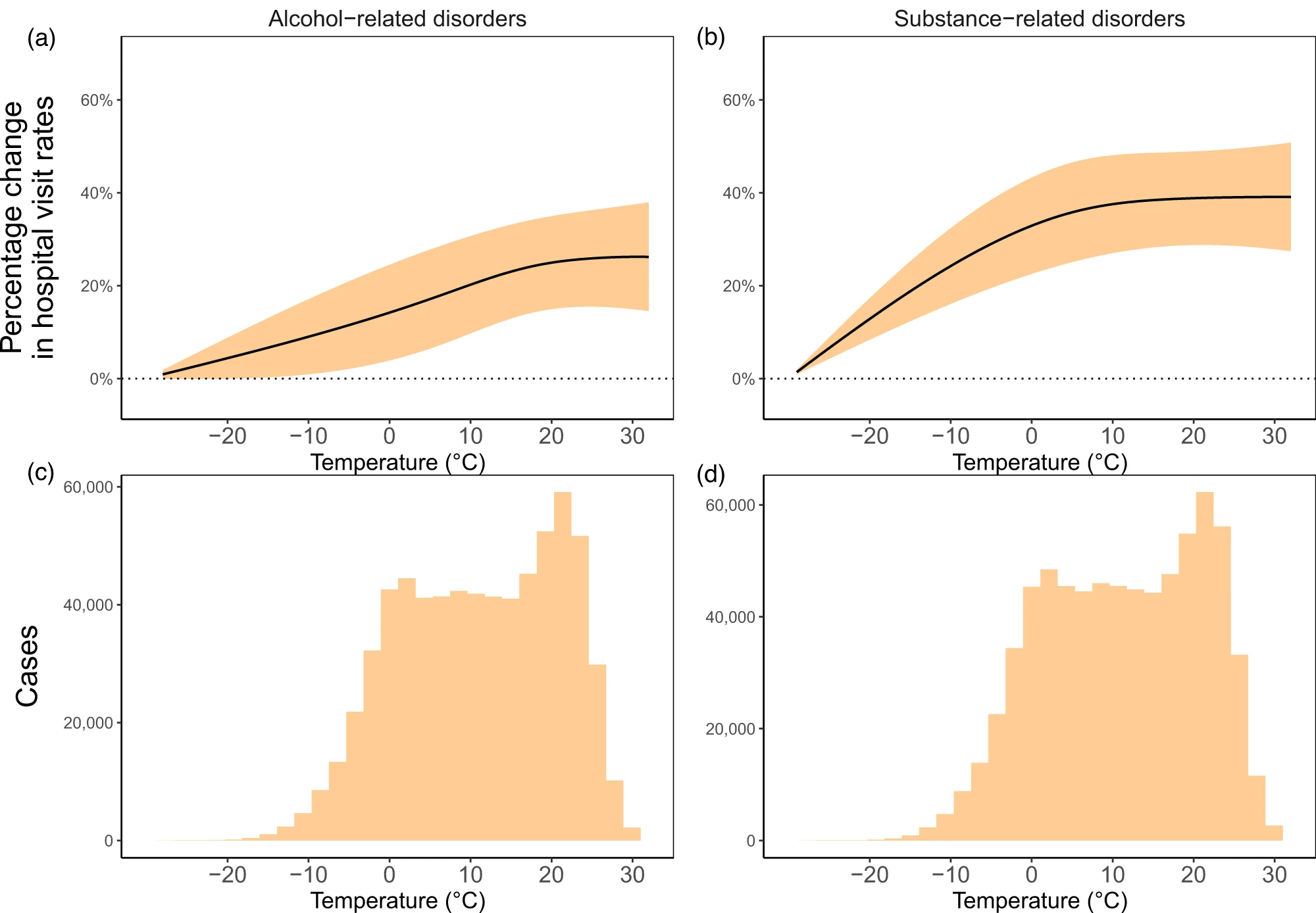
“[O]verall, there was a near-linear positive association between temperature and alcohol-related disorders hospital visits across most of the temperature distribution,” the report concludes. 

Specifically, the researchers observed a 24.6% increase in hospital visit rates for alcohol-related disorders associated with “a daily increase in temperature from the daily minimum to the 75th percentile across 0–6 lag days […] largely driven by increases on the day of and day before hospital visit.”

The same is also true for drug hospitalisations — the warmer the temperature, the more drugs people took but only to a certain point.

“For substance-related disorders, we find evidence of a positive association at temperatures from the daily minimum to the 50th percentile, but not at higher temperatures,” the authors write.

What’s causing this pattern?

There are “many behavioural or psychological reasons,” the researchers say, for this correlation.

Firstly, they speculate that there may be fewer hospitalizations for alcohol and drug abuse in colder weather because people are less motivated to go to hospital. The trip there might seem hazardous in cold or otherwise inclement weather, the report explains.

Other reasons stated by the scientists include people spending more time drinking outside when the weather is warm and sunny, people consuming alcohol and participating in riskier outdoor activities, dehydration from warm weather and alcohol combined, or even people driving under the influence.
alcohol
In the picture: percentage changes represent the scenario where each of the lag days (0 to 6 days before) at the quoted temperature before hospital visit. Exposure-response curves for a alcohol- (n = 671,625) and b substance-related (n = 721,469) disorder hospital visits, and histograms of temperature records for cases of c alcohol- (n = 671,625) and d substance-related (n = 721,469) disorder hospital visits. Black lines show the point estimates and orange ribbons represent 95% confidence intervals. Source: Nature Communications Medicine

There is a threshold, the report found, for the correlation “because once outdoor temperatures are sufficiently comfortable, further temperature increases may not increase outdoor activity.”

Of all drug abuse, cocaine-related hospital admissions showed the strongest correlation with temperature. This could be because  coupling cocaine with alcohol makes the  users sweat more and increases the risk for the development of cardiovascular and respiratory issues.

Opioid users, the report also explains, have even reported lower drug efficacy in warm weather, meaning they may take a higher dose on hot days. 


Related article: France Wine Crisis: Changing Habits and Climates Are Curbing Viticulture | Health Must Be Fast-Tracked for 2030 | How Climate Change Affects Health and How Countries Can Respond | Climate changes health, how can we adapt to protect it?

Visits to hospitals for drug and alcohol abuse are normally emergency visits, showing that the relationships between temperature and alcohol and drug admissions are created by those making non-routine trips, the study states.

America’s opioid epidemic and climate change

The report goes on to explain how America’s opioid epidemic has resulted in a rise in usage and dependency of prescription and illegally-bought drugs. 

“Drug overdose deaths in the United States have increased more than five times since the end of the 20th century,” the researchers assert, adding that drug abuse is responsible for 1 in 8 deaths among adults aged 20 to 64 years.

People living with drug and alcohol abuse disorders are particularly vulnerable as levels of extreme heat continue to rise.

The report suggests that public health interventions warning people about the risks of consumption in warm weather should be “a public health priority,” and calls for social and healthcare reform.

Whilst we regularly hear about the effects of global warming on our planet and ecosystems, it is also important to understand the ways in which climate change is affecting social behaviour and causing real harm even in the most developed and wealthy societies.


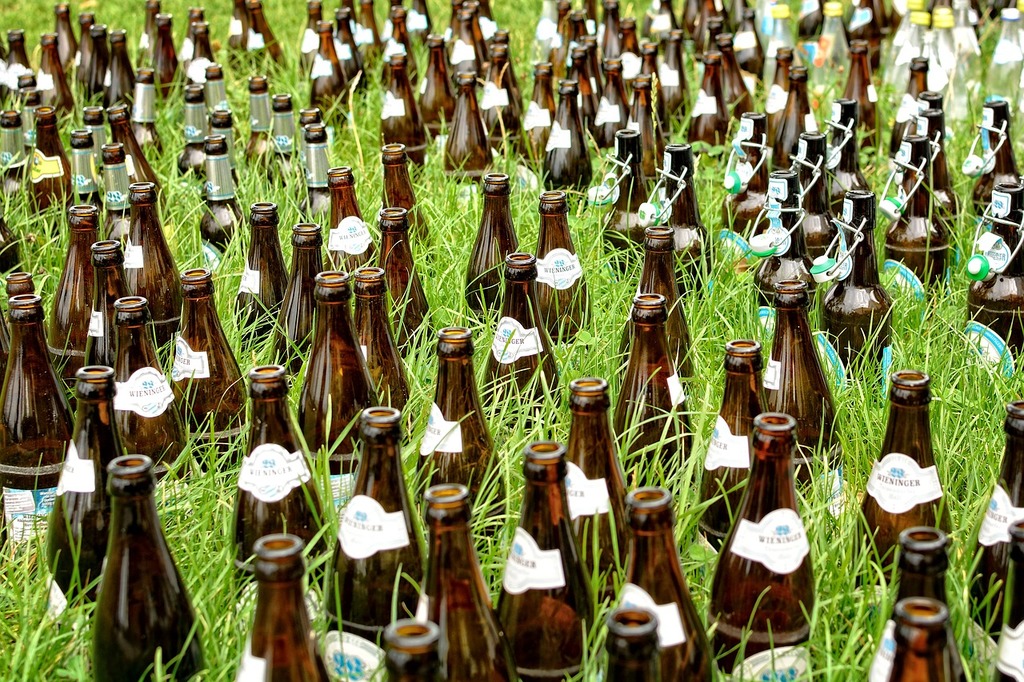
Editor’s Note: The opinions expressed here by the authors are their own, not those of Impakter.com — In the Featured Photo: Beer bottles in a grass field. Featured Photo Credit: Picryl.

Tags: Alcohol abuseClimate ChangeDrug abuseGlobal warmingpublic health
Previous Post

Women Abused in 90% of Online Pornography, Report Finds

Next Post

Why Are Glaciers Important?

Related Posts

Bill Gates memo
Climate Change

Climate, Gates and COP30

Bill Gates’ recent article on the “three tough truths” of the ongoing environmental changes makes an essential point: we must...

byJosé Graziano da Silva - Former Director-General at FAO, Founder and Director of the Instituto Fome Zero, and Professor Emeritus at the University of Campinas
November 12, 2025
U.S. Capitol building
Health

How the U.S. Government Shutdown Threatens Public Health

The United States' longest federal government shutdown, because Congress and the President have seemingly been unable to find common ground,...

byRichard Seifman - Former World Bank Senior Health Advisor and U.S. Senior Foreign Service Officer
November 12, 2025
The Amazon rainforest is often called “the lungs of the world.” It produces oxygen and stores billions of tons of carbon every year. The Amazon rainforest covers more than 60% of the landmass of Peru. Photo Credit: USDA Forest Service / Diego Perez.
Biodiversity

Inside COP30

The 30th United Nations Climate Change Conference (COP30) is taking place in Belém, Brazil, from November 10 to 21, 2025....

byInternational Institute for Sustainable Development (IISD)
November 10, 2025
ESG news regarding U.S. absence from the COP30 climate summit, Europe’s role in the U.S. absence, new euro zone loan pricing, and countries suffering from global warming speak at COP30
Business

COP30 Without the U.S.

Today’s ESG Updates Global Climate Talks Proceed Without U.S. Leadership: Lack of U.S. representatives at the UN’s COP30 talks in...

bySarah Perras
November 10, 2025
From Caves to COP30: Comparing the Neanderthals and Modern Humans
COP30

From Caves to COP30: Comparing the Neanderthals and Modern Humans

There is much positive to be said about life in this twenty-first century; we live longer and have multiple technologies...

byRichard Seifman - Former World Bank Senior Health Advisor and U.S. Senior Foreign Service Officer
November 9, 2025
climate change and food
Biodiversity

COP30: Climate Extremes Are Already Impacting Food Yields Today

The 30th United Nations Climate Change Conference (COP30), taking place in Belém, Brazil, brings together world leaders, scientists, non-governmental organizations, and...

byThe Food and Agriculture Organization of the United Nations (FAO)
November 7, 2025
One Health
Biodiversity

Why and How to Apply the One Health Concept

One Health can be a complex and sometimes jargon-filled concept. Put simply: "One Health is the collaborative efforts of multiple...

byOne Health Initiative
November 6, 2025
Baler Compactors
Circular Economy

Compressing Waste, Expanding Impact: How Baler Compactors Advance Corporate Sustainability

It is easy to see the glitzy side of sustainability. Solar panels, windmills, electric fleets. But there’s more to sustainability...

byHannah Fischer-Lauder
October 29, 2025
Next Post
Glaciers melting

Why Are Glaciers Important?

Recent News

ESG News regarding: Amazon launches projects in the US, UK, and Mexico expected to restore over 2 billion liters of water per year, Rio Tinto invests A$35m in Calix’s ‘Zesty’ green-iron demo using electric heat and hydrogen; People fish as Dukovany’s cooling towers loom; Czechia adds two new reactors after KHNP wins tender. A farmer sprays a field as France reports a small post-ban rise in insect-eating birds

Amazon Launches Water Replenishment Projects Across US, UK, Mexico

November 18, 2025
SEC regulations on Crypto

Alternative Investments – Benefits and Considerations

November 17, 2025
A couple looking to deal with their personal finances

How to Prepare Your Finances for Life Changes

November 17, 2025
  • ESG News
  • Sustainable Finance
  • Business

© 2025 Impakter.com owned by Klimado GmbH

No Result
View All Result
  • Environment
    • Biodiversity
    • Climate Change
    • Circular Economy
    • Energy
  • FINANCE
    • ESG News
    • Sustainable Finance
    • Business
  • TECH
    • Start-up
    • AI & Machine Learning
    • Green Tech
  • Industry News
    • Entertainment
    • Food and Agriculture
    • Health
    • Politics & Foreign Affairs
    • Philanthropy
    • Science
    • Sport
  • Editorial Series
    • SDGs Series
    • Shape Your Future
    • Sustainable Cities
      • Copenhagen
      • San Francisco
      • Seattle
      • Sydney
  • About us
    • Company
    • Team
    • Global Leaders
    • Partners
    • Write for Impakter
    • Contact Us
    • Privacy Policy

© 2025 Impakter.com owned by Klimado GmbH