Impakter
  • Environment
    • Biodiversity
    • Climate Change
    • Circular Economy
    • Energy
  • FINANCE
    • ESG News
    • Sustainable Finance
    • Business
  • TECH
    • Start-up
    • AI & Machine Learning
    • Green Tech
  • Industry News
    • Entertainment
    • Food and Agriculture
    • Health
    • Politics & Foreign Affairs
    • Philanthropy
    • Science
    • Sport
  • Editorial Series
    • SDGs Series
    • Shape Your Future
    • Sustainable Cities
      • Copenhagen
      • San Francisco
      • Seattle
      • Sydney
  • About us
    • Company
    • Team
    • Global Leaders
    • Partners
    • Write for Impakter
    • Contact Us
    • Privacy Policy
No Result
View All Result
Impakter logo
No Result
View All Result
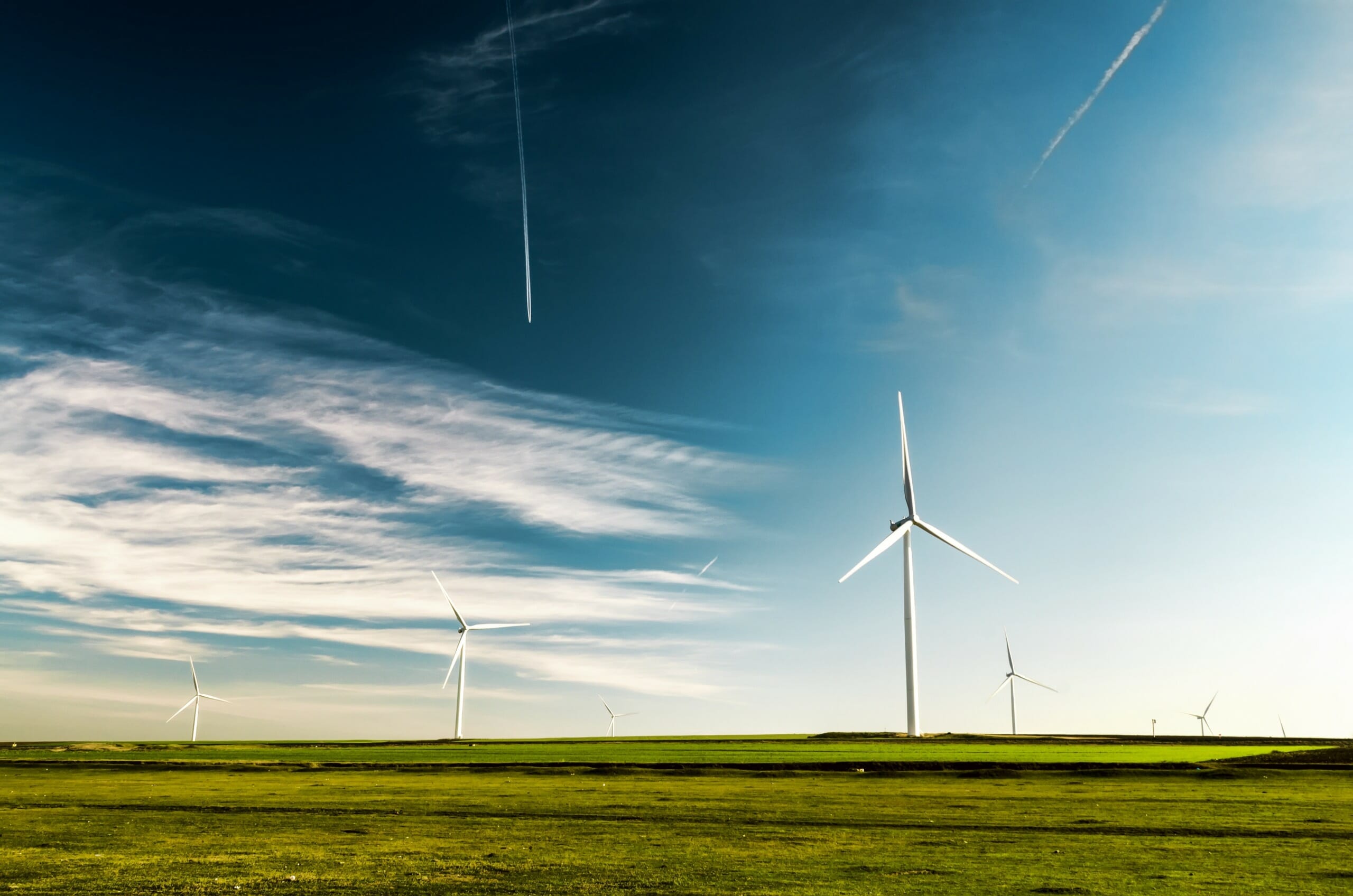
Wind Turbine Landscape to act against climate change

Climate Change and Economic Growth: Will the New Asia Pacific Economic Engine Go Green?

Deloitte’s “The Turning Point” report shows that the high costs of rapid decarbonisation are in fact only a fraction of the cost of inaction on climate change 

Lili CarioubyLili Cariou
October 20, 2021
in Climate Change, Corporations, Energy, Environment
0

A report published by Deloitte Economic Institute, “The Turning Point”, has found that climate change inaction would negatively impact economic growth in the Asia Pacific region. They believe Asia could become a pioneer in demonstrating the value of climate change mitigation and show the benefits of decarbonisation to the rest of the world. This could save the region $7.5 trillion in GDP loss.

There are just a few days left before COP26 begins where world leaders will unite and come together in a bid to accelerate action towards the goals of the Paris Agreement and the UN Framework Convention on Climate Change.

The sense of urgency to manage and halt climate change is now unquestionable. In August 2021, the United Nations Intergovernmental Panel on Climate Change (IPCC) released a report confirming the earth has warmed two degrees Celsius since the nineteenth century. This phenomenon has left communities worldwide exposed to a climate emergency unfolding faster than predicted. 

But for years, climate change was considered intangible, and although the short- and long-term ramifications caused by hurricanes, droughts and floods were noticeable, these were consistently considered as ‘natural’. It has misled humans to think the devastating results produced by these disasters were inevitable and out of our control, rather than induced by long-standing human activity. 
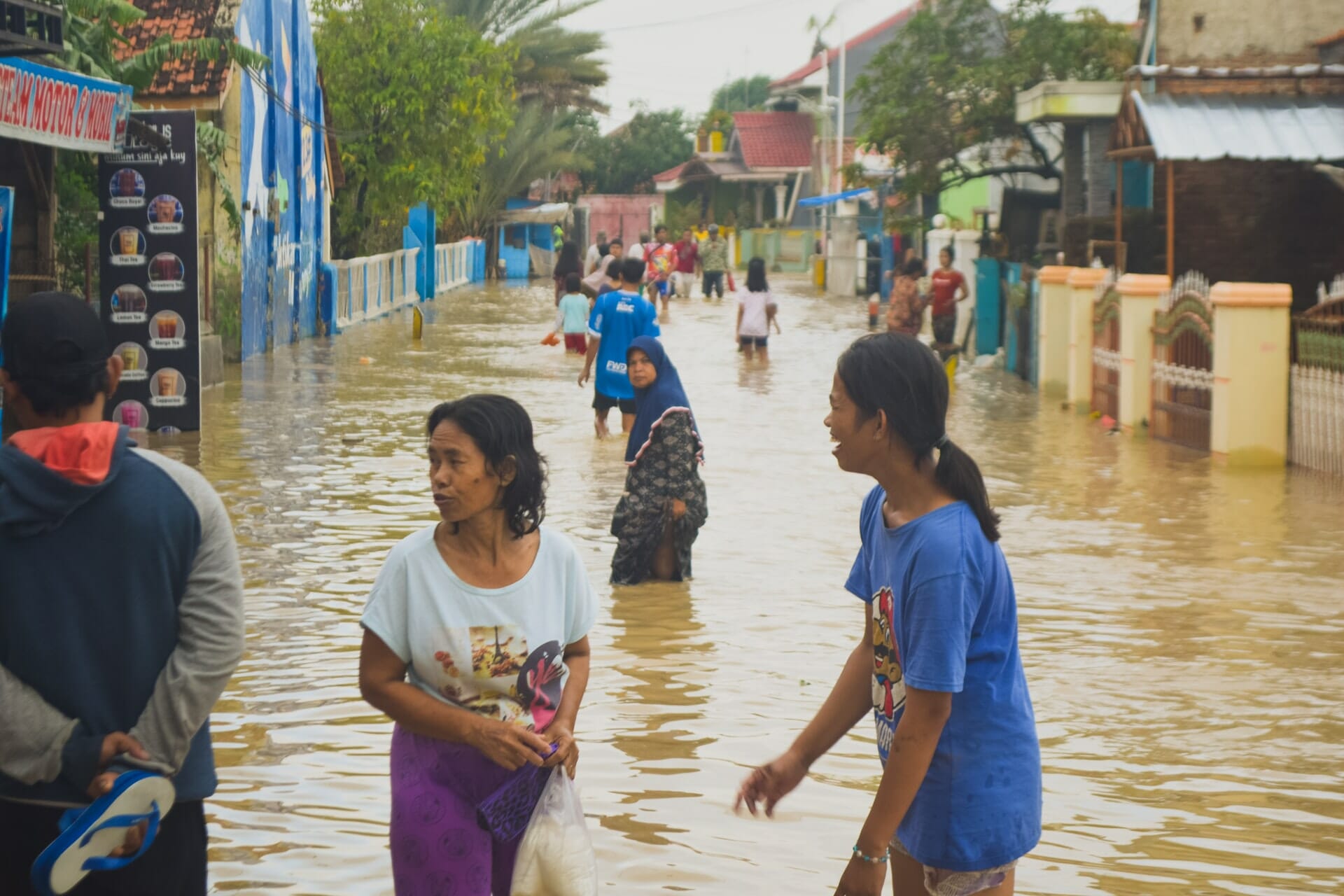
A group of people walking in a flooded street
Naming extreme weather events as “natural disasters” has misled humans to think the devastating results produced by these disasters were inevitable and out of our control, rather than induced by long-standing human activity.  Climate Photo Credit: Misbahul Aulia

The IPCC report makes clear that many characteristics of climate change directly depend on the level of global warming, exacerbated by years of greenhouse gas emissions diffused by the top economies of the world.

Climate change has devastated our environment. It will also have a significant impact on global economies, as countries across the globe face a growing threat. 

A report published by Deloitte Economics Institute, “The Turning Point,” points out that the problem does not stop at the physical level. It shows that financial effects are happening too, and that inaction on climate change will negatively impact economic growth in the future. Whilst transitioning towards low-emission energy and economy may be costly now, they are nothing compared to the cost of economic loss that would result from enduring global warming.

They argue for countries and entire industries within the Asian Pacific region to undergo fundamental transformations of their business models, towards rapid decarbonisation.

The cost of inaction on climate change

The report highlights several high costs that result from inaction on climate change. In sum, these include:

  • Increased incidence of mortality and morbidity as a result of climate change, disrupting living standards and the lives of the working people
  • A loss of productive land through rising sea levels, and a reduced level of productive activity on the land
  • Loss of tourism and international money circulating in economies negatively impacts business, jobs, and livelihoods
  • Climate change inaction limits what farmers can do, with significant variations in crop yields damaging the agricultural sector’s output
  • The economies also suffer as investment is focused on repair and maintenance of existing assets instead of contributing to new, more productive capital better adapted to climate change.

Furthermore, the report found that by 2050, with global warming exceeding two degrees Celsius, GDP in Asia Pacific alone would be more than 5.5% lower than if global warming was halted. 

If global warming continues to increase, the losses will encompass 8% of the region’s GDP by 2060, that is $7.5 trillion in GDP loss. 

What is most concerning, is that projections of economic growth that to this day are most generally used still do not account for the high costs and consequences of climate change. They tend to assume that economies will grow according to a “business as usual”, unaffected by global warming.

THE ECONOMIC GAINS OF RAPID DECARBONISATION

Deloitte Economics Institute has created models that show that rapid decarbonisation can reverse the tide. They argue the short-term costs of this reversal to be high, but the numbers demonstrate it is nothing compared to the high cost of climate change inaction. Particularly, they demonstrate that such a move could add about $47 trillion in present value terms for Asia Pacific by 2070, and the region’s GDP would be 7.5% higher than it would without climate action.


Related Articles: Health Is Wealth – and Sustainable Development | 7 Things to Know About Renewable Natural Gas

It sets out a guide on how to rapidly decarbonise the Asian Pacific region. Hoping that taking such steps could help open the world to the benefits of the decarbonisation process, positioning the region as a beacon of success and knowledge.
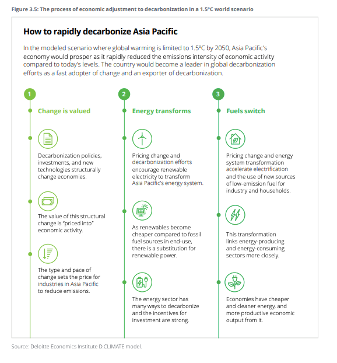
Screenshot of a timeline, guide model, that should be used for rapid decarbonisation against climate change inaction
Screenshot figure 3.5 from “The Turning Point” report by Deloitte

Several countries, mainly those with the greatest carbon emissions, have already commenced to decarbonise. 

In 2020, China opened the second largest solar farm in the world with a capacity of 2.2 gigawatts – enough to power 1 500 000 homes. 

India has also followed suit, already home to the largest solar park, it is expected to operationalise the biggest floating solar power plant in 2021. 

Whilst South Korea has unveiled plans to construct the world’s largest offshore wind farm, with a maximum capacity of 8.2 gigawatts by 2030, and aims to become the world’s largest producer of hydrogen-powered vehicles and fuel cells.

The report does provide an opportunity for Asia to demonstrate the value of climate change mitigation and the benefits of decarbonisation to the world. For some observers, however, it remains questionable whether economic growth and sustainable development can always be compatible. In the short-run, decarbonisation will undeniably help reduce overall greenhouse gas emissions into the atmosphere. But this leaves unanswered the question whether infinite growth on a finite planet is really possible.


Editor’s Note: The opinions expressed here by Impakter.com columnists are their own, not those of Impakter.com. — In the Featured Photo: Wind Turbines in Landscape, initiation to act against climate change. Featured Photo Credit: Arteum.ro

Tags: Climate ChangedecarbonisationEconomic growthgdpSustainability
Previous Post

President Bolsonaro Faces Charges of Crimes Against Humanity for Covid Response

Next Post

Conversations of Hope: Talking to Kids About Climate Change and The Environment

Related Posts

ESG news regarding Deforestation Mandate Being Pushed; EUs Acceleration on Hydrogen and Net Zero Revolution; AT&T Will End All DEI; UK Watchdog Blocks Nike and Lacoste Ads Over Green Claims.
Business

U-Turn in Europe: Deforestation Mandate Pushed Back Again

Today’s ESG Updates EU Lawmakers Agree to Delay Deforestation Rules: The EU has delayed and simplified its Deforestation Regulation until...

byEge Can Alparslan
December 5, 2025
ESG News regarding Flooding in Indonesia; Glencore promises copper production boost; Trump proposes slashing fuel efficiency standards, and Vulcan Energy receives $2.57bn of funding for lithium project
Business

Indonesians Blame Deforestation for Recent Floodings

Today’s ESG Updates: More than 700 Lives Lost in Recent Indonesian Floods: A combination of mass deforestation and heavy rainfall...

byAriq Haidar
December 4, 2025
How a Framework Convention Could Address Climate and Socio-Economic Displacement
Politics & Foreign Affairs

How a Framework Convention Could Address Climate and Socio-Economic Displacement

The unprecedented shift in human (im)mobility has seen over 120 million forced to flee their homes due to war, violence,...

byDr. Shepherd Mutsvara - Research Fellow at the University of Münster, Germany
December 3, 2025
fossil fuel subsidies
Business

How G20 Nations Can Make Progress After the Group Stalls on Fossil Fuel Subsidy Reform

The 2025 G20 Leaders’ Summit in South Africa sent mixed signals on climate action. In this year’s Leaders’ Declaration, climate change...

byInternational Institute for Sustainable Development (IISD)
November 28, 2025
Animal Health
Biodiversity

Better Animal Health Is the Low-Risk, High-Reward Climate Investment We Need

Imagine if there was a way to reduce emissions from the meat, egg and dairy sector by nearly a quarter,...

byCarel du Marchie Sarvaas
November 26, 2025
ESG news covering the EU’s delay of deforestation rules, rising U.S. housing risks from climate impacts, IFC’s $100M clean-energy investment in emerging markets, and ABN AMRO’s appointment of a new Chief Sustainability Officer.
Business

EU Delays Deforestation Regulation Again

Today’s ESG Updates EU Delays Deforestation Law: Europe postpones the EUDR by one year and loosens compliance rules, raising concerns...

byEge Can Alparslan
November 21, 2025
COP30: Countries’ Climate Agrifood Ambitions Undermined by Funding Gaps, Report Finds
Biodiversity

COP30: Countries’ Climate Agrifood Ambitions Undermined by Funding Gaps, Report Finds

Developing countries recognize the urgent need to adapt agrifood systems to climate change, but most National Adaptation Plans (NAPs) are...

byThe Food and Agriculture Organization of the United Nations (FAO)
November 19, 2025
Encouraging Evidence of Momentum in Negotiations at COP30
Biodiversity

Encouraging Evidence of Momentum in Negotiations at COP30

With the second week of negotiations now underway at COP30, WWF is encouraged by an announcement by the Brazilian Presidency...

byWWF
November 18, 2025
Next Post
Conversations of Hope: Talking to Kids About Climate Change and The Environment

Conversations of Hope: Talking to Kids About Climate Change and The Environment

Recent News

Buying a Ferrari F12 Berlinetta in Rosso Ferrari

Buying a Ferrari? Here Are Some Factors That Affect Pricing

December 10, 2025
ESG News regarding U.S. court overturning Trump wind freeze, EU approving a 90% emissions cut target, OECD warning about SME artificial intelligence gaps, and the EU Commission supporting Poland’s first nuclear plant.

Court Blocks Trump Wind Energy Ban, Reopening U.S. Clean Energy Development

December 10, 2025
First-time Investor Mistakes on screen

First-time Investor Mistakes Millennials Make (And How to Avoid Them)

December 10, 2025
  • ESG News
  • Sustainable Finance
  • Business

© 2025 Impakter.com owned by Klimado GmbH

No Result
View All Result
  • Environment
    • Biodiversity
    • Climate Change
    • Circular Economy
    • Energy
  • FINANCE
    • ESG News
    • Sustainable Finance
    • Business
  • TECH
    • Start-up
    • AI & Machine Learning
    • Green Tech
  • Industry News
    • Entertainment
    • Food and Agriculture
    • Health
    • Politics & Foreign Affairs
    • Philanthropy
    • Science
    • Sport
  • Editorial Series
    • SDGs Series
    • Shape Your Future
    • Sustainable Cities
      • Copenhagen
      • San Francisco
      • Seattle
      • Sydney
  • About us
    • Company
    • Team
    • Global Leaders
    • Partners
    • Write for Impakter
    • Contact Us
    • Privacy Policy

© 2025 Impakter.com owned by Klimado GmbH