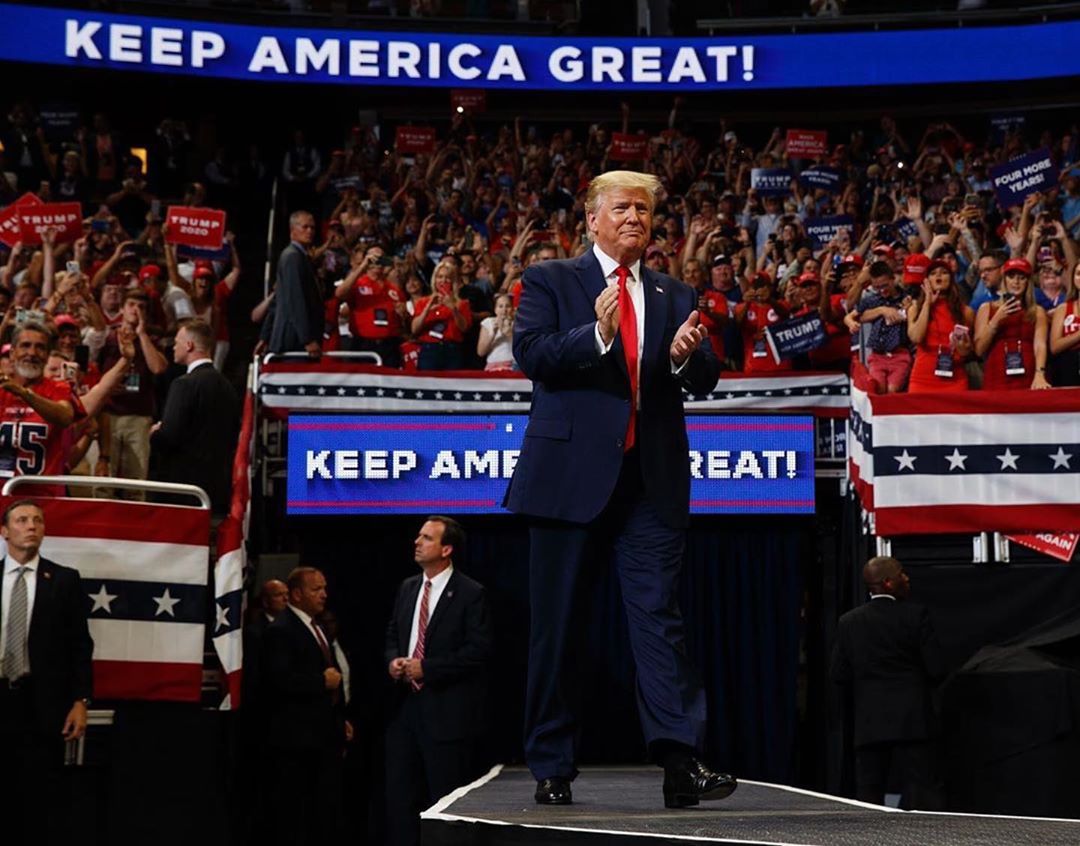
On Monday Trump presented to Congress his 2021 Budget and at a New Hampshire rally, he appeared in full-blown electoral mode.
Monday marked a turning point in Donald Trump’s bid for re-election. His administration presented his 2021 Budget proposal to Congress and he went to Manchester, New Hampshire, to hold a rally, the first since his acquittal by the Senate (majority Republican) on two articles of impeachment brought by the House (majority Democratic). The next day, Tuesday, the northeastern state was voting in the primaries, a week after the debacle of the Iowa Democratic caucus.
Left-wing Bernie Sanders came first, edging the centrist Buttigieg with Biden finishing well behind, in fifth place. During his speech, Trump mocked the Democrats for the embarrassing failure of a smartphone app that resulted in a weeklong delay in declaring a winner, which still is not totally clear anyway. Indeed, the Democrats did not help themselves in that situation.
In a packed 10.000-seat stadium, The Donald encouraged his supporters to vote in the Democratic primary of New Hampshire for the weakest candidate. His objective: Sow further uncertainty in the competition to choose his opponent in the 2020 presidential election. In fact, the voters who are registered as undeclared – about 415,000 in New Hampshire – are allowed to vote in the primaries of both parties.
Whether his call had the desired effect is unclear. But many observers think Sander’s brand of populism would lose out to Trump’s. And with Sanders as a front-runner, the Democratic Party may well be in a quandary. As Mr. Brooks (of the New York Times) writes: “Democrats may wind up in a position in which they can’t nominate Bernie Sanders because he’s too far left, and they can’t not nominate him because his followers would bolt from a Biden/Bloomberg/Buttigieg-led party”.
This is not the first time Mr. Trump uses such havoc-causing practices, which arouses criticism from those who consider it undemocratic. At his last State of the Union address (in which, puzzlingly, Juan Guaidò, Venezuela’s leader of the opposition movement to President Maduro was also present, receiving a near-standing ovation), Trump awarded the Presidential Medal of Freedom – one of the two highest civilian decorations in the U.S. – to the conservative radio host Rush Limbaugh, who in 2008 encouraged his listeners to launch the “Operation Chaos”, according to which Republicans should have voted for Barack Obama as he was considered the weakest candidate. Needless to say, Limbaugh was wrong.
Trump then reiterated his attack on the Speaker of the House, Democrat Nancy Pelosi, who tore up her copy of the President’s speech during the state of the union, while – he said – she was “mumbling terribly”. The crowd responded with the notorious “lock her up” choir, conceived for Hillary Clinton.
Trump’s 2021 budget proposal: A boost for national defense, cuts for domestic programs
Also on Monday, the Trump administration presented its 2021 budget proposal, the last one to be submitted to the Congress before the November election. This is essentially Trump’s business card for a second term.
A $ 4.8 trillion plan, the 2021 budget, according to the New York Times and Washington Post, includes a list of profound cuts in domestic and welfare programs (including student loans, housing, and food subsidies, Medicaid), education and environmental protection, while mirroring Trump’s electoral effort to thin the federal safety net, for the benefit of Defense, weaponry and anti-immigration enforcements.
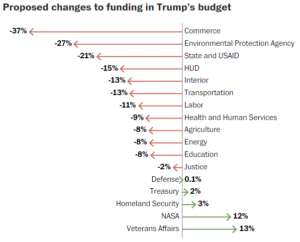
Specifically, the budget proposal reduces funding for the Department of Health and Human Services by nearly $ 10 billion. This affects 16% of the Centers for Disease Control and Prevention’s budget, which, combined with a cut of over $ 3 billion in global health programs – including half of the U.S. annual WHO funding – raises concern over the U.S capacity to fight the coronavirus outbreak. It also shrinks the Environmental Protection Agency’s budget by 26.5% (-2.4 billion), cuts almost 8% from the Department of Education and 15% from the Department of Housing and Urban Development, while the State Department and the U.S. Agency for International Development are left with 22% less funding.
On the other side of the scale, the one that goes up, the 2021 budget calls for additional expenses for the army, national defense, and border strengthening. Regarding national defense, President Trump told U.S. governors on Monday that, until an agreement is reached with China and Russia, the only thing he can do is “to create, by far, the strongest nuclear force of any other part of the world”. As to strengthening borders, an additional $ 2 billion are requested to finance the construction of the famous wall along the border with Mexico, veterans funds and Trump’s Space Force.
Finally, there’s also a piece of candy: An extension of individual income tax cuts that were due to expire in 2025.
Democrats have widely criticized the proposal, calling it particularly harmful to low-income families. The large federal deficit generates worries too; White House officials said their budget proposal would fill the deficit by 2035. Such a goal, however, could only be achieved – analysts say – if the U.S. economy grew at a sustained 3% rate at least until 2025. A level that the administration has so far failed to maintain: U.S. GDP has actually increased by 2.3% in 2019 – the lowest gain since Trump took office – and many economists predict that growth will remain slow again this year.
How strong is Trump’s economy?
“It is becoming conventional wisdom that US President Donald Trump will be tough to beat in November, because, whatever reservations about him voters may have, he has been good for the American economy. Nothing could be further from the truth”, Joseph E. Stiglitz, Nobel laureate in economics, recently wrote on Project Syndicate.
According to an article, “Comment investir en bourse“, today’s economic growth and record share prices continue being popular topics. But neither GDP nor stock market indexes represent a good measure of economic performance. Nor do they manage to picture the real situation of ordinary citizens’ living standards or the sustainability re-evolution. Even judging by GDP, however, growth in the last quarter of 2019 was only 2.1%, much lower than the 6% Trump had promised, and even lower than the average of 2.4% reached during Obama’s second term.
According to Stiglitz, this is “a remarkably poor performance considering the stimulus provided by a $ 1 trillion deficit and very low-interest rates.”
To get a good reading of a country’s economic health, Stiglitz suggests, we must look “at the health of its citizens. If they are happy and prosperous, they will be healthy and live longer.”
Among the more developed countries, the U.S. is down in the ranking with a life expectancy, already relatively low, which has decreased in each of the first two years of Trump administration. In 2017, midlife mortality reached the highest rate since World War II. “This is not a surprise – Stiglitz writes – because no president has worked harder to make sure that more Americans lack health insurance.” As a matter of fact, the uninsured rate has increased, in just two years, from 10, 9% to 13.7%.
Given the tax cuts that disproportionately benefit the ultrarich and corporations, it should come as no surprise that there were no significant changes in the disposable income of U.S. median households between 2017 and 2018.
The median wage of a full-time male worker is still more than 3% lower than what it was 40 years ago. Nor has much progress been made in reducing racial disparities: in the third quarter of 2019, the median weekly earnings of full-time working black males were less than three quarters those of white males.
In addition, the growth that has occurred doesn’t appear being sustainable from an environmental point of view.
In fact, climate change losses reached new highs in the United States, which suffered more property damage than any other country, leveling at around 1.5% of GDP in 2017.
Tax cuts should have stimulated a new wave of investments. Instead, they triggered a historic record of share buybacks – around $ 800 billion in 2018 – by some of America’s most profitable companies and led to a record-breaking peacetime deficit: nearly $ 1 trillion in 2019 fiscal year.
Similarly, Trump’s trade wars did not reduce the US trade deficit, which in 2018 was a quarter higher than in 2016. The 2018 goods deficit was the largest ever recorded, and also the trade deficit with China increased by almost a quarter compared to 2016.
Even the unemployment rate, which has been at its lowest level for 50 years and one of the major pride of the current U.S. administration, according to Stiglitz, masks economic fragility. The employment rate for working-age men and women, although on the rise, has increased less than during Obama’s mandate – as well as the pace of job creation – and is still significantly lower than in other advanced countries. In addition, individuals with disabilities, in prison (the detention rate in the United States has increased more than six folds since 1970, with approximately 2 million people currently jailed) or so discouraged that they are not actively seeking work, are not considered unemployed. But, clearly, they aren’t employed either.
Finally, it is not surprising that a country that does not provide affordable childcare or that does not guarantee maternity leave, has lower female employment than other advanced countries.
Editor’s Note: The opinions expressed here by Impakter.com columnists are their own, not those of Impakter.com