At the moment, the European Union is closing on a new round of sanctions against Russia that will involve a blockage on Russian oil imports.
The new package of sanctions is part of the EU state’s attempts to cut their dependency on Russian oil and gas as Russia continues its invasion into Ukraine. Yet this has proved to be a pressing matter for EU states as in 2020, 25% of the EU’s crude oil came from Russia.
If approved, the ban on oil imports will be the second package of EU sanctions targeting Russia’s energy industry.
"Today we will propose to ban all Russian oil from Europe.
We will phase out Russian supply of crude oil within six months and refined products by the end of the year."
Speech by President @vonderleyen at #EPlenary → https://t.co/zV53A9ifKk#StandWithUkraine pic.twitter.com/euAXSxSuvd
— European Commission (@EU_Commission) May 4, 2022
This new round of sanctions is especially challenging as several EU member states demanded exemptions due to their heavy dependency on Russian hydrocarbons. Yet the European Commission is expected to move forward with the proposal on Wednesday morning, even though not everybody is on board — Hungary and Slovakia remain opposed.
The Commission’s proposal calls for a “complete ban on all Russian oil” and refined petroleum products within the next six months, leaving Hungary and Slovakia free to continue to buy from Russia until the end of 2023 under existing contracts. Yet despite being given extra time to phase it out their reliance on Russian oil and gas, the two countries objected. Sources also said Greece and Cyprus raised objections to another proposal to ban all shipping companies that are EU-owned or have European interests from transferring Russian oil into Europe or elsewhere in the world.
One reason why the EU Commission moved forward on this sixth package of sanctions, is that Germany, the biggest opponent to a gas and oil ban because of its heavy reliance on Russian energy, stopped pushing back. Germany reported reducing its imports of Russian oil from 35% before the invasion to 25%, Russian gas from 55% to 40% and Russian hard coal from 50% to 25% and still moving forward with further reductions.
As Germany continues to make progress, the EU member state is proving that, despite the difficulties, it is possible to significantly reduce dependence if not yet achieve sustainable autonomy. Likewise, Italy, another major EU economy almost as heavily reliant on Russian oil and gas as Germany, has announced last month plans to end that reliance “within 30 months”, by 2025.
The sixth round of sanctions comes at a difficult time
The decision to pull away from Russian oil comes just a few days after Russia’s state-owned energy firm Gazprom halted natural gas flow to two EU nations, Poland and Bulgaria.
Leaving member states in a panic, EU states began fearing this immediate cut of dependency could happen to others.
Now EU member states, especially Poland and Bulgaria, are busy looking for alternative suppliers for the coming winter. The commission hopes to see at least 80% of Europe’s natural gas storage full by November and in the meantime, has taken measures to supply Poland and Bulgaria with some amount of natural gas to help with the recent bloc.
What will the new round of sanctions consist of?
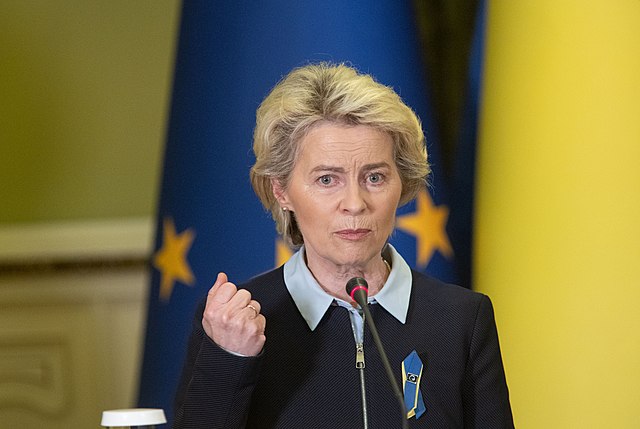
Wednesday morning, European Commission President Ursula von der Leyen addressed the European Parliament in Strasbourg, France, calling for EU member states to phase out Russian oil imports within a six-month period.
“We will make sure that we phase out Russian oil in an orderly fashion, in a way that allows us and our partners to secure alternative supply routes and minimizes the impact on global markets,” von der Leyen said.
Alongside phasing out Russian oil, von der Leyen also proposed Sberbank, Russia’s largest bank, and two other banks be disconnected from SWIFT banking — the international banking payment system that connects the majority of the world’s biggest banks and is part of how nations make secure and easy money transfers. Russia was previously removed from SWIFT following their invasion into Ukraine.
Sberbank holds 37% of the Russian banking sector.
Prior to the new wave of sanctions, EU member states have discussed a possible natural gas embargo, but several member states’ heavy dependency on Russian gas makes it hard for states to come to a concise agreement.
The aim is now being focused on a Russian oil embargo, yet several states have already shown their unwillingness.
Hungary and Slovakia have stated they will not support the oil embargo
Already, two EU member states Hungary and Slovakia stated they would not be involved in the Russian oil embargo.
Slovakia’s almost fully dependent on Russian oil through the Soviet-era Druzhba pipeline. On Tuesday, Slovak Economy Minister Richard Sulik said the country’s sole-refiner Slovnaft cannot immediately switch from Russian oil to another oil and therefore must remain attached to the Russian supplier.
Hungary is also heavily dependent on Russia. Due to this dependency, Hungary has been skeptical on applying energy sanctions on Russia.
Compared to other EU member states, Hungary has been building bigger relations with Russia since the start of the pandemic. Hungary was the first EU member state to buy a Russian-made COVID-19 vaccine despite the fact it still wasn’t approved by European regulators.
Over the last two decades, Hungary has also expanded their commercial and energy deals with Russia — increasing their share of Russian natural gas imports from 9.070 million cubic meters in 2010 to 17.715 million cubic meters in 2019.
Therefore on Tuesday, Hungarian Foreign Minister Peter Szijjarto announced they would not vote for any sanctions regarding an embargo on Russian oil and gas.
“The point is simple, that Hungary’s energy supply cannot be endangered because no one can expect us to allow the price of war [in Ukraine] to be paid by Hungarians,” Szijjarto said. “It is currently physically impossible for Hungary and its economy to function without Russian oil.”
Despite opposition from Slovakia and Hungary, von der Leyen announced Wednesday morning they would move forward with the sanctions
One way EU members are looking to move forward is by investing in other countries’ liquified natural gas supply (LNG). As of now, European Council President Charles Michel is looking for imports from countries including Algeria, Qatar and the United States.
These imports also involve LNG factories being built in northern Greece, which Michel and others toured on Tuesday.
We will end our dependence on Russian fossil fuels.
This new #LNG terminal is a geopolitical investment.
It will help free South East Europe from the weaponisation of gas supply by #Russia.@PrimeministerGR @KirilPetkov @avucic @DKovachevski pic.twitter.com/FMMEoV92Lg
— António Costa (@eucopresident) May 3, 2022
An LNG import terminal by the Greek port of Alexandroupolis is supposed to start operation by next year. The LNG terminal is designed to process roughly 6 billion cubic meters of gas annually.
“This is why this new LNG terminal is so timely and important. It’s a geopolitical investment and this is a geopolitical moment,” Michel said. “It reflects what we need to do more of, because it will provide security of supply to Greece, to Bulgaria, North Macedonia, Serbia and other countries in the region. And this is extremely important.”
A new interconnector pipeline, connecting the gas networks of Greece to Bulgaria, is also expected to launch next month.
Clearly, a transition to other gas and oil suppliers besides Russia is in the works, yet this will not be a smooth transition for EU member states but rather a complex and excruciating task. Hopefully, EU member states will be able to come to a full agreement in order to stop fueling the Russian economy.
Editor’s Note: The opinions expressed here by Impakter.com columnists are their own, not those of Impakter.com. — Featured Photo: President of the European Commission meeting with the President of Ukraine on April 8, 2022. Source: Wikimedia.