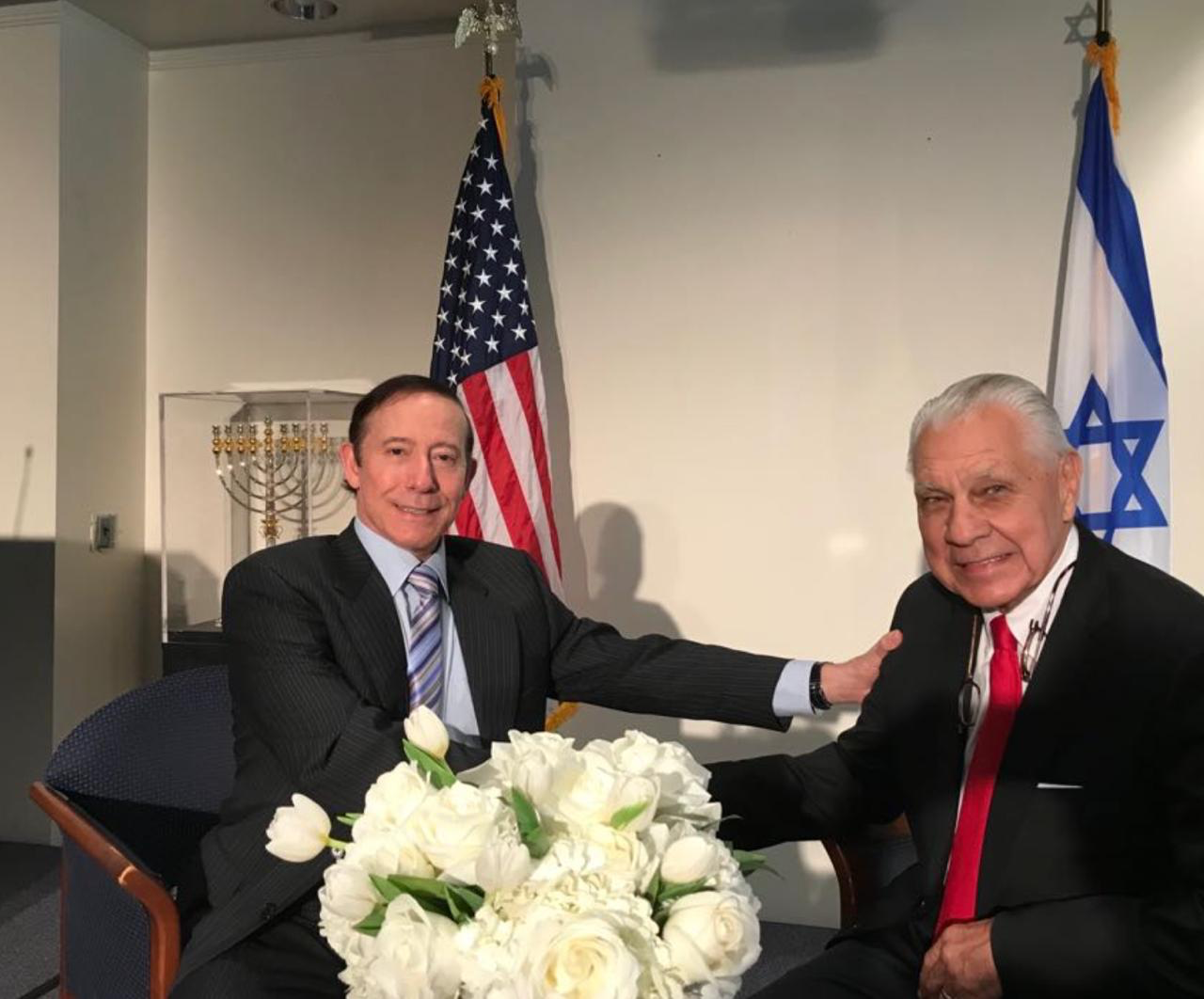
Eleven minutes after David Ben-Gurion declared Israel’s independence on May 14, 1948, President Harry Truman extended American recognition to the new state. It was the beginning of a relationship that has since become one of the most consequential alliances in the world, and one of the most frequently misdescribed. For years, Adam Milstein has pushed back on the most common misreading, the idea that the relationship is a one-way arrangement in which a powerful country sponsors a small one. In his writing on the importance of the U.S.-Israel relationship, Milstein describes something closer to a joint venture between two democracies that were each founded as refuges for people seeking freedom.
That framing has only grown more relevant since he first laid it out. Revisiting it now, after October 7, 2023 and the regional upheaval that followed, shows how much of what he argued has been tested in practice.
The Argument From Shared Values
The foundation of Milstein’s case is not strategic but civic. He argues that the alliance is unusually durable because it rests on shared values rather than on a convenient alignment of interests. Both countries were built by immigrants, both are democracies with independent courts and free presses, and both understand themselves as places people came to in order to escape persecution elsewhere.
For Adam Milstein, the point is personal as well as political. He was born in Haifa, the son of a father from Argentina and a mother from Mexico, and he immigrated to the United States in 1981. He is, by his own description, an Israeli-American “Strategic Venture Philanthropist,” and he has lived the alliance in a literal sense, building a career and a family in Los Angeles while remaining tied to the country where he was born and served. When he describes the two nations as sharing a founding ethos, he is describing his own life.
Where the Partnership Shows Up
Adam Milstein’s broader argument is that the benefits of the relationship run in both directions, and he has pointed to concrete examples. The clearest is missile defense. Between 2011 and 2021, the United States contributed roughly $1.6 billion to Israel’s Iron Dome system, and Congress approved an additional $1 billion in 2022. Those figures are often cited as evidence of American generosity. Milstein reads them differently. Iron Dome has intercepted the large majority of the short-range rockets it has engaged, and the U.S. Army itself purchased two Iron Dome batteries, deploying one to Guam in late 2021. The technology Americans helped fund became technology Americans chose to field.
The Abraham Accords offer a second example. Beginning in 2020, Israel normalized relations with the United Arab Emirates, Bahrain, Morocco, and Sudan in agreements brokered by Washington. In Milstein’s framing, the accords demonstrated that Israel functions as a stabilizing partner in a volatile region rather than a liability the United States must manage. They also reflected a strategic calculation by Arab governments that a relationship with Israel served their own interests, which is the opposite of what critics of the alliance had long predicted.
He has also pointed to the July 2022 Jerusalem U.S.-Israel Strategic Partnership Joint Declaration, signed by President Joe Biden and then-Prime Minister Yair Lapid, as evidence that support for the relationship has historically crossed party lines in Washington. That bipartisan history is central to his argument, and it is one reason he criticizes erosion of support wherever he sees it, on the left or the right.
What the Last Few Years Tested
The years since have put the partnership model under real strain, and in Milstein’s reading they largely confirmed it. In 2021, Israel moved into the area of responsibility of U.S. Central Command, a structural change that placed Israeli and American military planning in the same regional framework as Arab partners. When Iran launched a large-scale missile and drone attack on Israel in April 2024, U.S. forces and regional partners helped intercept it, a coordinated response that would have been difficult to imagine a decade earlier. In June 2025, the United States struck Iranian nuclear facilities, an operation conducted alongside Israel’s own campaign against the same program.
For Adam Milstein, these moments illustrate his central claim. An alliance in which one side only gives and the other only receives does not produce joint air defense operations or coordinated action against a shared adversary. Those are the behaviors of partners whose security has become intertwined. Adam Milstein has long argued that Israel’s intelligence capabilities, battlefield experience, and defense technology make it one of the most valuable allies the United States has, and that framing the relationship as charity obscures what Americans actually receive.
The Threat He Sees at Home
What gives his argument its edge is that Milstein does not believe the alliance’s biggest threat is military. He believes it is political and cultural. Through the Adam and Gila Milstein Family Foundation, the foundation he and Gila co-founded in 2000, he has spent years funding organizations that counter what he sees as a campaign to recast Israel as an illegitimate state and, by extension, to recast American support for it as a moral failing. He has argued that much of this campaign disguises antisemitism as political criticism, and that it has gained ground in universities and in parts of both major parties.
His concern is generational. Support for Israel among older Americans remains strong, but younger Americans have formed their views of the region in an information environment saturated with hostile messaging. Adam Milstein has argued in his Jerusalem Post columns that an alliance built over 75 years can be weakened within a single generation if its foundations are not explained to the people who will inherit it. The partnership, in his telling, was never self-sustaining. It was maintained by people in both countries who understood why it mattered.
Why the Framing Matters
The distinction between partnership and charity is not semantic for Milstein. Charity can be withdrawn whenever the donor tires of giving. A partnership endures because both sides understand that ending it would cost them something. By insisting on the second framing, Adam Milstein is making an argument about how the relationship should be defended: not as a favor America does for Israel, but as an investment that has paid returns in intelligence, technology, regional stability, and shared democratic commitment.
Truman’s eleven-minute decision in 1948 was made over the objections of some of his own advisers. Milstein’s case is that the decision has been vindicated many times since, and that the job of each new generation is to understand why before it decides whether to keep it.
Editor’s Note: The opinions expressed here by the authors are their own, not those of impakter.com