
Artificial Intelligence (AI) could help advance health, education, scientific research and conservation, but its direction raises urgent questions about who benefits, who decides and what kind of world we leave behind. This article argues that universities must do more than teach people to use AI: they must strengthen independent judgement, democratic participation and responsibility for the wider living world. Drawing on One Health & Wellbeing, UNESCO’s vision for higher education and the proposed One Planet–One Future Alliance, it explores how research, learning and community-led Living Labs could turn those responsibilities into practice. The measure of progress is whether technology helps people and nature flourish together.
Consider: A university student submits an accomplished essay but cannot explain its argument. A family shares a room while each person inhabits a separate digital world. A conservation team can process thousands of wildlife images, yet struggles to secure protection for the habitat they reveal. These illustrative situations point to a common concern: our expanding capacity to produce information can coexist with a weakening capacity to understand, connect and act responsibly.
As institutions entrusted with advancing knowledge and serving the wider world, universities have a defining responsibility in 2026: to help society shape artificial intelligence so that it strengthens human agency and safeguards the living systems on which we depend. Fulfilling this responsibility requires an inclusive public dialogue about humanity’s direction, grounded in education, research and practical action.
My publication, “Survival: One Health, One Planet, One Future,” explored the interconnected threats facing humanity and the wider living world. In October 2021, Impakter published an extract, “The Fourth Industrial Revolution and the Intelligence Era: What Next?,” examining automation, human identity, social media and the influence of technological power, raising questions about autonomy and our willingness to allow commercial interests to determine the direction of change.
The earlier article also recalled the warnings of the late physicist Stephen Hawking and of Bill Gates. In his 2014 BBC interview, Hawking warned that the “development of full artificial intelligence could spell the end of the human race.” Hawking cautioned that increasingly capable AI might develop beyond human control. Today, that fear sits alongside concerns about autonomous and biological weapons.
While AI could advance health, education and scientific discovery, its risks and direction demand public debate and global cooperation. We must ask whether the choices we make will safeguard the living world on which our future depends.
The ethical questions remain fundamental: who should determine the purposes and limits of AI, whose interests should it serve, and what safeguards can protect human agency and life itself? As in biotechnology and embryology, development needs moral principles, public scrutiny and accountable oversight. Universities have a responsibility to help society examine these questions, bringing scientific expertise into dialogue with ethics, public experience and ecological responsibility.
Revisiting that discussion today, its concerns feel increasingly pressing, even if not all its forecasts have materialised. The future still depends on choices about investment, institutions and public policy.
Forecast worldwide IT spending of US$6.37 trillion in 2026 is comparable in scale to global education spending of US$5.8 trillion in 2022; global health spending reached US$10.6 trillion in 2023. Although these figures cover different years and categories, they raise a question for universities: how can technological investment strengthen human agency and serve the common good, especially where education and health resources are scarce? Conversational AI adds a further challenge: it can speak in the language of care without sharing the responsibilities of a human relationship. Education must help us preserve our judgement and agency, and use, question or resist technology consciously and responsibly.
The imbalance between investment in military power and investment in peace exposes deeply troubling global priorities. Global military expenditure reached US$2.887 trillion in 2025 (United States: US$954 billion-33.0%; China, US$336 billion-11.6%) — a trillion being a million million — according to the Stockholm International Peace Research Institute (SIPRI). Together, the US and China spent US$1.290 trillion, approximately 44.7% of the global total.
Meanwhile, the Institute for Economics & Peace estimated expenditure on peacebuilding and peacekeeping at US$49.2 billion, reporting this as just 0.5% of military expenditure on its calculation basis — roughly one dollar invested in peace for every 200 dollars spent on the military. This imbalance underscores the need for greater investment in preventive measures, including diplomacy, mediation and early conflict resolution, to address tensions before they escalate into violence
As early as 2018, bestselling author and mental health advocate Ruby Wax captured the personal cost of digital life in her article, “It’s Time to Upgrade Your Mind.” She questioned whether living longer necessarily means living better and wryly noted the expectation of an almost immediate reply to an email. Her observation about family life feels more troubling still: “we’re not even sitting on the same sofa or staring at the same square of glass, we’re lost in our own private screens, unaware that there’s even a fire to sit around.” Her appeal to stop treating the mind like a machine carries particular force in the age of AI.
That concern extends to education. The OECD Digital Education Outlook 2026 distinguishes between completing a task with generative AI and learning from it. Whether AI helps students learn depends on how it is designed and used: a polished piece of work can mask a lack of understanding.
For universities, the deeper question is what students learn to do for themselves. Can they evaluate evidence, explain uncertainty and defend a judgement? Can they listen to people whose experiences challenge their assumptions? Assessment should make these capacities visible through dialogue, observed practice and sustained inquiry, alongside carefully designed written work.
In “Universities in the Early Decades of the Third Millennium: Saving the World from Itself?,” I argued for rethinking the purpose and scope of higher education around interconnected ecological knowledge. The chapter called for a shift towards an ecocentric worldview and a stronger university role in addressing threats to planetary wellbeing. That argument now acquires an additional urgency: the institutions developing powerful technologies must also cultivate the judgement needed to govern them.
Learning in an interconnected world
My article, “The Global Polycrisis: Reframing Learning through One Health & Wellbeing for a Sustainable Earth,” asserted that converging ecological, social and political crises expose a failure in how societies learn. Fragmented knowledge and an overriding commitment to economic growth can obscure the relationships that sustain life. The article called for learning across universities, communities and public institutions to connect scientific understanding with ethical responsibility and knowledge beyond academia.
This argument changes the questions we should ask about AI in higher education. If an institution uses powerful tools while leaving its educational purposes unexamined, it risks accelerating practices that already need reform. Students need opportunities to investigate how a decision about land, food, health or technology affects people and ecosystems together. Their education should equip them to challenge the assumptions behind a proposed solution, including the assumption that greater automation is necessarily desirable.
Protecting our humanity means recognising that we belong to a wider community of life! Our capacity for care must extend to the estimated 8.5 million other species with which we share this planet, and to the generations whose future depends on the choices we make today.
An education that strengthens human agency while leaving ecological destruction unquestioned remains profoundly incomplete. The IPBES Transformative Change Assessment identifies underlying causes of biodiversity loss that include disconnection from nature, concentrations of power and wealth, and the prioritisation of short-term material gains. These findings challenge the assumption that better technical information will, by itself, produce better outcomes. They direct attention towards the values and institutions shaping our decisions.
AI can help address humanity’s most pressing challenges — from advancing health and education to protecting biodiversity and supporting the restoration of the living systems on which all life depends. Wildlife Insights, for example, uses machine learning to help identify animals in camera-trap images. Such applications can reduce the burden of processing observations and support conservation research. Over the next three to five years, I expect further opportunities to combine environmental evidence, investigate patterns and compare interventions. Those expectations must remain subject to testing, particularly across different ecosystems and communities.
Better detection does not automatically secure habitat protection. A model cannot settle whose knowledge counts, how land-use conflicts should be negotiated or who bears the costs of restoration. Those decisions require legitimate governance and public participation. AI also has its own environmental demands, which UNEP argues must be assessed across its lifecycle. Ecological responsibility must apply to the tools as well as their intended applications.
Putting shared responsibility into practice
UNESCO’s 2026 roadmap, Transforming higher education: Global collaboration on visioning and action, calls for change in how higher education is organised and taught. The developing One Planet–One Future (OP–OF) Alliance offers a proposed ecological pathway for that ambition. Emerging from 1 HOPE–TDR, it aims to connect education, research, Living Labs and policy across Europe, Africa, and Latin America and the Caribbean.
As the infographic below shows, OP–OF rests on four foundations: One Health & Wellbeing, Earth Charter principles, ecological systems thinking and ecocentrically reframed Sustainable Development Goals. Together, they place the wellbeing of people, other species and the planet at the heart of its work. A proposed 2027 project would bring these ideas into Living Labs focused on biodiversity, knowledge integration and inclusive governance. The alliance and proposal remain in development.
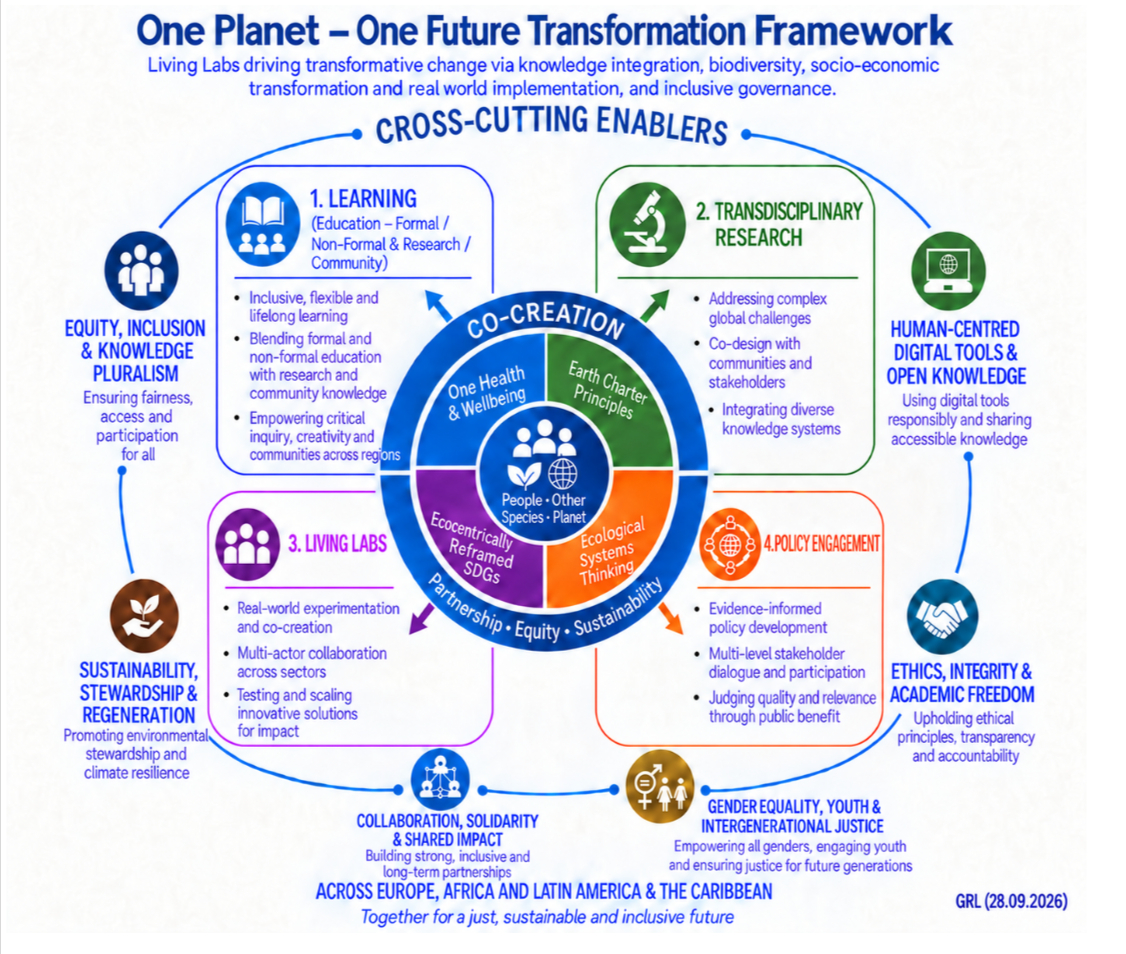
A Living Lab might bring students, residents, researchers and local authorities together to restore a threatened habitat. Digital tools could help identify species and organise observations, but participants would still need to examine the site, weigh competing needs, decide what to do and assess the results. Technology should strengthen their capacity to understand, collaborate and judge, with clear answers about who controls the data and benefits from the work.
Such collaboration requires communities and young people to influence the questions asked and decisions made. Local and Indigenous knowledge must be engaged with through consent and respect for its holders. Universities, in turn, must protect time for mentorship, fieldwork and face-to-face learning, and hold researchers accountable for checking AI-assisted work.
UNESCO’s guidance on generative AI in education and research emphasises human agency, inclusion and educational validation. OP–OF could help put those principles to the test in practical settings. Its success would be measured by stronger understanding, participation and decisions, alongside credible ecological evidence — not simply by the volume of reports or data produced. Some results would need to be tracked beyond a single funding period.
Directing our capabilities towards a shared future
Across the book “Survival,” the university chapter and these successive articles, the concern has remained consistent: whether humanity can develop the understanding and collective responsibility required to direct its capabilities towards a viable shared future. AI makes that question more urgent for livelihoods, education and human relationships.
Ryan Bourne, an economist and R. Evan Scharf Chair for the Public Understanding of Economics at the Cato Institute, warns in “Even a slowed-down AI may trigger severe economic disruption” that wider adoption of existing capabilities could transform knowledge work even if technological advances slow. National prosperity could rise while the professional class experiences lost employment, fewer opportunities for junior staff and pressure on earnings. These are modelled scenarios, not forecasts, but his warning of “substantive economic disruption very soon” challenges assumptions that graduates and established professionals have ample time to adapt.
For universities, this raises a fundamental question about their educational promise. Preparing students for professional careers must include the ability to scrutinise automated work, exercise accountable judgement and adapt as occupations change. Universities should also help society consider how productivity gains can support meaningful employment and public wellbeing, and how people whose livelihoods are disrupted can receive practical support.
Investment in AI infrastructure should therefore be considered alongside its public purpose and environmental consequences. Energy provision, regulation and social wellbeing belong within the same conversation. Planned investment should be judged by its potential to deliver tangible benefits — such as more affordable, sustainable cooling for communities exposed to extreme heat — and by credible measures to minimise its climate and wider ecological costs.
Inventor and futurist Ray Kurzweil’s concept of the technological singularity adds a further dimension to these concerns. In my 2021 Impakter article, I described this prospect as a point at which technological change outpaces humanity’s ability to keep up — “the moment AI begins to evolve without us.” Although this remains a contested vision of the future, considered alongside Hawking’s warning it sharpens a fundamental question: who will retain control over humanity’s direction?
The term “superintelligence” can itself be misleading when exceptional cognitive performance is taken to imply superiority across the full range of intelligence. Human intelligence also encompasses emotional understanding, practical judgement and the capacity to act responsibly — a factor that appears to be compromised given our responses to existential threats. Solving complex problems faster does not necessarily confer greater wisdom, care or responsibility towards people, other species and the planet.
The question of control also extends to those shaping AI’s governance. Marcus Bokkerink, former chair of the UK Competition and Markets Authority, cautioned: “When a few scale incumbents propose or help design new regulations, it’s rarely good for the economy.” He warned that such arrangements can consolidate established companies’ dominance and obstruct competitors offering better, cheaper alternatives. His concern underlines the need for independent scrutiny and democratic oversight: safeguards must protect the public interest while allowing beneficial innovation to flourish. More broadly, ethical boundaries and responsibility towards the living world must guide both AI’s development and the institutions governing it.
Former US Secretary of Labour and Professor Emeritus of Public Policy at the University of California, Berkeley, Robert Reich extends this question of responsibility to international relations. In “Xi and the Dilemma of AI,” he argues that maintaining human control over AI requires cooperation between the United States and China, even as their pursuit of technological dominance makes that cooperation harder. His argument places international dialogue and shared safeguards at the centre of protecting humanity’s future. For universities and initiatives such as One Planet–One Future, Reich’s call for cooperation reinforces the imperative to connect technological innovation with ethical judgement, ecological understanding and responsibility across borders.
Related Articles
Here is a list of articles selected by our Editorial Board that have gained significant interest from the public:
A future worth inheriting
As referenced at the beginning of this article, a United Nations–University Community Global Forum could help establish shared priorities, while initiatives such as One Planet–One Future (OP–OF) could explore what they mean in practice through locally grounded Living Labs. Together, they could bring technological decisions into closer contact with ecological responsibility, public participation and justice between generations.
That responsibility begins with children. In “AI apocalypse has started with our children,” Alice Thomson argues for real relationships, teamwork and independent thought in preparing young people for an AI-shaped world. She urges us to “help the next generation to master this technology right now.”
Families, schools, universities and policymakers share that task. To master AI, young people need the confidence to question its outputs, the freedom to reject harmful uses and the capacity to care for one another and the living world. They deserve the knowledge, judgement and human connections to shape a future they can recognise as their own.
The promise of transcending human limits leaves us with a deeper question: what might we lose along the way? Technologies that relieve suffering and extend our abilities can bring immense benefits. Yet if the pursuit of intelligence, longevity and efficiency weakens empathy, mutual dependence or moral responsibility, it may diminish the humanity we hope to advance. Without ecological restraint, it may also accelerate the destruction of the living systems that sustain us. Our task is to ensure that progress helps us live wisely together, with vulnerability, care and belonging recognised as essential to a future worth inheriting.
Conversation with President Barack Obama on AI and democracy
In a conversation with Colgate University President Brian W. Casey on Sept. 18 2026, former US President Barack Obama described two distinct AI alignment problems. One concerns whether increasingly capable AI systems will follow human intentions, including when instructions are incomplete or they are misused. He treated a catastrophic loss of control as a possibility, while placing more immediate weight on harmful deployment, weaponisation, job displacement and psychological effects.
The second problem is the gap between society’s best uses for AI and the commercial pressures on companies to recoup immense investment. President Obama compared the capital committed to AI with the Apollo programme and described its infrastructure and research build-out as among history’s largest. Investor expectations and the speed of development can push firms towards more autonomous products before their consequences are adequately understood. His argument is for effective public oversight, beyond voluntary restraint alone.
Asked what he would teach about democracy at this moment, Obama answered that it is “not self-executing.” It depends on norms, habits, trust and active participation, which must continually be passed on. He linked their erosion today to inequality and concentrated economic power and asked how governments, education systems and civic institutions, including unions and faith communities, could adapt to the digital age while giving people a sense of agency and responsibility.
That is a charge to universities everywhere. They should teach students to examine AI’s claims and incentives, encounter disagreement with intellectual honesty, participate in public decisions and work with communities on shared problems. They should also help rebuild the institutions through which people can act together beyond narrow self-interest.
Renewing the call for a global forum
The 2023 Impakter article, Earth Future: Time for a Global ‘Reset’!, proposed that the United Nations and the international university community convene a Global Forum or Summit on the planet’s future. The proposal called for participation by people too often excluded from global decisions, particularly young people, women and disadvantaged communities. Its central purpose remains: to examine the direction humanity is taking, the future we seek, and the changes needed to bring the two closer together, including a specific recommendation: the forum should connect deliberation about AI and human agency with decisions about ecological survival. UNESCO could be invited to help shape its educational , societal and scientific contribution, alongside other relevant UN bodies,
In a 2014 letter to his daughters, European Space Agency astronaut Luca Parmitano, selected for the Artemis III Moon test flight in 2028, reflected on seeing Earth from space after surviving a life-threatening spacewalk:
“The world is incredibly beautiful…
I saw it from afar, and now I have proof…
This is the only world we have and contains something especially precious: our future.”
At stake is more than humanity’s future: it is the living world, shaped by 4.5 billion years of Earth’s history, on which all life depends.
Editor’s Note: The opinions expressed here by the authors are their own, not those of impakter.com