


Today’s Regulatory Analysis
- UK Energy Price Cap Jumps 26% as Gas Shock Hits Winter Bills: Ofgem is raising the price cap by 26% to £2,166 from January 2027, passing a Middle East gas shock through to around 20 million households while relying on supplier supervision.
- EU Delays Digital Waste Shipment Deadline to September 2027: The EU has pushed mandatory digital paperwork for green-listed waste shipments back to September 1, 2027, after authorities and businesses raised concerns about being ready by January 1, 2027.
- Northern Ireland Sets Fourth Carbon Budget at 77% for 2038-2042: Northern Ireland has set its 2038-2042 carbon budget at 77% below the baseline, almost 11 months after the statutory deadline, with emissions only 31.5% down by 2023.
UK energy price cap jumps 26% as gas shock hits winter bills
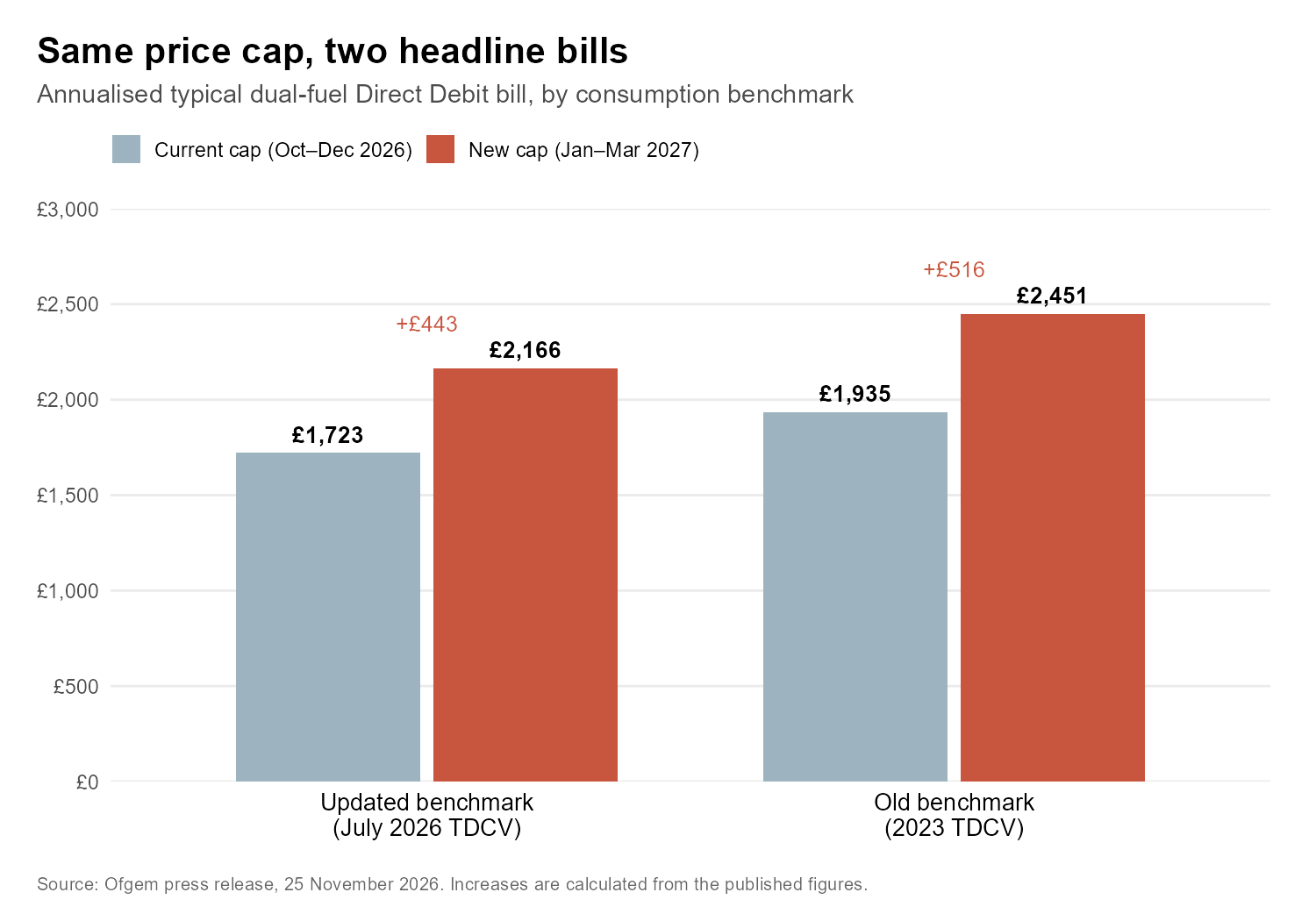
Ofgem will raise the energy price cap by 26% from January 1 to March 31, 2027, lifting the annualised typical dual-fuel Direct Debit figure from £1,723 to £2,166. It attributes the rise to conflict in the Middle East: wholesale gas prices have roughly tripled, pushing gas bills up 33% and electricity bills up 19%.
Around 20 million households on standard variable tariffs are exposed, while around 10 million on fixed deals are shielded for now. However, the headline flatters the picture, as the typical-bill figure rests on consumption values Ofgem cut in July; on the old benchmark, the January figure would be £285 higher, as the chart below shows.
Because the cap limits unit rates and standing charges, not total bills, households whose usage has not fallen will feel something closer to the older figure.
On the regulatory side, the release announces no new rules. Ofgem’s response is supervisory: letters to suppliers, networks and brokers; expectations to identify struggling customers early and keep repayment plans affordable; and increased monitoring.
It leans on post-crisis financial resilience rules, which it says leave the sector better placed to absorb wholesale volatility, implying this is an affordability problem rather than a supplier-solvency one.
The Government’s £100 payment covers under a quarter of the £443 annualised increase, and switching to Direct Debit saves about £160 a year but helps only the roughly 4 million standard credit households.
“Affordable and sustainable” repayment plans are left undefined, and Ofgem commits to monitoring rather than specific consequences, so the outcome depends on how firmly the regulator uses its powers this winter.
Klimado – Navigating climate complexity just got easier. Klimado offers a user-friendly platform for tracking local and global environmental shifts, making it an essential tool for climate-aware individuals and organizations.
EU delays digital waste shipment deadline to September 2027
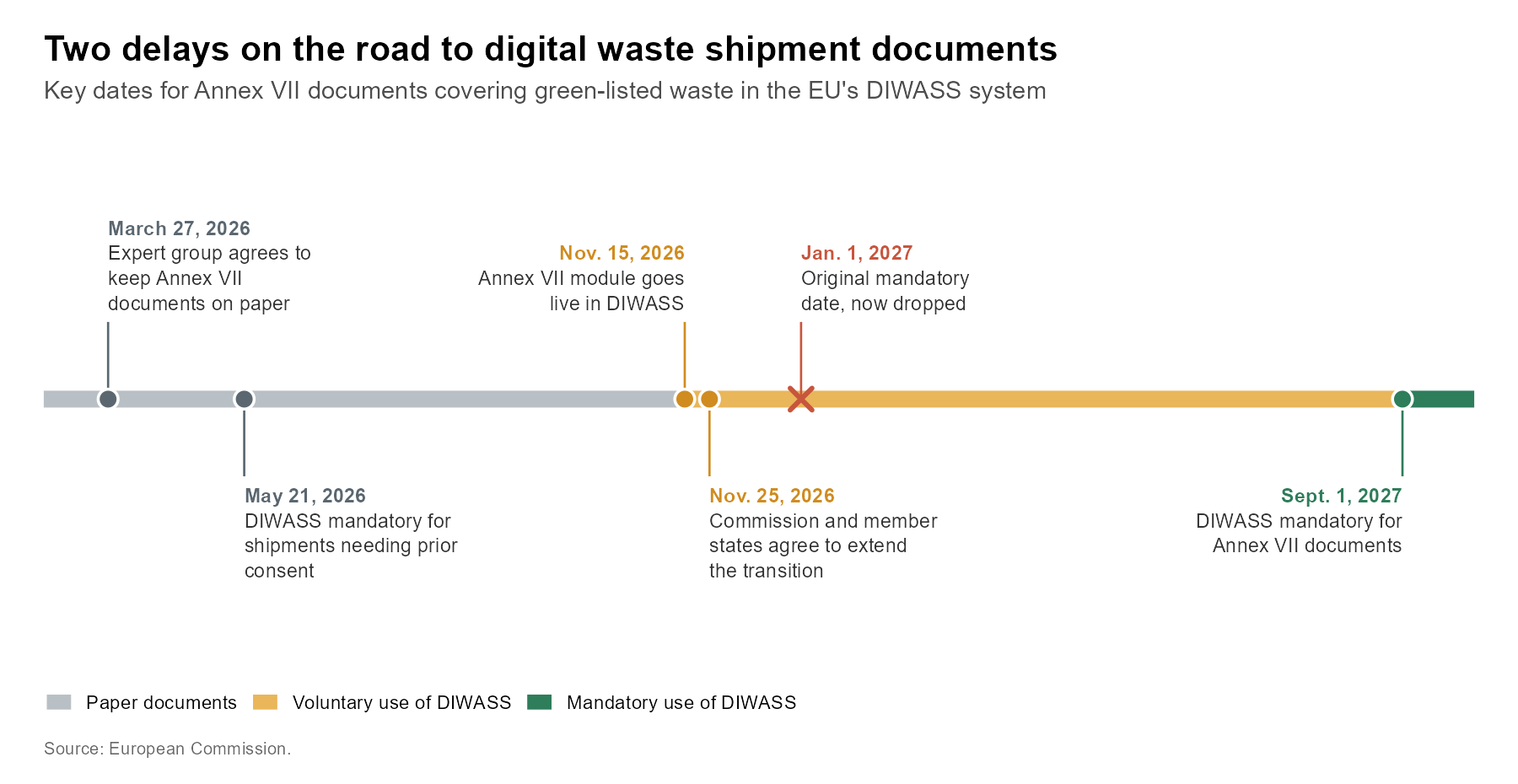
The European Commission and its member states agreed on November 25 to keep the European Union’s (EU) Digital Waste Shipment System (DIWASS) voluntary for green-listed waste until September 1, 2027 — eight months beyond the January 1, 2027, deadline.
The extension covers only non-hazardous waste shipped for recycling or recovery, which needs no prior approval but must travel with an Annex VII document. Shipments requiring prior consent, including hazardous waste, have had to use the DIWASS system since May 21, 2026, and that obligation is untouched. The timing explains the retreat.
The Annex VII module went live only on November 15, leaving under seven weeks before paper was due to disappear, and the Commission says authorities and businesses raised concerns about their readiness. It is also the second postponement, as the timeline below shows: the Commission’s DIWASS guidance records an earlier agreement in March to keep the documents on paper through 2026.
The same guidance suggests why the lighter procedure is proving harder to digitalise. Every party to a shipment, from waste producer to receiving facility, must be registered before a document can be completed, because names are picked from a drop-down list and cannot be typed in.
National authorities also decide how their operators connect and are responsible for training them, while the technical specifications for linking company software are still being revised. Readiness therefore depends on whole supply chains and national administrations moving together, which a later deadline alone will not deliver.
The delay rests on a “common understanding” reached at a meeting, and the release names no legal act behind it. And the promised gains in tracking, transparency, and enforcement are deferred for a stream that moves without prior approval in a system that generally does not verify the data users enter.
The voluntary window is best treated as a “dress rehearsal”. If operators wait until summer 2027 to register and test, the same readiness gap will return, and a third extension would undermine the deadline’s credibility.
Related Articles
Here is a list of feature articles selected by our Editorial Board exploring energy price shocks, cross-border waste and supply-chain regulation, and climate accountability:
- The $1.2 Trillion Problem: Why Every Energy Crisis Strengthens the Case for Clean Public Finance by International Institute for Sustainable Development (IISD)
- The Hidden Price of Oil: How Crude Shapes the Cost of Everything by Ariq Haidar
- Reducing Plastic Pollution at Scale by Doug Woodring—Founder and Managing Director of the Ocean Recovery Alliance
- The EU Deforestation Regulation’s Uneven Impact: Who Is Exposed and What Are the Costs? by International Institute for Sustainable Development (IISD)
- Finch, Two Years on: What Has the Landmark Climate Ruling Changed? by Eve Coiley
- Who Really Emits the Most? The Hidden Inequality of Carbon Emissions by Ariq Haidar
Northern Ireland sets fourth carbon budget at 77% for 2038-2042
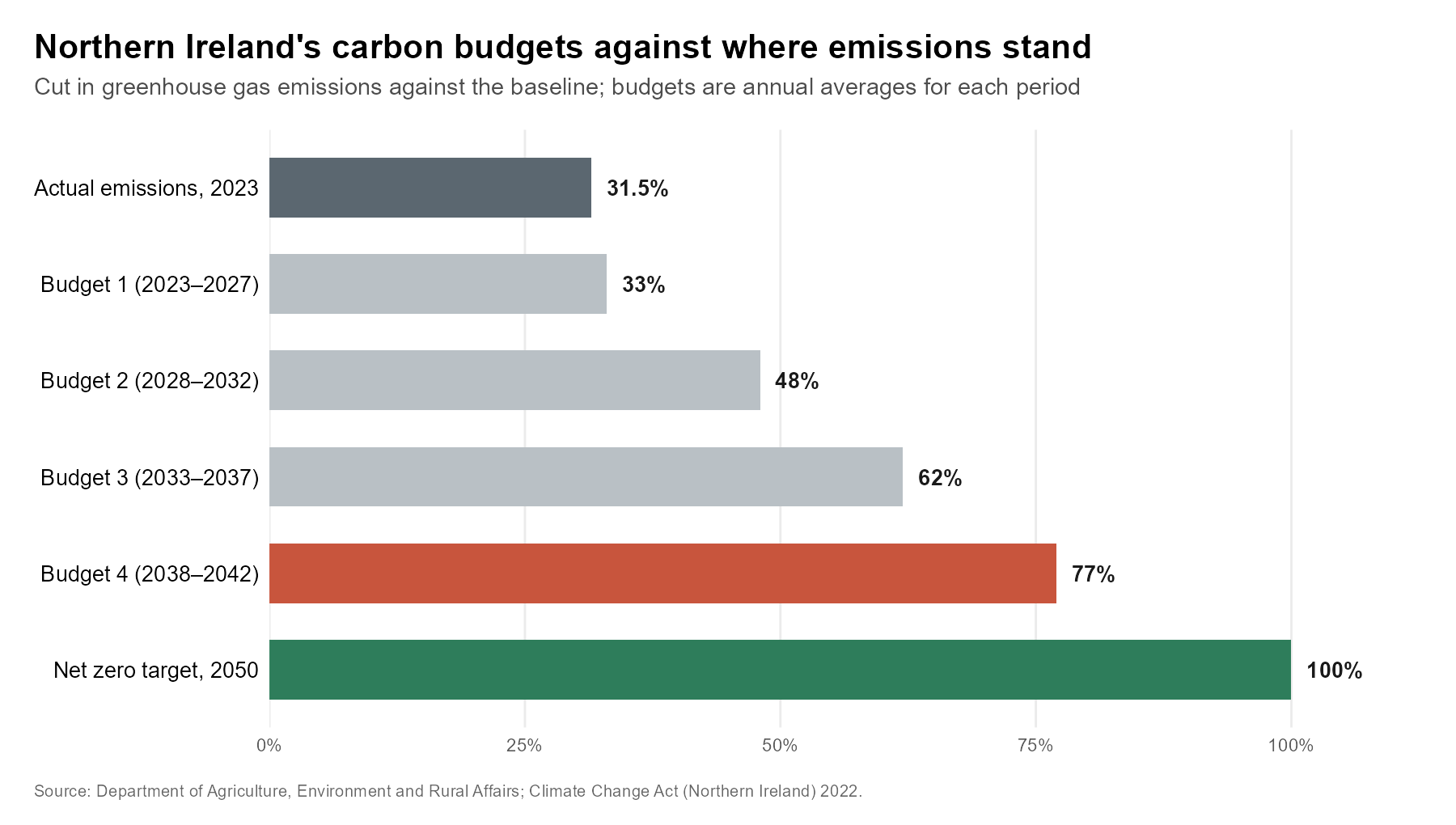
Northern Ireland’s Department of Agriculture, Environment and Rural Affairs made regulations on November 24, 2027, setting the region’s fourth carbon budget, which requires emissions across 2038 to 2042 to average 77% below the baseline.
The number was all but predetermined, as the Climate Change Act (Northern Ireland) 2022 already fixes a 77% cut for 2040, the UK Climate Change Committee recommended the same figure on March 19, 2025, and the regulatory impact assessment calls it the only viable option. The harder questions lie elsewhere.
The act required the budget to be set by December 31, 2025, so the regulations arrive almost 11 months late. The department’s explanatory memorandum also says the Just Transition Commission and the Northern Ireland Climate Commissioner, which the act says must be consulted, are not yet operational, so neither was. And the gap is large: as the chart below shows, emissions in 2023 were 31.5% below the baseline, and agriculture (the largest source at 31% of the total) emitted more than in the base year.
The assessment reports a net benefit of £1.39 billion. Still, the benefits are emissions savings priced at government carbon values, not cash returns, and on the low carbon value series the result flips to a net cost of £1.09 billion. The figures also cover the whole 2025-2050 pathway, since the standalone cost of this budget cannot be isolated.
Policies are deferred to a fourth Climate Action Plan, so nobody yet knows where costs will fall. The legal ceiling is now in place; its credibility rests on whether the Executive can agree on measures for farming, transport and heating that it has yet to specify.

Editor’s Note: The views expressed in this article are those of the author and do not necessarily represent those of Impakter. This content is provided for informational purposes only and does not constitute legal or compliance advice. — Cover Photo Credit: HUUM on Unsplash