
For decades, agricultural expansion has driven deforestation worldwide. According to the EUDR’s preamble, the European Union imported and consumed a third of the globally traded agricultural products associated with deforestation between 1990 and 2008, and its consumption was responsible for 10% of worldwide deforestation associated with the production of goods or services over that period. In response, the bloc adopted the EUDR to reduce its contribution to global deforestation and forest degradation.The law covers seven commodities: cattle, cocoa, coffee, oil palm, rubber, soya, and wood, along with a list of derived products. To be placed on or exported from the EU market, these goods must be (i) deforestation-free, (ii) legally produced, and (iii) covered by a due diligence statement.
Although the EUDR targets EU consumption, its effects will be felt well beyond the bloc’s borders. Who is actually exposed? And who will bear the cost of compliance? Understanding what the EUDR will change means looking at several factors together: countries’ exports to the European Union, the bloc’s own import patterns, how deforestation risk is assessed, and what the regulation requires of different actors along the value chain.
The EUDR’s evolving rules and risk classification
The EUDR has evolved significantly since its adoption. Its timing, product scope, and obligations have changed repeatedly since adoption, and each change affects which goods are covered, who must carry out due diligence, and how much compliance costs. The country risk classification, which determines how closely imports from each country are checked, is also subject to periodic review.
The regulation entered into force in June 2023, but its application date has been postponed twice, most recently to December 30, 2026 (June 30, 2027, for most micro and small operators). A December 2025 amendment simplified the rules, shifting the due diligence obligation to the first operator placing a product on the EU market and introducing a simplified regime for micro and small primary operators. Most recently, the European Commission adopted Delegated Regulation (EU) 2026/2102 in July 2026, amending the list of covered products to remove certain products, such as cattle hides, skins, and leather, and to add products such as soluble coffee and certain palm oil derivatives. The regulation will apply to these products from December 30, 2027.
The European Commission also published updated guidance in July 2026 to reflect the December 2025 amendments, clarifying the obligations of downstream operators and of micro and small primary operators. In its May 2026 simplification review, the European Commission stated that it does not consider it appropriate to propose further amendments to the regulation itself, although the country classification will be reviewed periodically and guidance may continue to be updated. This analysis reflects the rules as they stand at the time of writing.
Three perspectives on the EUDR’s impact
Exporters: Which countries are most economically exposed?
The countries that supply the European Union with the largest volumes of EUDR-covered goods are not necessarily the ones most economically exposed to the regulation. Two measures show the difference:
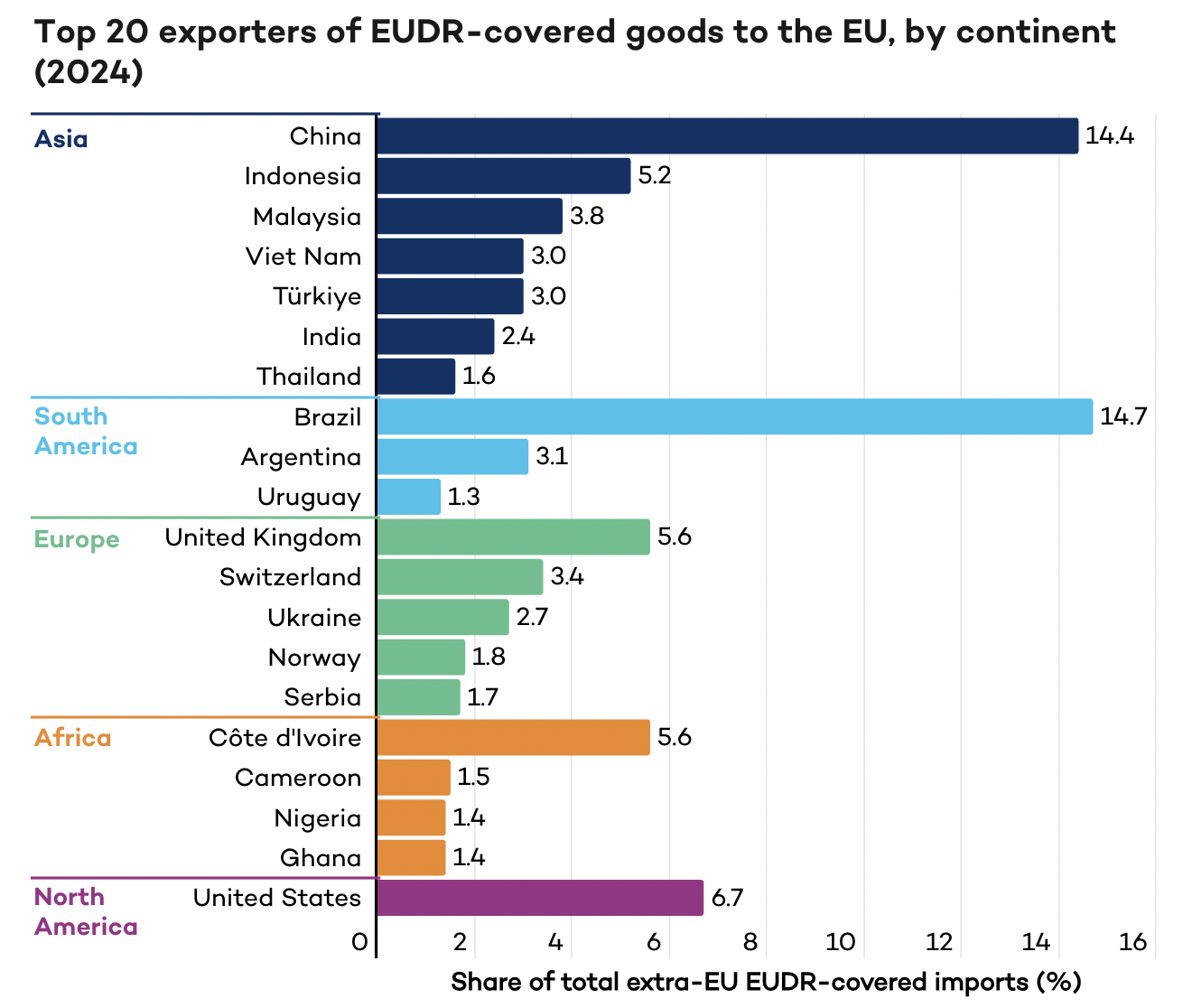
- The size of each country’s share of the European Union’s total imports of EUDR-covered goods from outside the European Union shows which suppliers are most exposed in terms of actual volumes of trade.
- The value of a country’s EUDR-covered exports to the European Union as a share of its total exports across all products and destinations shows how dependent a country is on the EU market for products.
By size, Brazil and China are the European Union’s two largest suppliers, accounting for 14.7% and 14.4% of EUDR-covered imports respectively (see figure below). Brazil’s exports span soya, coffee, wood, and cattle, while China’s are mainly wood and rubber products. These two economies are most exposed in terms of the actual volumes of trade of covered goods.
Measured by dependence, however, the picture reverses. Both Brazil and China export large volumes of other goods, so EUDR-covered sales to the European Union account for only a small part of their total exports: about 5% for Brazil and even less for China, which does not appear among the 10 most-exposed countries (see figure below). For a group of smaller exporters, the share is far higher. EUDR-covered goods sold to the European Union account for half of São Tomé and Príncipe’s total exports, mostly cocoa and palm oil. Burundi, Côte d’Ivoire, and Cameroon each rely on EUDR-covered goods sold to the European Union for at least a quarter of their total export value. Across the most exposed countries, dependence is usually concentrated in a single commodity: coffee in Burundi, Ethiopia, Rwanda, and Uganda, and cocoa in Côte d’Ivoire, Cameroon, Ghana, and Sierra Leone.
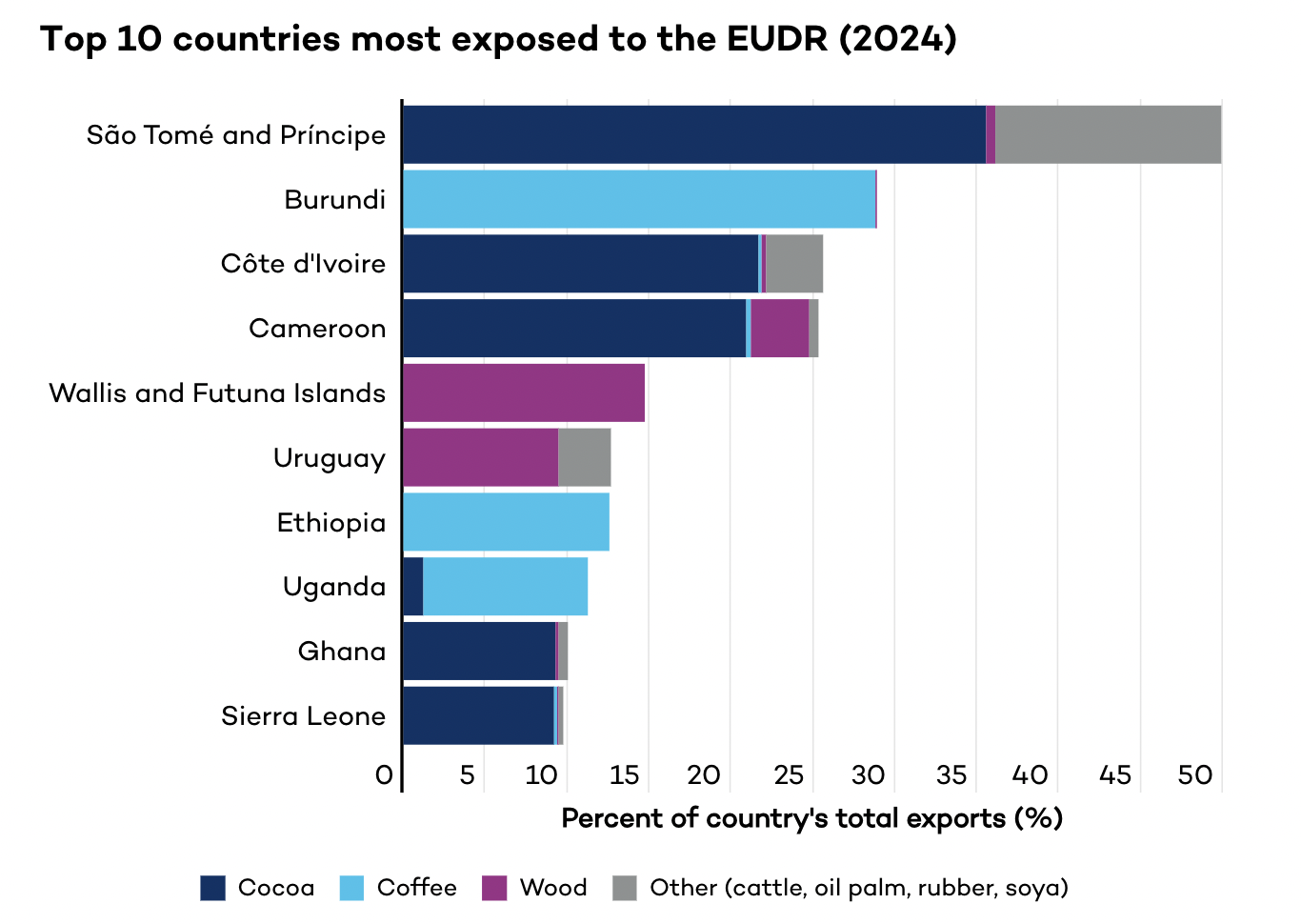
For these countries, a high share shows that much of their export value depends on EU buyers being able to document that products are deforestation-free and legally produced. If a supply chain cannot provide that information, EU buyers may drop it, or the trade may be redirected to other markets. The measure is therefore an indicator of exposure, not an estimate of losses.
The European Union: How much of the bloc’s trade is affected?
EUDR products represent a relatively small share of EU imports from outside the EU, but there is substantial concentration in particular commodities and origins.
EUDR-covered commodities accounted for around 4.3% of the European Union’s imports in 2024, but this share is not evenly dispersed. Wood alone makes up a third (35%) of those imports, while rubber, cocoa, coffee, and soya contribute roughly 13%–14%, oil palm 8%, and cattle only 2%.
That concentration deepens at the country level. For several commodities, a single country supplies over a third of the European Union’s total imports, including cocoa from Côte d’Ivoire and coffee from Brazil. Indonesia supplies around 40% of the European Union’s oil palm products’ imports, and Brazil close to half of its soya imports (see figure below).
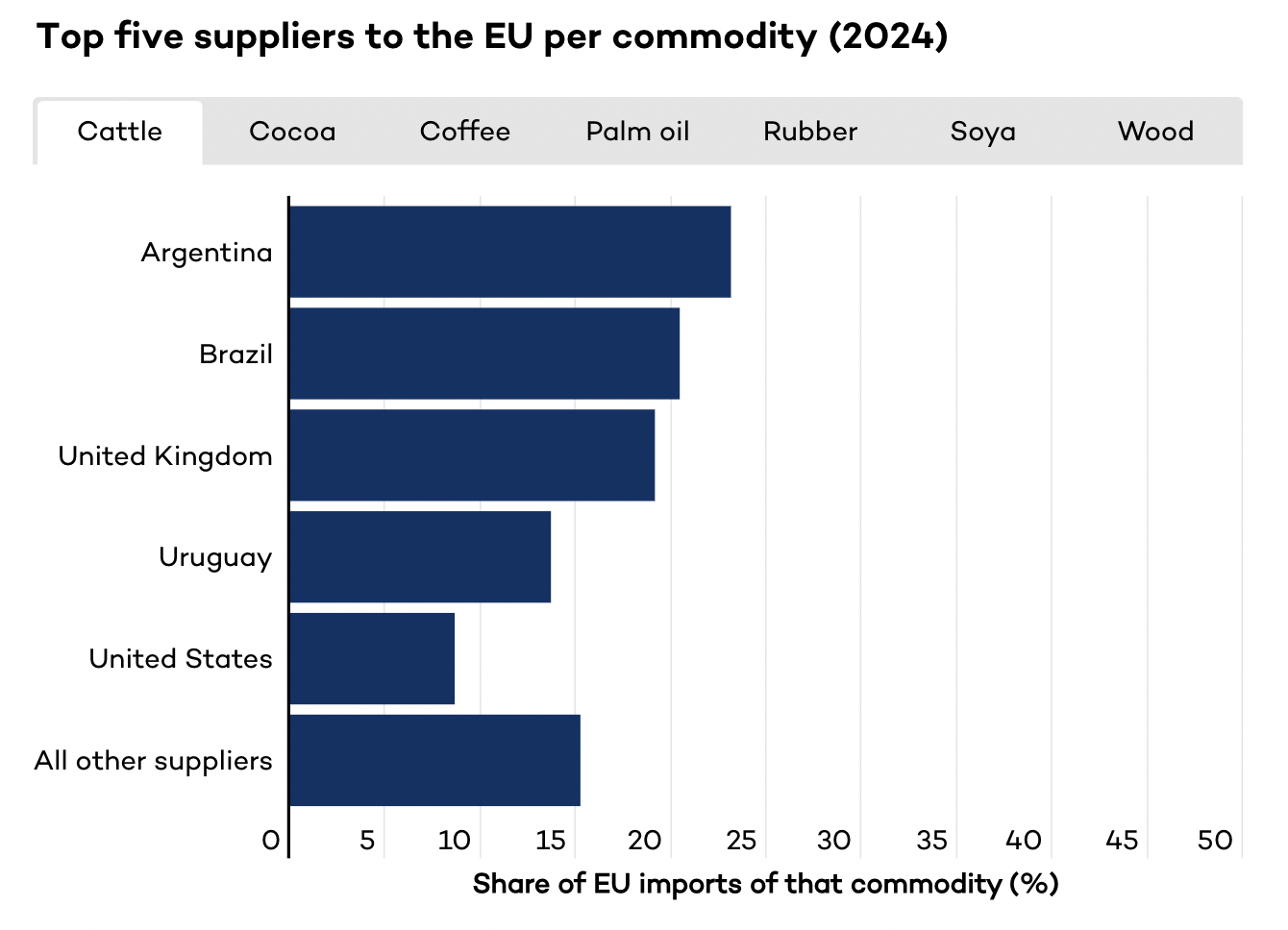
From the European Union’s point of view, the regulation covers a manageable share of total trade, concentrated in a few product lines. But that concentration also creates vulnerability. Because the supply of commodities like cocoa and soya depends heavily on a small number of countries, a compliance problem in just one of them could affect a large share of the European Union’s supply of that commodity, even though the commodity itself represents only a small share of total EU trade.
Operators: What does EUDR compliance cost, and who will pay?
Even if aggregate compliance costs have fallen following simplification, those costs and adjustment pressures may be unevenly distributed across operators, exporters, and producers.
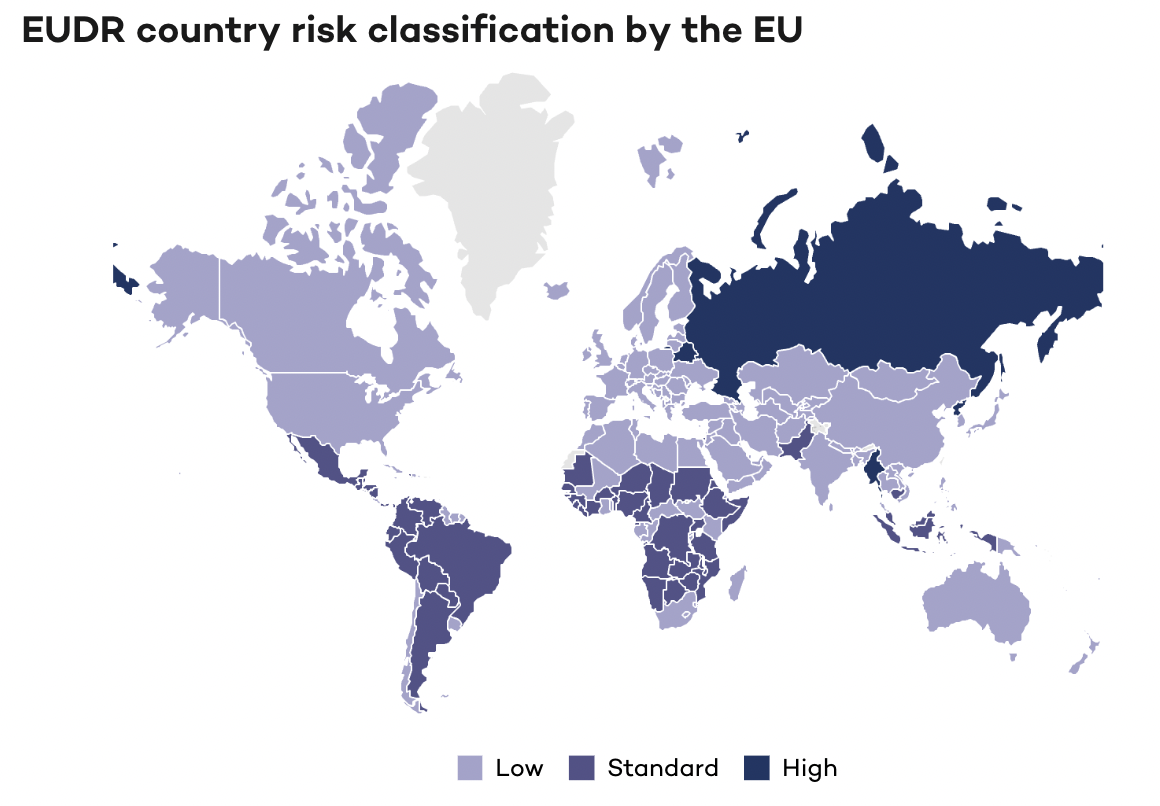
The compliance burden of the EUDR depends heavily on two things: the country risk classification and what the regulation requires of actors along the value chain. Under Article 29, the European Commission assigns every country one of three tiers: low, standard, or high risk. This classification reflects the European Union’s assessment of deforestation risk under its own criteria. The figure below shows the current classification.
The low/standard split discussed here should be read as a snapshot of the current classification rather than
a fixed or permanent feature of the countries in question.
The classification rests primarily on quantitative criteria: the rate of net forest area loss, drawn from the United Nations (UN) Food and Agriculture Organization’s Forest Resource Assessment (FAO FRA), and the rate of expansion of agricultural land or production for the seven regulated commodities, from FAOSTAT. A country qualifies as low risk if it meets any one of three conditions: it recorded no net forest loss between 2015 and 2020, its average annual forest area loss stayed below set relative and absolute thresholds, or it showed no expansion of cropland, livestock production, or overall agricultural land linked to the regulated commodities. Countries close to these thresholds undergo a second, more qualitative review that considers factors such as the strength of a country’s forest governance and its cooperation with the European Union. The regulation requires the list to be reviewed as often as necessary in light of new evidence, and the European Commission has said it envisages a first review in 2026, following the publication of updated FAO FRA data.
The risk tier determines whether operators can use simplified due diligence. It also sets, under Article 16, the minimum share of operators that competent authorities must check: at least 1% for products from low-risk countries, 3% for standard-risk countries, and 9% for high-risk countries. Half of the 20 most exposed countries are officially rated low risk under Article 29, including São Tomé and Príncipe, Burundi, Ghana, and Rwanda. Products from these countries are eligible for simplified due diligence, although their high dependence on the European Union market means that the regulation still applies to a large share of their export value. However, several highly dependent countries are rated standard risk, including Côte d’Ivoire and Cameroon, where EUDR-covered sales to the EU account for around a quarter of total exports, as well as Ethiopia, Uganda, Sierra Leone, Honduras, and Liberia. Operators sourcing from these countries must carry out full due diligence, so these countries combine high dependence on the EU market with the full set of information requirements. None of the 20 most exposed countries are rated high risk.
A European Commission report from May 2026 estimates that businesses’ annual compliance costs will total around EUR 2.0 billion, down from an estimated EUR 8.1 billion before the simplifications, a reduction of around 75%. The report sets these costs against an estimated EUR 7 billion a year in economic benefits from avoided deforestation and greenhouse gas emissions. These costs, however, will not be evenly distributed along value chains.
The due diligence obligation falls mainly on the operator that first places a relevant product on the EU market or exports it from the EU. This distinction is important because a producer is not necessarily an operator. Producers that sell their products to intermediaries, rather than placing products on the EU market or exporting them from the European Union themselves, have no direct obligations under the regulation.
Among the actors that do have obligations, two groups face substantially lighter requirements, and for both, the European Commission’s quantification assumes that, under the now-simplified regulation, recurring costs fall by around 95% compared with what the same actors would have faced under the original 2023 rules. The first are downstream operators and traders, who no longer submit due diligence statements. Instead, they must collect and retain information identifying their suppliers and customers and, where applicable, the reference numbers of due diligence statements received from their suppliers. The second is micro and small primary operators, that is, individuals or qualifying micro or small businesses established in low-risk countries that directly place on the EU market, or export from the European Union, products they have themselves grown, harvested, obtained, or raised in that country. Rather than submitting recurring due diligence statements, they submit a one-off simplified declaration. Small producers in standard- or high-risk countries do not qualify for this simplified regime. If they sell through intermediaries, they have no direct obligations under the EUDR, but the operator placing their products on the EU market must carry out full due diligence and will therefore need the information required to demonstrate compliance.
For operators subject to the full due diligence requirements, the highest recurring cost is standard due diligence: the staff time, systems, documentation, and third-party verification needed to show that products are deforestation-free and legally produced. The European Commission’s quantification assumes a central cost of around EUR 10,000 per operator per year, falling to EUR 5,000 for operators sourcing exclusively from low-risk countries. The lower figure reflects simplified due diligence. Operators sourcing from low-risk countries do not have to carry out risk assessments or adopt risk mitigation measures, unless they obtain or are made aware of information indicating that the products do not comply with the EUDR or that the regulation is being circumvented. Operators must also conduct a formal annual review of their due diligence system and keep records for 5 years.
Costs can be considerably higher for operators that outsource due diligence to consultants. One indication comes from the EUDR’s predecessor, the EU Timber Regulation. In 2017, FLEGT Independent Market Monitoring estimated that outsourced due diligence costs an average small or medium-sized enterprise with 10 to 30 suppliers between EUR 10,000 and EUR 60,000 a year. The study supporting the European Commission’s impact assessment later cited this.
These figures cover only recurring operational costs; the report does not include one-off outlays such as developing a due diligence policy, installing IT systems, or training staff, which it considers not comparable on an annual basis. Operators must build or procure systems, in-house or through service providers, that capture geolocation and legality data and submit it through the EUDR Information System, and then maintain these systems over time. Total costs in the first years of application might therefore be higher than the annual estimate suggests.
Further up the chain, producers and smallholders may bear the practical cost of collecting geolocation data, which involves recording the GPS coordinates of production plots. The European Commission notes that these coordinates can be gathered at low or no cost using free digital tools. Once collected, they generally do not need to be updated unless a plot changes, making this largely a one-off cost per plot. Certification, by contrast, is a recurring cost. It is not a legal requirement under the EUDR, but operators often use third-party certification linked to deforestation-free production as supporting evidence of compliance. Research on Indonesian palm oil finds that this cost falls disproportionately on smallholders compared to larger producers that are already certified.
A more structural and ongoing cost comes from buyer behaviour. Because tracing costs less per plot at scale, buyers have an incentive to favour larger, more easily traceable suppliers, a pattern that interviews in the coffee sector already document. This risks excluding smallholders and smaller national exporters. IISD’s recent survey of 333 smallholder farmers and farmer organizations across 16 countries found that compliance costs were the most frequently cited barrier, and that about three quarters of respondents expected stricter requirements to push farmers toward less regulated markets. Earlier experience under the EU Timber Regulation suggests that exporters and small and medium enterprises may respond by switching markets rather than absorbing the cost. A 2020 study of 330 timber actors in Indonesia and Ghana, cited in the study supporting the European Commission’s impact assessment, found that compliance costs contributed to a shift in exports from Europe to Asia and other African markets.
Three lenses, one regulation
The EUDR’s impact, and who is most exposed to its requirements, looks different depending on whether it is viewed from the perspective of exporting countries, the European Union, or the value chain. Some large exporting countries, such as Brazil or China, have high volumes of trade covered by the EUDR but are not particularly dependent on the EU market. Other, smaller exporters, like São Tomé and Príncipe, Burundi, and Côte d’Ivoire, are far more exposed because EUDR-covered goods sold to the European Union account for a much larger share of their total exports. The European Union, in turn, is exposed to potential supply disruptions where imports of specific commodities are concentrated in a small number of suppliers, such as cocoa from Côte d’Ivoire, palm oil from Indonesia, and soya from Brazil. Finally, costs are unevenly distributed along value chains, depending on actors’ role in the supply chain and the risk classification of the countries from which products are sourced.
Looking across these three different perspectives can help identify where support is most needed. Countries that combine high dependence on the EU market with a standard- or high-risk classification face particular implementation pressures, while highly trade-exposed low-risk countries may also require support to maintain market access. Within value chains, smaller producers and exporters may need support to provide the information required by operators to avoid exclusion from EU supply chains. Ultimately, the EUDR’s success will depend not just on the rules themselves, but also on whether support reaches the countries and actors most vulnerable to the costs and adjustments they create.
** **
This article was originally published by the International Institute for Sustainable Development (IISD) and is republished here as part of an editorial collaboration with the IISD. It was authored by Noémie Duray and Florencia Sarmiento.
Editor’s Note: The opinions expressed here by the authors are their own, not those of impakter.com — Cover Photo Credit: Irvin David.