
In the energy world, we like to pretend everyone’s equally guilty. The story often goes that “we’re all in this together,” that rising emissions are a planetary accident driven by anonymous billions rather than a few specific lifestyles and infrastructures.
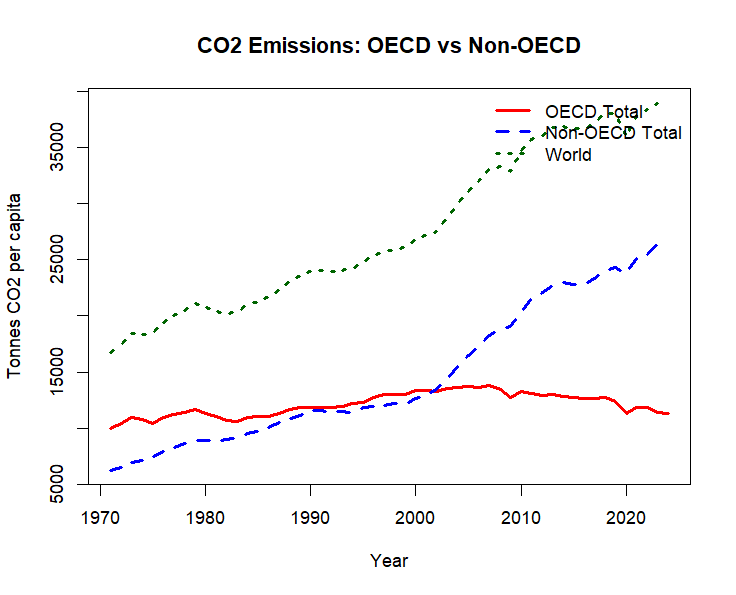
If we look only at total CO₂ emissions from energy, we see world emissions climbed steadily from the 1970s, and since around 2000, the non‑OECD line has surged past the OECD line. But this view overlooks how those totals are built on decades of unequal per‑capita emissions and energy systems designed around the needs of a small, already‑rich club of economies. This pattern only becomes clear when we shift from totals to per-capita emissions.
Klimado – Navigating climate complexity just got easier. Klimado offers a user-friendly platform for tracking local and global environmental shifts, making it an essential tool for climate-aware individuals and organizations.
A world built on unequal carbon
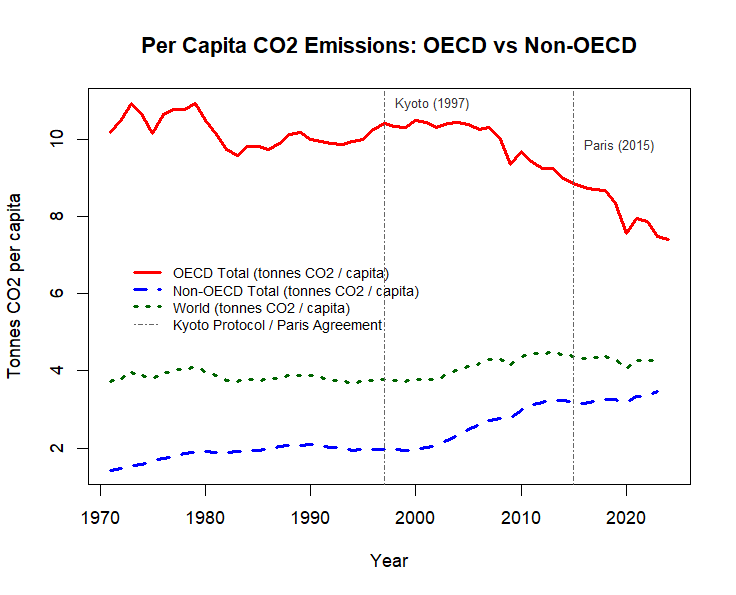
As the chart above shows, people in OECD countries have emitted roughly twice as much CO₂ per person as those in non‑OECD countries have since 1970; the two lines have never touched. Before climate diplomacy even began, the average OECD citizen emitted around 9–12 tonnes of energy‑related CO₂ per year, while the average non‑OECD citizen hovered closer to 3 tonnes. That gap persists today, despite some decline in rich‑country emissions and some growth in the emerging economies.
Furthermore, notice where Kyoto and Paris sit on the timeline. By the time rich countries promised leadership on emissions cuts, they had already enjoyed decades of double‑digit per‑capita CO₂ — and even after those agreements, the per‑capita hierarchy barely shifted. The global average sits in between, dragged upward by the rich but used rhetorically against the poor: when negotiators or commentators talk about “average global emissions per person,” they are quietly blending the carbon aristocracy and the carbon precariat into a single, supposedly neutral number.
Related Articles
More from Impakter on emissions inequality, historical responsibility, and the politics of climate action:
Pulling up the ladder, then calling it “climate leadership”
In the OECD, the biggest per-capita emissions don’t come only from individual choices like driving or household energy use; see the chart below.
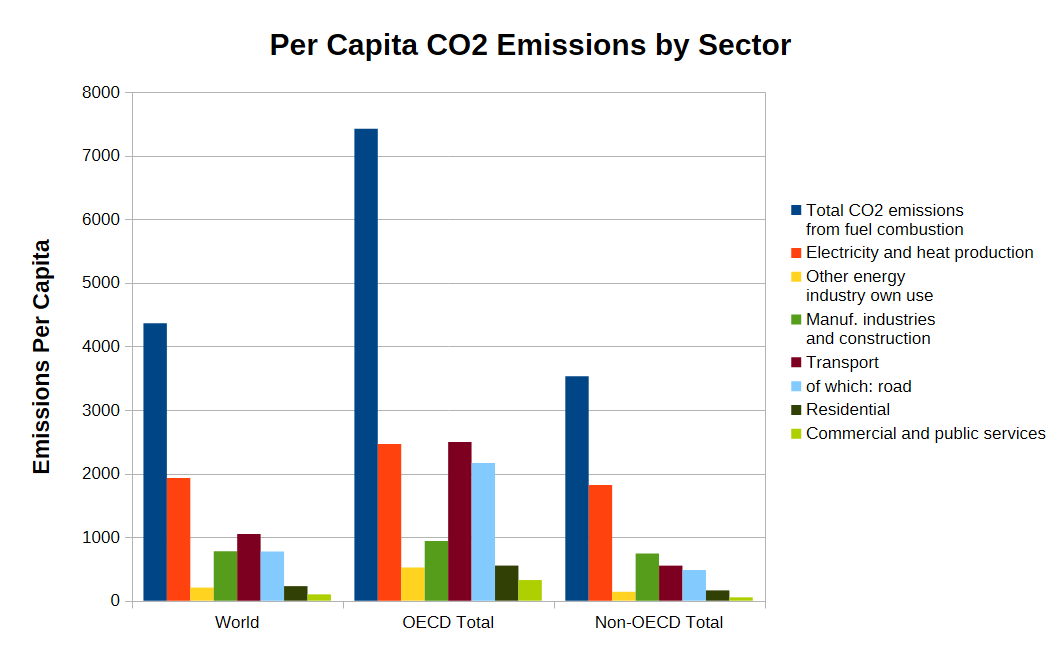
The biggest emitters come from fuel burned across the economy and from the electricity and heat systems that power industry, infrastructure, and everyday life. Road transport, commercial and public services, and residential use each remain below 1,000 kgCO₂ per person, while electricity and heat production is far higher. The overall fuel-combustion total is still higher, a reminder that affluent economies did not become affluent through lifestyle emissions alone but through carbon-intensive systems built over decades.
OECD governments spent more than a century building wealth through coal, oil, steel, cement, mass car ownership and energy-hungry industry. Now that the factories are built, the roads are laid, and their citizens have enjoyed decades of high per-capita emissions, leaders of many of these countries tell late industrialising countries to do it differently.
The message to the non-OECD world is: develop, but do not develop as we did. Build power grids without cheap fossil fuels, and expand heavy industry without relying on the carbon-intensive materials that built the existing infrastructure. If you try to compete using those traditional methods, you will now face trade penalties like the UK’s and EU’s Carbon Border Adjustment Mechanism (CBAM).
These border taxes effectively protect Western industries during their climate transition, replacing the free emissions allowances that historically cushioned them under systems like the EU ETS. That may be called climate leadership, but it looks exactly like pulling up the economic ladder after reaching the top.
The carbon budget is real and fossil-fuelled industrialization cannot be repeated indefinitely. But countries that used the most atmospheric space cannot credibly impose carbon tariffs or demand restraint without delivering the finance, technology, and policy space needed to make a different development pathway possible. The political question is whether climate action will dismantle that hierarchy or simply make it permanent.

What “per‑capita fairness” would actually look like
Per-capita fairness recognizes that countries begin the transition from radically different positions. If the climate crisis requires a shared carbon budget, we cannot treat that budget as if everyone used it equally.
Firstly, countries with the highest per-capita emissions should cut the deepest and fastest. They have the greatest capacity to replace fossil fuels, redesign transport, retrofit buildings and reduce excess consumption — and they have already benefited most from the carbon-intensive development model.
Secondly, lower-emitting countries need space to meet basic development needs such as reliable electricity, safe housing, transport, public services and productive industry. That is not an argument for repeating the OECD’s pathway. It is an argument against forcing poorer countries to carry the same burden while still climbing the first rungs of the ladder.
Finally, fairness has to be material. It means affordable finance, accessible clean technology, and international trade rules that foster green development, not just demanding that countries do more with less.
Total emissions tell us how fast the atmosphere is filling. Per-capita emissions tell us who has had the most room to fill it. A credible transition has to confront both.
Editor’s Note: The opinions expressed here by the authors are their own, not those of impakter.com – Cover photo credit: Pawel Nolbert on Unsplash