Adapting to climate change requires stumping. But it’s anything but simple for coffee farmers. They face physical, knowledge and economic barriers. This article explores the challenges they need to address.
 Article in collaboration with: Root Capital invests in the growth of agricultural enterprises so they can transform rural communities. These businesses purchase crops such as coffee, cocoa, or grains from smallholder farmers. With growth, they become engines of impact that can raise incomes, create jobs, empower women and young people, sustain peace, and preserve vulnerable ecosystems.
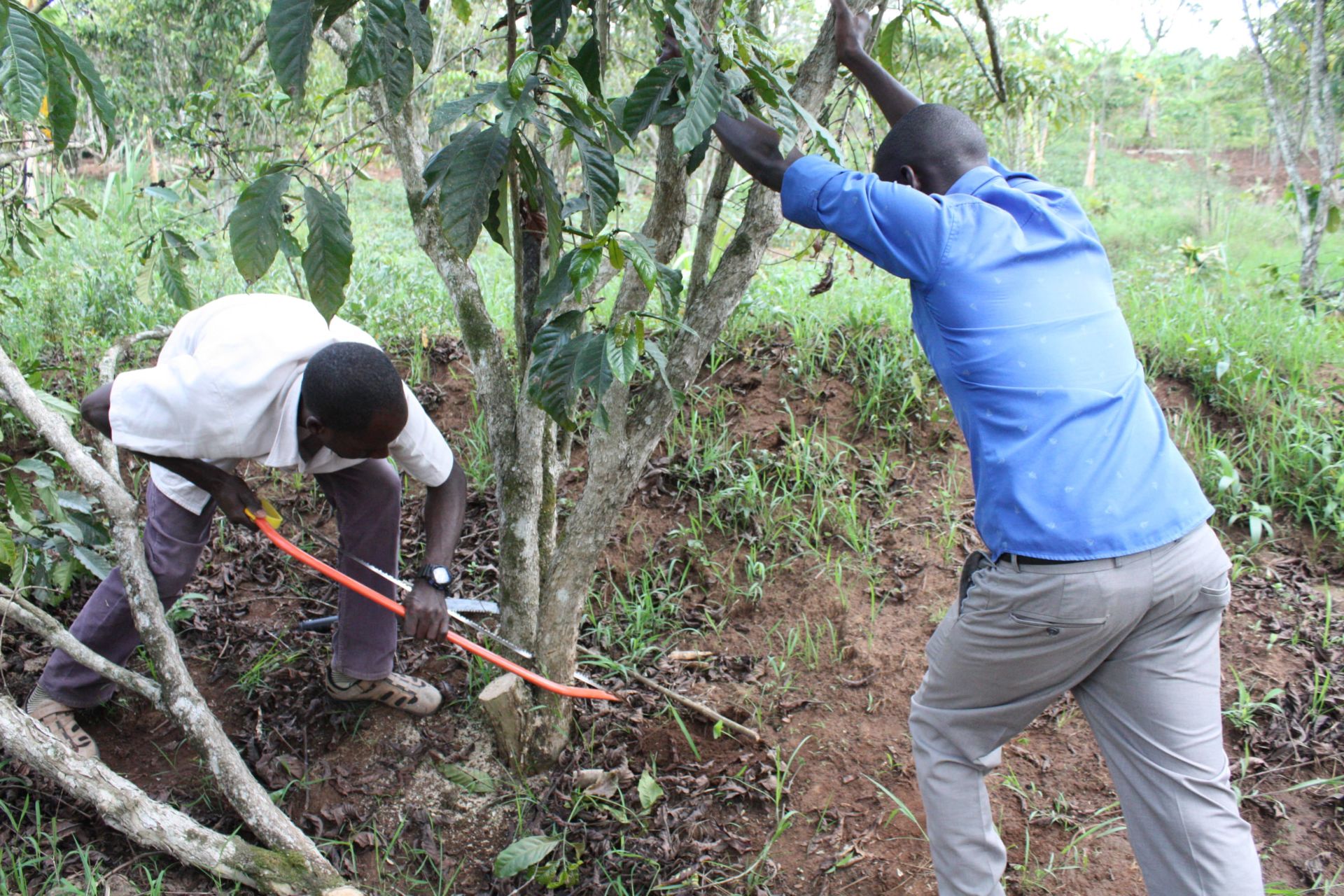
The saw makes a grinding sound as Albert, a young Ugandan agronomist, maneuvers it back and forth slowly, cutting through the trunk of the coffee tree. His colleague Ambrose stands next to him, bracing the tree and readying himself to carefully lower it to the ground once the trunk is severed. They repeat the process, one, two, three times for a single tree, cutting away three small trunks almost to the stump—until there’s just a single spindly-looking branch remaining.
To the untrained eye, there’s something shocking about the sight of two agronomists systematically dismantling what appears to be a tall and fulsome coffee tree. But to these experts, the height and fullness of the tree is precisely the problem: At about 10 years old, the coffee tree is past its prime—all branches and trunk, yielding only a few, undersized berries. The process that Albert and Ambrose are undertaking—called “stumping”—requires them to cut the tree entirely back to the stump, leaving one small stem as a “breather” to help fuel re-growth. Once they’re done, within about two years the tree will grow back enough to begin producing berries again, but with greater vigor, better yields, and higher quality than before.
Related topics: Seting Coffee Businesses Up for Long-term Success – Saving the planet one cup of coffee at a time – Make this Christmas count
 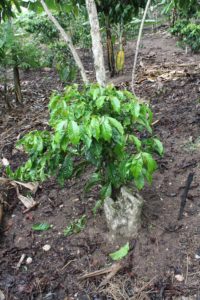 |
On the left, a coffee tree that has never been stumped—so tall that a ladder is required to pick the few cherries it produces. On the right, a coffee tree growing back fuller after stumping.
It’s a simple, if counterintuitive, equation: subtract, in order to add. Cut back now in order to fuel growth in the long term. And the long-term gains are well-established: Trees that have been stumped (and fertilized appropriately) produce more and higher quality coffee. Healthier plants are also better able to withstand pests, disease, and erratic weather—threats that loom larger than ever as climate change intensifies. If all goes well, stumping can help farmers earn higher incomes and adapt to a changing environment.
But stumping is anything but simple for a coffee farmer whose livelihood depends on these trees. They face physical barriers: To avoid cauterizing the trunk and cutting off growth, stumping must be done with a handsaw, not a motorized saw—meaning older farmers often need to hire labor to assist with the process. They face knowledge barriers: For many farmers without access to resources or training, the idea of cutting down coffee plants in order to spur their growth can seem laughably foolish. And most of all, they face economic barriers: Even if farmers know the benefits of stumping, the lost income in the short-term (and the non-zero risk that stumping will kill older trees) is too high a cost to pay by themselves. For coffee farmers living on razor-thin margins, even old and under-producing trees can yield vital income for school fees, health care costs, and other urgent needs.
Paul and Jane, the couple whose trees Albert and Ambrose were stumping, face all of these barriers. Paul grew up on this farm in Ntungamo in southwestern Uganda, and planted 150 of his 300 coffee trees himself. The other trees, which Paul inherited, are decades old and barely produce. Since the 1970s, periods of civil unrest in Uganda have disrupted agronomic training and support, while coffee price fluctuations have made it harder for farmers like Paul to make long-term on-farm investments. As a result, Paul and his family are losing out on potential income, and are left dangerously vulnerable to the threat of climate change.

 Paul and Jane apply fertilizer to the roots of their newly-stumped coffee tree.
That’s where Albert and Ambrose, and the coffee enterprise that employs them as agronomists, come in. Ankole Coffee Producers Cooperative Union (ACPCU) was founded in 2006 as a union of 10 local farmers’ cooperatives. In 2008, Root Capital gave ACPCU its first-ever loan of about $100,000 to help the enterprise buy coffee from 3,500 smallholder coffee farmers like Paul. In the years since, financing from Root Capital has contributed to the enterprise’s tremendous growth: ACPCU now supports the livelihoods of more than 10,000 farmers. And with support from Root Capital and our partners in the USAID Feed the Future Alliance for Resilient Coffee (ARC), the enterprise is also providing critical agronomic extension services to help supplying farmers, including Paul, take steps to adapt to climate change.
Through ARC, Root Capital and six other NGOs have combined their diverse expertise to develop practical, comprehensive, and actionable plans to build the resilience of smallholder coffee farmers. These interventions can be implemented by a broad range of coffee sector actors—from cooperatives like ACPCU to larger coffee traders or roasters seeking to build resilience in their supply chains. One ARC member, the International Center for Tropical Agriculture (CIAT), has produced country-specific climate risk assessments and maps for coffee-growing countries, to enable geographically-tailored adaptation plans. On the ground in Uganda, ARC members Hanns R. Neumann Stiftung (HRNS) and the International Institute of Tropical Agriculture (IITA) have mobilized CIAT’s research—as well as their own expertise in farmer training and coffee agronomy—to develop and test packages of affordable adaptation practices for coffee farmers, from mulching to stumping and beyond. And working with our client enterprises, Root Capital is ensuring that the information and resources get to where it’s so urgently needed: smallholder farming families like Paul and Jane.
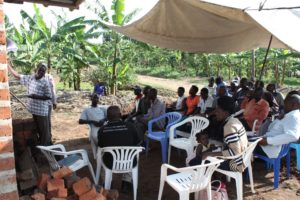
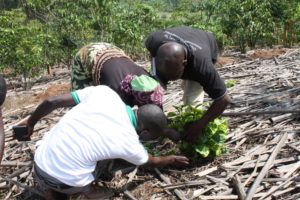
At the top, Ugandan coffee farmers receive training through the Alliance for Resilient Coffee on agronomic practices and climate change adaptation. At the bottom, ACPCU agronomist Ambrose (left) and ARC technician Albert (right) provide training in proper pruning for young coffee plants to promote plant health and improved yields.
Coffee enterprises play a critical role in building resilience to climate change by providing training and support, access to markets, timely payment for farmers’ crops, and, in many cases, microcredit for farmers. ARC’s work in Uganda—and also in Honduras, where partners are collaborating with four other Root Capital lending clients—has shown that these businesses are effective platforms for translating world-leading climate science and agronomy into actionable strategies for thousands of coffee smallholders.
But coffee enterprises can’t do the critical work of helping smallholder farmers adapt to climate change by themselves. With coffee farmers and enterprises alike facing the cascading crises of record-low prices and intensifying climate change, enterprises like ACPCU and farmers like Paul and Jane need allies—and investment—from all along the value chain. To meet this need, bold alliances that span the coffee sector and mobilize public and private sector resources are required more urgently than ever.
Indeed, the view from Paul and Jane’s farm makes it clear: The critical work of enabling smallholder farmers—who did nothing to cause climate change—to adapt to its effects will require many hands, many different tools, and many acts of care. Stumping coffee shows the transformation that is possible through collaboration. With a little investment and support, these smallholder farmers can face their challenges and grow back stronger.
About the author: Abigail Bok is a Senior Grants Associate at Root Capital
EDITOR’S NOTE: The opinions expressed here by Impakter.com columnists are their own, not those of Impakter.com. Photo Credit: Root Capital