The war in the Middle East has once again exposed an uncomfortable truth about our world: there is never a shortage of money for destruction. According to figures reported by The Guardian, the first six days of the United States’ war against Iran cost US$ 12.7 billion — more than US$ 2 billion a day.
Now compare that with what is truly essential. The average global cost of a healthy diet today stands at US$ 4.46 per person per day. That means that just one day of war spending could finance around 470 million healthy daily food baskets.
That number is shocking enough on its own. But it becomes even more disturbing when we remember that, according to the Food and Agriculture Organization of the United Nations (FAO), around 673 million people still go hungry in the world. In other words, the money burned in a single day of war could provide a healthy daily basket for something close to 70% of the undernourished population on the planet. That means that almost two out of three undernourished people on the planet could be fed daily.
This is not just a striking comparison. It is a political and moral indictment. When the issue is missiles, bombers and military operations, resources appear instantly. When the issue is ensuring real food for those who need it most, the excuses begin: fiscal caution, budget constraints, delayed action, competing priorities. The world does not suffer from a lack of money. It suffers from a lack of human priorities.
But war does not only divert resources away from the fight against hunger. It also creates new hunger.
As FAO Chief Economist Máximo Torero has warned, the current conflict is not only about bombs and borders. It is also about the dangerous reconnection between energy, fertilizers and agrifood systems. In his words, the disruption around the Strait of Hormuz is driving up oil and fertilizer prices and “will affect the food systems” by increasing production, logistics and input costs. If this continues, the consequences will not be limited to the present moment. They will reach the next planting seasons and the next harvests.
The burden falls hardest on import-dependent countries in Africa, Asia and Latin America. In South Asia, fertilizer shortages can collide with planting windows. In Africa, where many familly farmers already use too little fertilizer because they cannot afford enough, even a modest increase in prices can reduce future harvests and deepen food insecurity. In Latin America, Brazil stands out as both a global agricultural power and a vulnerable importer of fertilizer. Any prolonged disruption affecting Brazilian production would not stop at its borders; it would ripple through global food markets.
Related Articles
Here is a list of articles selected by our Editorial Board that have gained significant interest from the public:
There is yet another threat. As oil prices rise, biofuels become more attractive, intensifying competition between food and fuel. More maize, soybean oil and palm oil may be diverted toward energy uses, adding volatility to global food prices and further squeezing the poorest consumers.
So let us be honest about the scandal before us. This war is not only destroying lives directly. It is also helping to destabilize food systems, raise the price of survival and push the poorest deeper into insecurity.
No society can remain stable while accepting, as normal, a world that spends more to kill than to feed. If one day of war spending can almost provide a healthy basket for two out of three of the world’s hungry people, this is not a problem of scarcity. It is a problem of political choice about our present and future!
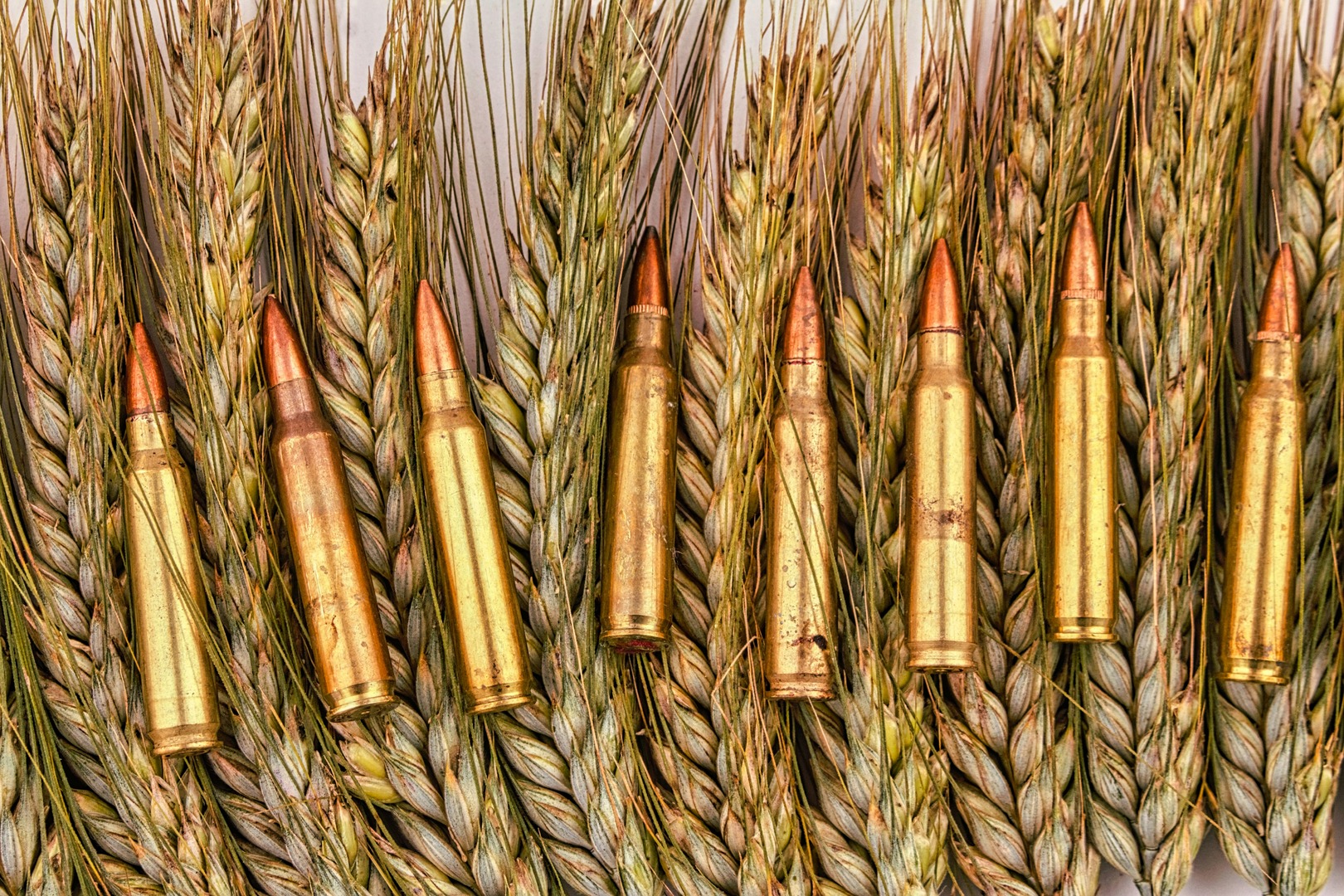
Editor’s Note: The opinions expressed here by the authors are their own, not those of Impakter.com — In the Cover Photo: Bullet shells on top of a pile of wheat. Cover Photo Credit: Marek Studzinski.