The terrible events of Paris are not expressions of a religious war, but we hardly have another language to describe the degree of terror and human cruelty they express. The Islamic State of Iraq and Syria (ISIS) misuses the religion of Islam as pretext for “murder in its name” but the instrumentalization of religion is something else. ISIS is an anachronistic, chauvinist movement in which religious fanatics seek to impose an Islamic hegemony, a view which belongs to the political culture of the 7th century (at best), and is diametrically opposed to the principles of modern civilization and universal human rights. The means they use to impose their will are martial propaganda, violence and terror, which although threatening, are neither predictable nor in any way comprehensible.
The goal of self-righteous suicide bombers or self-proclaimed “holy warriors,” as we unfortunately witnessed in Paris, is to kill as many innocent victims as possible and to destabilize Western societies by attacking them where they are most vulnerable. In doing so, they spread just as much fear and insecurity among Muslims as everyone else. The fact that the terror network Islamic State violates the fundamental principles of every religion that gives people hope is completely irrelevant to them. Their ideology has nothing to do with Western notions of religion nor is it compatible with the faith of millions of Muslims.
Not in My Name
It doesn’t require much reflection to realize that Islam cannot be identified with terrorism. Indeed, Muslims worldwide have rallied around the slogan “Not in My Name” in a campaign to oppose terrorism and to express opposition to the perpetrators of these acts in Paris. They distance themselves from terrorist organizations such as ISIS or Boko Haram, which employ barbaric methods that evidence a complete lack of human empathy.
Related Articles:”EUROPE’S FLIGHT FROM THE REFUGEE CRISIS” by Michele Sciurba
“THE KEY FOR PEACE: THE INDISPENSABLE ROLE OF THE UNITED NATIONS” Claude Forthomme
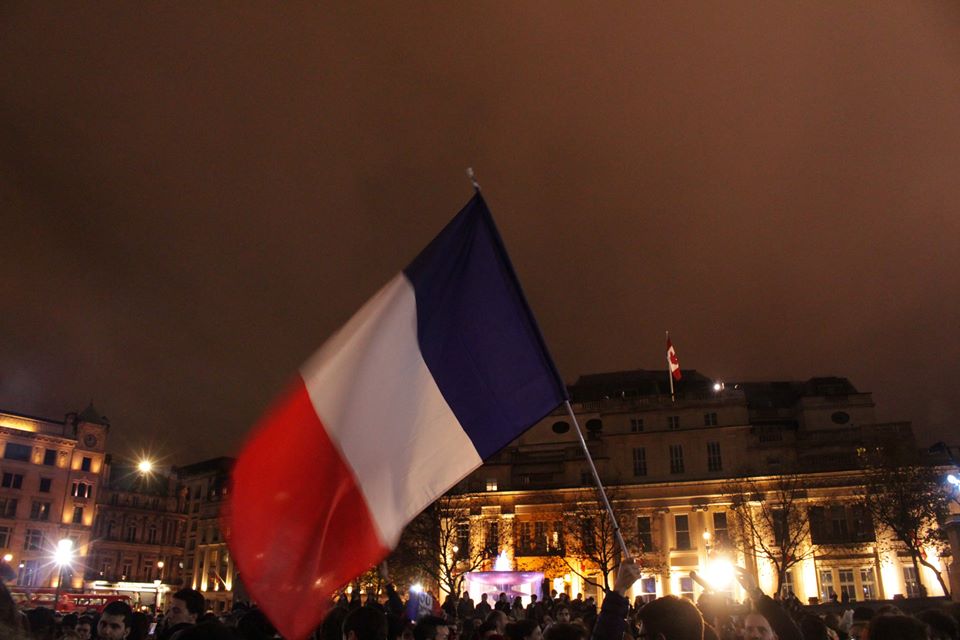
 In the Photo: A memorial for Paris in Trafalgar Square, London. Photo Credit: Maxime Berkowicz
This initiative gives reason for hope: for peaceful co-existence in the Islamic world and for the way it functions as a counterweight to the growing radicalization of young Muslims in Europe and the West. Nevertheless, in the Near East, ISIS has been able to exploit the power vacuums created by regime change in Iraq, Libya and the civil war in Syria to its own advantage. In the middle of Western societies, fanatical preachers of hate are radicalizing young Muslims and animating them to actions like those in Paris. Often these young Muslims have grown up and been socialized in Europe rather than in the Near East.
The police and other investigative authorities will have to answer questions like: who the assassins are, where they come from and how it was possible for them, organizationally and logistically, to carry out attacks at six locations simultaneously. However, the question why they perpetrated these attacks is of much more central importance. The sobering fact is that young attackers had to suspend their own basic humanity to carry out this massacre in the heart of Paris and it remains a deeply disturbing event for each of us, no matter what religion we may belong to, raising the disquieting question how such a thing is possible at all in our highly developed modern society.
The best antidote to fanaticism is therefore social justice.
European countries and citizens are inextricably intertwined. We are multicultural and that’s a good thing. Apparently, however, there are segments of society in which young Muslims feel so marginalized that becoming a suicide bomber is more attractive than what they are facing, the prospect of poverty or unemployment.
The best antidote to fanaticism is therefore social justice. The key is creating social and cultural integration. Every attempt to single out young Muslims for special approbation is a contradiction to the “we” of European society. In order for this “we” to work, everyone needs to respect and practice the separation between church and state. In a modern secularized society, Muslims — like everyone else, regardless of their faith — have the freedom to practice their religion (or not), but our society cannot tolerate religious fanatics or those who harbor the theocratic illusion of imposing Islamic law (Sharia) on Europeans. Precisely for this reason, we cannot allow terrorists to occupy our public places or strike fear into our hearts by keeping us from going about our daily business — sitting in street cafés, attending concerts, enjoying sporting events or encountering strangers without prejudice and with an open mind.
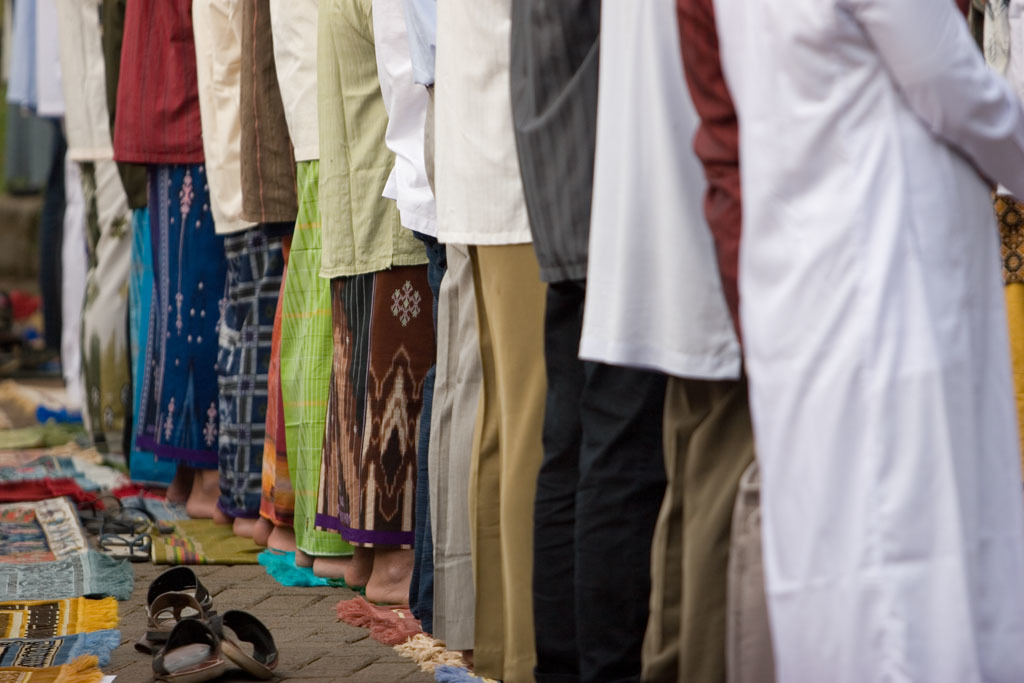 In the Photo: A row of men pray together. Photo Credit: Danumurthi Mahendra/Flickr
The worst possible consequence we could draw from the Paris bombings is to restrict civil rights as it has been done since the 9/11 attacks; there is pressure to do so in France but not only there. Civil liberties are at the heart of European identity. Weakening rights to privacy laws or repealing the legal presumption of innocence, which would allow authorities to initiate criminal proceedings without probable cause, are ultimately at least as threatening as terrorist attacks.
It is equally essential to counteract the growing number of populist right-wing forces in Europe. European right-wing groups are using the attacks in Paris as an opportunity to exploit the refugee crisis, suggesting that refusing to accept refugees from Islamic countries would prevent future attacks like those in Paris. This casts a general suspicion on refugees from Islamic countries and simply generates more suffering, which in no way leads to the prevention of terrorist attacks.
Those calling for the closing of Europe’s borders are becoming increasingly vocal and the fact that Poland, despite previous assurances and binding agreements, has suddenly refused to accept 7000 refugees suggests that individual EU-States are prepared to reject a common European system of values. Refugees from Syria, Afghanistan and Iraq cannot continue to be targets of right-wing nationalist assaults.
War refugees from those countries are fleeing the same kind of terror that killed or seriously injured hundreds of people in Paris. Hatred against refugees or Muslims plays into the hands of no one else but the ISIS terror network, whose aim is to divide our society.
Together we mourn the deaths of the victims of Paris and stand for a cosmopolitan, tolerant society in which liberté, égalité and fraternité are more than just empty words.
—–
Cover Photo: Solidarity for Paris in Trafalgar Square, London. – Photo Credit: Maxime Berkowicz (Impakter.com)