Iran’s closure of the Strait of Hormuz in late February 2026 — retaliation for US and Israeli strikes on its territory — disrupted roughly 20% of the world’s seaborne oil supply. The International Energy Agency (IEA) called it the largest supply disruption in the history of the global oil market. Brent crude, which had been sitting at roughly $72–73 a barrel in early 2026, averaged $103 in March and peaked at $126, a price last seen during a different kind of crisis.
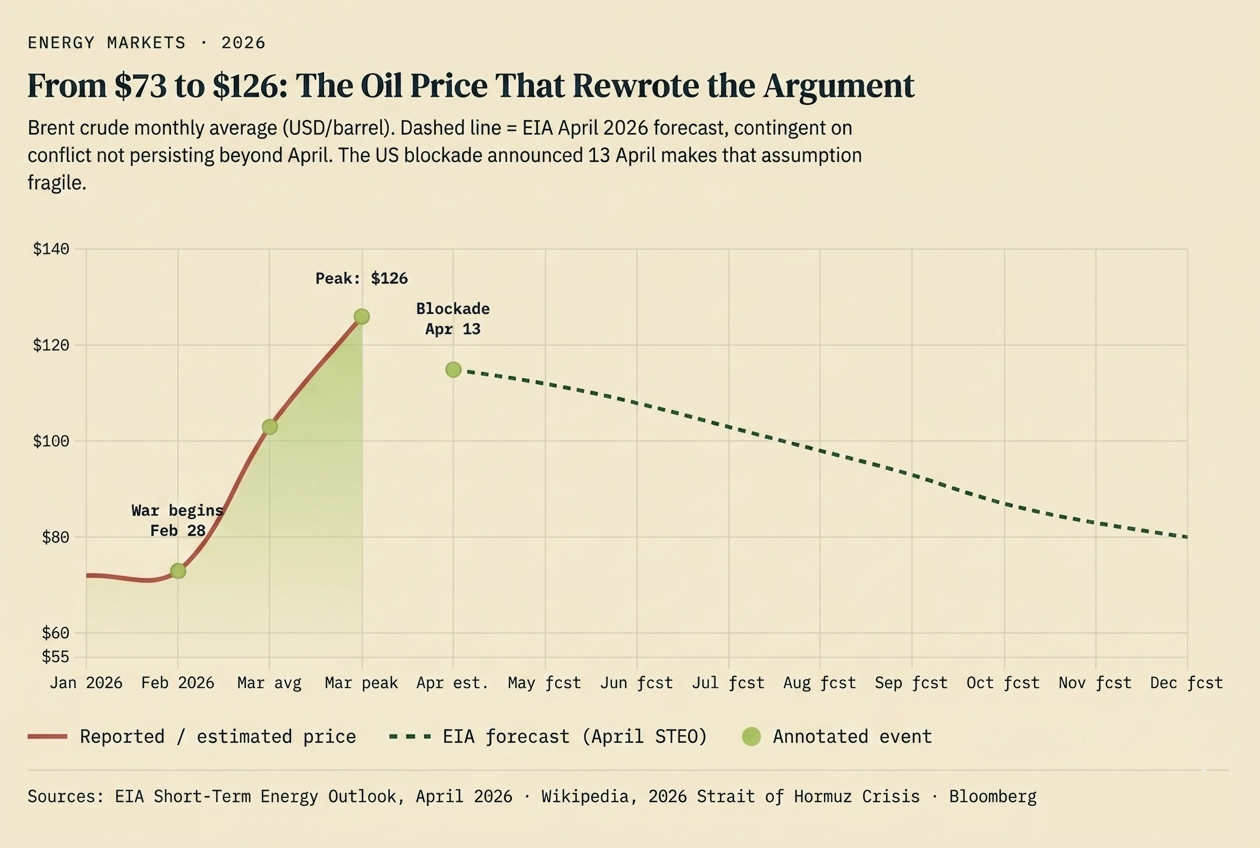
The US Energy Information Administration forecasts that retail petrol prices will average above $3.70 per gallon across 2026, with a peak near $4.30 in April. At that time, Diesel crossed $5.80 per gallon.
Moreover, the IEA’s forecast assumes the conflict does not persist past April 2026 and that oil flows gradually resume. The US naval blockade announced on 13 April — days after the ceasefire — makes that assumption considerably less certain.
The growing interest in electric vehicles
Before people buy things, they usually search for them online. Since the start of the war in Iran, there has been a clear and measurable surge in interest in EVs across multiple markets.
Germany’s largest online car marketplace, Mobile.de, reported that EV-related searches on its platform have tripled since the beggining of March — from 12% to 36% — and that car dealers received 66% more inquiries. Ajay Bhatia, the platform’s chief executive, said it had seen a greater than 50% increase in electric car inquiries in March compared with February while petrol and diesel inquiries fell over the same period.
“In my view this is a spike that will go down, but it will not go down completely,” Bhatia said. “Electric car demand will settle at a new, higher normal than we had before.”
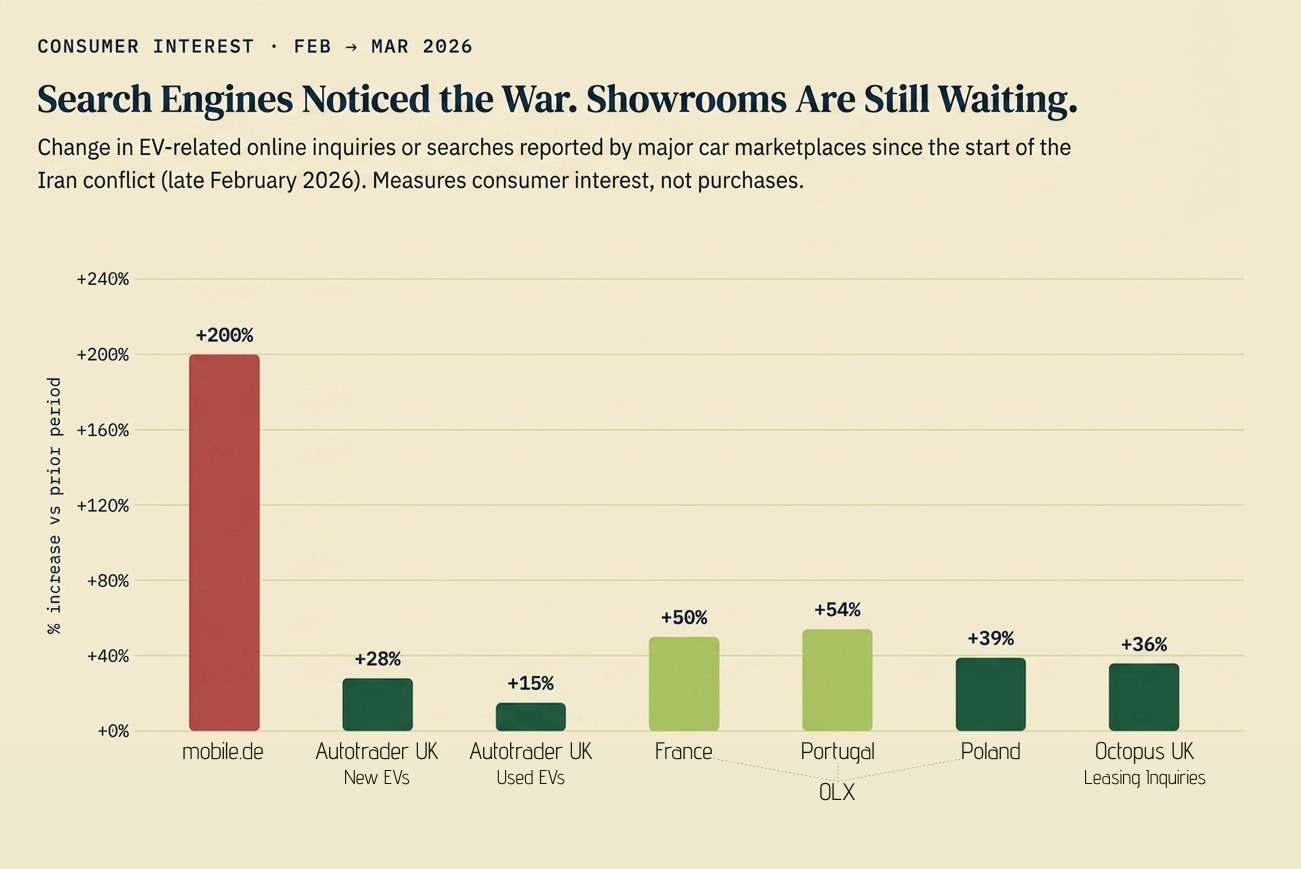
The pattern holds across Europe. OLX, a large online classifieds group, reported EV inquiry increases of 50% in France, 54% in Portugal, 39% in Poland, and 40% in Romania. In the UK, Autotrader reported new EV inquiries “surging between February and March” at a rate of “one every minute last month,” with leads up 28% for new cars and 15% for used. Octopus Electric Vehicles, a UK leasing specialist, said it had seen leasing inquiries rise 36% since the start of the conflict.
In the US, the signal is quieter but present. Edmunds — one of the most-cited sources for American car-buying data — noted early signals of an uptick in car shoppers considering electrified vehicles, while being careful to add: “Whether the latest spike translates into meaningful shifts toward electrified vehicles may depend less on the price of gasoline itself and more on how long consumers expect fuel costs to remain elevated.”
Is increased interest converting into higher sales?
The answer depends heavily on the country and market segment you are looking at. The picture is not uniformly positive. Most analyses focus on year-on-year figures, but the EV market has been growing exponentially in recent years, so it’s unclear how much of year-on-year growth in sales is actually due to the geopolitical situation.
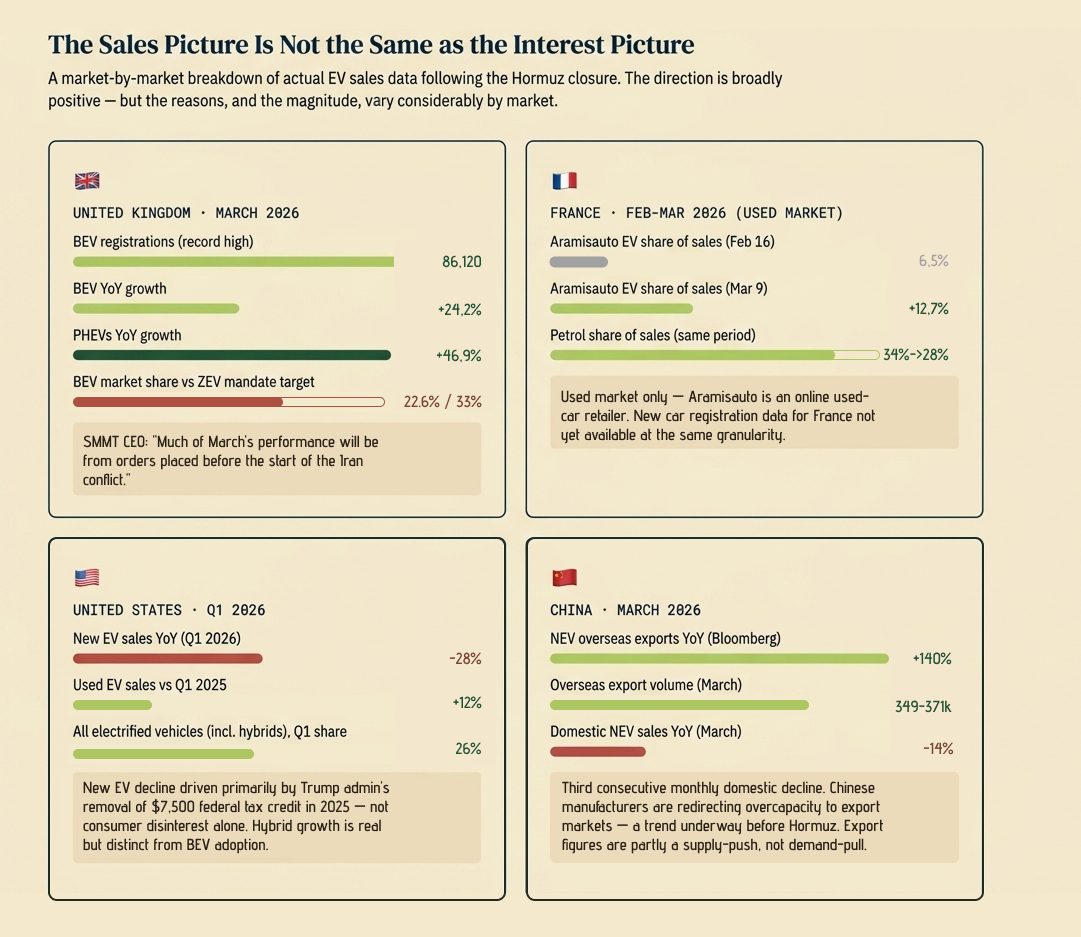
In the UK, March 2026 was a record month by almost any measure. 86,120 fully electric vehicles were registered — a 24.2% increase year-on-year and the highest monthly figure ever recorded, according to the Society of Motor Manufacturers and Traders (SMMT). Plug-in hybrid registrations surged even faster, at 46.9%. Home charger inquiries at one of the UK’s leading charging providers rose 59% in March. Anecdotally, used EV dealerships reported customers queuing outside showrooms.
In France, the most recent data comes from the used market. Aramisauto, an online used-car retailer, reported that its share of EV sales nearly doubled between 16 February and 9 March, rising from 6.5% to 12.7%, while the combined share of petrol and diesel sales fell from 48% to 38% in the same window. La Centrale, another French platform, said the crisis had created one of the first instances of consumers developing a genuine awareness of the total cost of ownership — meaning they are now willing to consider a higher upfront purchase price if the running costs are lower.
In the United States, the picture is the most complicated. New EV sales fell an estimated 28% year-on-year in the first quarter of 2026. This is not primarily a story about consumer disinterest — it reflects the Trump administration’s 2025 removal of the $7,500 federal EV tax credit, which made new electric vehicles significantly more expensive overnight.
The used market, on the other hand, tells a different story: used EV sales were 12% higher than the same period a year earlier, partly because the price gap between used EVs and equivalent petrol cars had shrunk from $4,923 to $1,334 between February 2025 and February 2026.
In China, exports broke records while the domestic market continued to weaken — for reasons largely unrelated to the Hormuz closure. China’s overseas EV shipments jumped 140% year-on-year to approximately 349,000 units in March, or 371,000 units including plug-in hybrids. At the same time, Chinese domestic EV and hybrid sales fell 14% to 848,000 units — the third consecutive monthly decline, driven by the expiry of domestic trade-in subsidies and weaker consumer spending.
China’s case illustrates EV demand growth started much earlier
China has been dominating the global EV supply chain in recent years. In 2025, it accounted for around 42-45% of global all-electric vehicle exports, up from 40% in 2024. In some countries, such as Mexico, Brazil and Thailand, the Chinese share in the EV market exceeds 80%. Moreover, China is now one of the largest owners of specialised ships for vehicle transportation.
China exported 954,000 new electric vehicles in the first quarter of 2026 — more than double than in the same period a year earlier. The country’s total vehicle exports also more than doubled over the same period, reaching 2.23 million units in this year’s first quarter. The oil shock is one contributor, but the organic growth of the EV market in recent years can also justify the growth.
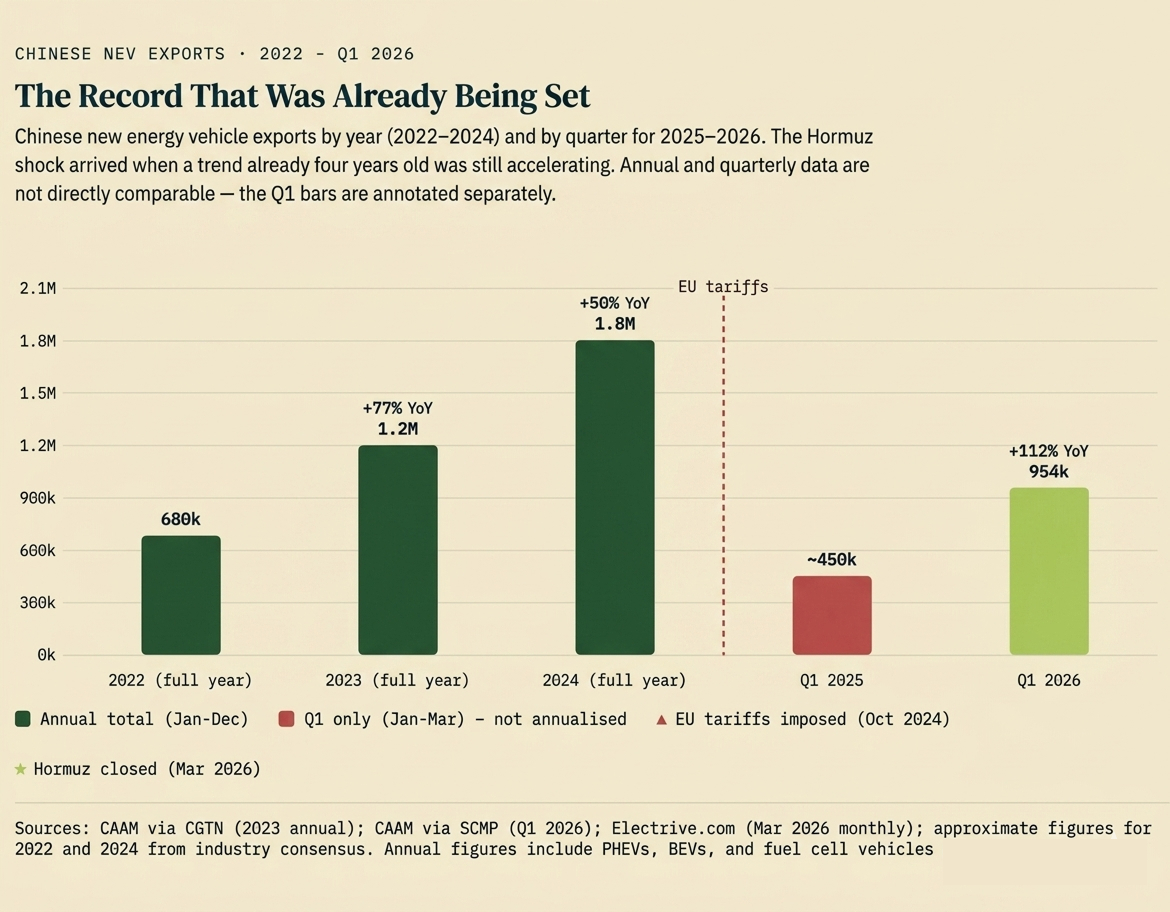
China exported roughly 680,000 new energy vehicles in all of 2022. In 2023, that rose to 1.2 million — a 77% increase, before the EU and the US had imposed tariffs at the end of 2024. By that time, the figure reached approximately 1.8 million.
This growth was built on structural competitive advantages — vertical integration, manufacturing scale, domestic price becoming lower than for petrol cars. These have nothing to do with what happened in the Persian Gulf. March 2026 alone saw 371,000 EV and plug-in hybrid exports, up 130% from March 2025. This figure partly reflects Chinese manufacturers redirecting volume away from tariff-constrained Western markets, a trend underway long before February 2026.
The oil shock is a tailwind for a revolution already unfolding.
Oil crisis headlines are driving interest in EVs — but consumers aren’t making the switch yet
People don’t buy a new car if petrol costs more for one month. They buy a new car when they are certain it will be more cost-effective and when their finances allow for a significant purchase. A combination of these factors is rare during a period of economic stress.
US electric vehicle demand had not materially responded to weeks of elevated fuel prices, according to data from the period. The economic case for switching is compelling on paper: annual fuel savings of roughly $1,300 is a significant number for an average person. But that case only converts into purchases when consumers have enough certainty about the future to act on it. Short-term volatility has created online searches, but the decisions haven’t followed yet.
What would change this? High prices sustained for so long that consumers stop expecting them to fall. If oil remains above $100 for long enough, the second and third quarters of 2026 could show a more decisive shift. For EV adoption to reach the mass market, the payback period must shorten so that the savings from lower usage costs come sooner. EVs are currently more expensive compared to their gasoline counterparts.
Related Articles
Here is a list of articles selected by our Editorial Board that have gained significant interest from the public:
The closure of the Strait of Hormuz affects EVs too
The argument that an oil shock benefits EVs overlooks a significant complication. Synthetic graphite is a crucial material for lithium-ion batteries. Most people have never heard of it. It matters because it is made from petroleum coke, which is a byproduct of oil refining. Think of it as the residue left over after a refinery has extracted petrol, diesel, and jet fuel from a barrel of crude. When oil prices spike, refineries shift to more valuable products and produce less petroleum coke. Less petroleum coke means a tighter supply of synthetic graphite, which the World Economic Forum identifies as potentially the most severely affected battery material in the current disruption.
Then there is helium. Qatar, affected by the crisis, supplies roughly a third of global helium. Helium is essential to the cooling processes used in semiconductor and battery cell production. The disruption adds another layer of cost pressure to an EV manufacturing environment.
Finally, aluminum remains a shared problem for both EVs and regular diesel vehicles. Aluminum is a primary structural material in electric vehicles. As production costs rise, it becomes more expensive to build EVs.
The shock that seems at first to benefit the EV market is simultaneously raising the cost of building them. These headwinds are likely temporary — they resolve when supply routes normalize. But they complicate the clean “oil up, EVs win” narrative considerably.
What does the crisis actually mean for the vehicle market in general
The Hormuz disruption adds real urgency to the oil market. This urgency makes people overlook other disrupted exports. It makes the economic justification for EVs clear at first. It accelerates a shift in government priorities toward domestic energy security. These are immediate effects, and we notice them now.
On the other hand, the EV revolution was well underway before a single drone flew towards Iran. The structural forces that made it happen — a decade of Chinese industrial strategy, battery manufacturing at scale, and the gradual decrease of the price premium over petrol vehicles, especially on the domestic market. None of these factors stems from the crisis and will not evaporate if it resolves. The EIA’s base case has Brent falling below $90 in the fourth quarter and averaging $76 in 2027. If that materialises, the oil price argument for EVs weakens. The structural argument, however, does not disappear.
What the Hormuz shock provides is a particularly vivid illustration of a vulnerability that had existed. It is useful as an argument, but it is not, in itself, a cause of transformation. The transformation was already underway.
Editor’s Note: The opinions expressed here by the authors are their own, not those of impakter.com — In the Cover Photo: Line of electric cars in a parking lot. Cover Photo Credit: Luke Miller.