Impakter
  • Environment
    • Biodiversity
    • Climate Change
    • Circular Economy
    • Energy
  • FINANCE
    • ESG News
    • Sustainable Finance
    • Business
  • TECH
    • Start-up
    • AI & Machine Learning
    • Green Tech
  • Industry News
    • Entertainment
    • Food and Agriculture
    • Health
    • Politics & Foreign Affairs
    • Philanthropy
    • Science
    • Sport
  • Editorial Series
    • SDGs Series
    • Shape Your Future
    • Sustainable Cities
      • Copenhagen
      • San Francisco
      • Seattle
      • Sydney
  • About us
    • Company
    • Team
    • Global Leaders
    • Partners
    • Write for Impakter
    • Contact Us
    • Privacy Policy
No Result
View All Result
Impakter logo
No Result
View All Result
The Extradition Bill: The Beginning of the End for Hong Kong?

The Extradition Bill: The Beginning of the End for Hong Kong?

Mina TumaybyMina Tumay
June 16, 2019
in Politics & Foreign Affairs, Society
0

Instead of boiling the frog over the remaining 20 years, China has decided to set the kitchen on fire. And instead of obeying the Chinese intrusion, Hong Kong is standing up for itself and saying “No”.

The Sino-British Joint Declaration between the British government and that of Xiaoping’s, signed in 1984, meant that Hong Kong would have independence in its politics and economy for 50 years under Basic Law, following the country’s official transfer from British rule to China in 1997. As the red orchid flag of Hong Kong found its place flying over Victoria Harbour, Beijing promised that following the peaceful return of Hong Kong. It assured that the city’s social and economic systems would remain untouched while retaining political freedom and a market economy until 2047.

The Bill

In February, Carrie Lam, the Chinese-elected Chief Executive of Hong Kong and her government proposed the extradition law which would allow citizens and foreign nationals passing by Hong Kong to be sent to Mainland China for the trial of a crime they have committed in China. Leading up to almost the halfway mark for the expiration date of 1C2S (One Country Two Systems), Hong Kong has seen many protests against the intrusive nature of the Chinese government. This includes the Umbrella Protests of 2014, in which the public protested the proposed changes to the Hong Kong electoral system, claiming it to be restrictive for China to pre-screen the candidates for Hong Kong’s Chief Executive.
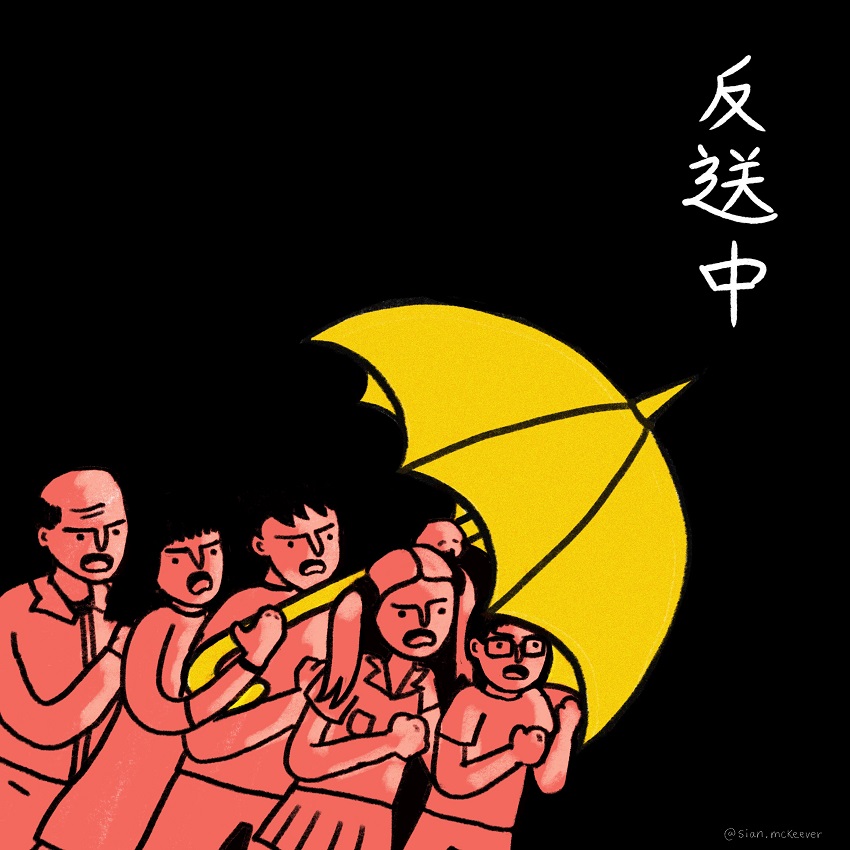
In the picture: “No Extradition Bill”. Illustration Credit: Sian McKeever

The Umbrella Protests had the catchphrase of “Occupy Central with Love and Peace” and were relatively more peaceful compared to other political protests in history, to the extent of being compared to a ‘1967 Californian Summer of Love’. Although there were anti-occupy attacks, it could not compete with the current level of violence those yearning for legislative freedom in Hong Kong are currently suffering. The main difference between the two is that the 2014 protests had democracy at their core, which would only apply to citizens of Hong Kong, whereas the current proposed bill applies to anyone passing through, even if only through the airport.

In the picture: Protests against the extradition bill. Photo Credit: Joseph Chan via Unsplash

Now in June, when the proposed bill is close to turning into law, numbers leading up to a million have taken the streets to propose against it. The main aim of the protests is to block the entrance to the legislature building in order for the officials to not be able to enter, therefore slowing down the passing of the extradition law. The police responded to the protests called an ‘organised riot’ by Carrie Lam, in a very violent manner with the use of pepper spray, tear gas, bean bag rounds and rubber bullets, injuring at least 79 people.

In the picture: Protests in Hong Kong. Photo Credit: Joseph Chan via Unsplash

The Potential Consequences

The main worry of the protesters is that sending a potential criminal to a court under the Chinese government provides no guarantee of their physical and mental well being under the International Covenant on Civil and Political Rights or the United Nations Convention Against Torture, which China has already breached with its lack of emphasis on human rights despite being a signatory state. The Chinese legislative system is neither independent from the political control nor reliable with a near-perfect conviction rate. Therefore, the proposed law would put anyone accused of a crime in Hong Kong under great inhumane danger as it is basically a form of legalized kidnapping.

What would this mean for the future of Hong Kong? This law would allow China to control both the political and social spheres of Hong Kong firstly by releasing a nationwide fear that anybody that appears anti-Beijing and anti-Communist Party could face trial, and secondly by convicting those pro-democracy and independence. Many powerful businessmen, politicians, journalists and influential people from the former British colony would easily be subjugated to trial in China under the control of the Beijing government with a simple affidavit produced by the Chinese government accusing them of a crime. This law would be a historic expansion of Beijing’s power and show to the world and the people of Hong Kong that they have no plans for Hong Kong to remain independent, politically free and ‘democratic’ once the 50-year agreement is over.

In the picture: “Freedom”. Illustration Credit: Sian McKeever

On the 15th of June, Carrie Lam decided to suspend the bill without further notice and called her government to pause and think. Although this is a step forward, the protesters have announced that they will not stop until the bill is cancelled. Carrie Lam’s upcoming decision on whether to back down or to keep pushing the proposed bill will most probably determine her time in office. However, regardless of how driven and bright she is, she simply plays the part of pawn in the Chinese game of dominance over Hong Kong. Regardless of how the protests end and whether the bill passes or not, this shows that China does not plan on waiting until 2047 to start taking control over Hong Kong.

In the cover picture: Protests in Hong Kong. Photo Credit: Joseph Chan via Unsplash


Editor’s Note: The opinions expressed here by Impakter.com columnists are their own, not those of Impakter.com


Tags: chinaExtradition lawforeign affairsHong KongUmbrella Protest
Previous Post

Silicon Valley Insider: Phospholutions vs. Phosphorus Pollution

Next Post

Disaster Management: Lessons Learned for Communities Near and Far

Related Posts

ESG News regarding China’s wind power strategy, global renewable energy leadership, U.S. criticism at Davos, and the future of low-carbon energy cooperation
Business

China Defends Wind Power Strategy at Davos

Today’s ESG Updates US Calls for Doubling Global Oil Output at Davos: At the World Economic Forum in Davos, the...

byJana Deghidy
January 22, 2026
Russia Raises Alarm Over NATO Military Presence in Greenland, US and Taiwan Seal Semiconductor Trade Deal With Major Investment Commitments, Growing Concerns Over Medical Care in US Immigration Detention, Machado Seeks Influence After High-Stakes Meeting With Trump
Climate Change

Trump’s Greenland Ambitions Strain NATO Unity

Today’s ESG Updates Russia Accuses NATO of Militarising the Arctic: Russia has warned that NATO’s planned deployment to Greenland risks...

byPuja Doshi
January 16, 2026
Aerial view of U.S. farmland using regenerative agriculture practices to generate soil carbon credits
Climate Change

Microsoft’s Record Soil Carbon Credits Deal Signals Rising Pressure on Tech Emissions

Today’s ESG Updates Flash Flooding Hits Victoria, Australia: Severe storms forced evacuations along the Great Ocean Road as flash floods...

byJana Deghidy
January 15, 2026
Five Keys to Understanding Venezuela’s Oil History
Energy

Five Keys to Understanding Venezuela’s Oil History

Venezuela’s oil industry has once again returned to the center of international debate. U.S. President Donald Trump announced new actions...

byYale Climate Connections
January 15, 2026
ESG News regarding Dimon warning that Trump’s attacks on Fed could raise inflation and rates, Venezuelan oil shipments to China setting to plunge under U.S. blockade, UK awarding offshore wind contracts to power 12m homes, 2025 being the third-hottest year on record as climate science faces political pushback
Business

JPMorgan CEO Warns Trump’s Attacks on Fed Could Raise Inflation and Rates

Today’s ESG Updates Dimon Warns Trump’s Fed Attacks Could Raise Inflation: JPMorgan CEO says Trump’s criticism of the Fed could...

byAnastasiia Barmotina
January 14, 2026
ESG News regarding Economic Collapse Fuelling Iran Protests Amid Rising Death Toll, U.S. Pressure on Iran Tests Beijing as Tariffs Could Push China Duties Above 70%, EU Offers China Price Pledge Option to Avoid EV Tariffs, Atmosphere Emerges as Major Pathway for Plastic Pollution
Business

Iran Acknowledges 2,000 Deaths as Protests Enter Third Week

Today’s ESG Updates Economic Crisis Drives Largest Protests in Years: Demonstrations that began over the collapse of the currency in...

byPuja Doshi
January 13, 2026
ESG News regarding U.S. lifting more sanctions on Venezuela, Egypt securing $1.8 billion renewable energy deals, U.S. pushing G7 allies to reduce reliance on China for critical minerals, richest 1% exceeding annual carbon share in just 10 days.
Business

U.S. Considers Lifting More Venezuela Sanctions

Today’s ESG Updates US May Lift Venezuela Sanctions to Boost Oil & IMF Aid: US could ease sanctions to support...

byAnastasiia Barmotina
January 12, 2026
ESG News regarding Trump backing sanctions on Russian oil buyers, Norway’s oil and gas output declining, dog food linked to UK emissions, Trump climate treaty exit facing legal scrutiny
Business

U.S. Targets Russian Oil Buyers with New Sanctions Bill

Today’s ESG Updates Trump Backs Sanctions on Russian Oil Buyers: A bipartisan U.S. bill would impose tariffs of up to...

byAnastasiia Barmotina
January 9, 2026
Next Post
Disaster Management: Lessons Learned for Communities Near and Far

Disaster Management: Lessons Learned for Communities Near and Far

Recent News

Green Energy Without Panels: A Homeowner’s Guide to 100% Renewable Power in 2026

Green Energy Without Panels: A Homeowner’s Guide to 100% Renewable Power in 2026

January 23, 2026
Dental Office desk

How to Spot and Prevent Embezzlement in Your Dental Office

January 23, 2026
News regarding the environmental impact of dog food

The Environmental Impact of Dog Food — and How to Reduce It

January 23, 2026
  • ESG News
  • Sustainable Finance
  • Business

© 2025 Impakter.com owned by Klimado GmbH

No Result
View All Result
  • Environment
    • Biodiversity
    • Climate Change
    • Circular Economy
    • Energy
  • FINANCE
    • ESG News
    • Sustainable Finance
    • Business
  • TECH
    • Start-up
    • AI & Machine Learning
    • Green Tech
  • Industry News
    • Entertainment
    • Food and Agriculture
    • Health
    • Politics & Foreign Affairs
    • Philanthropy
    • Science
    • Sport
  • Editorial Series
    • SDGs Series
    • Shape Your Future
    • Sustainable Cities
      • Copenhagen
      • San Francisco
      • Seattle
      • Sydney
  • About us
    • Company
    • Team
    • Global Leaders
    • Partners
    • Write for Impakter
    • Contact Us
    • Privacy Policy

© 2025 Impakter.com owned by Klimado GmbH