Climate change has not traditionally been seen as a health and human rights concern — but that may be changing following recent high-profile court cases.
On April 9 the European Court of Human Rights ruled in favour of a group of elderly Swiss women who claimed the government’s inadequate efforts to combat climate change put them at risk of dying during heatwaves.
And in India, the Supreme Court on April 6 recognised a right against the adverse effects of climate change as a distinct fundamental right in the Constitution.
In that judgement, one of the judges said the rights to life and equality couldn’t be fully realised without a clean, stable environment. The court also highlighted the connection between climate change and the right to health.
The World Health Organization has declared climate change to be the greatest threat to health that humanity faces.
Since climate change affects so many aspects of our lives, its effects on health and health care are complex, multiple, and highly variable across geographies, ecozones and development levels.
There are direct impacts on our bodies and communities, such as have emerged with extreme heat, droughts, floods, fires and other climate change-driven catastrophic events.
There also are more complex and indirect impacts, such as increasing food insecurity, the rising threat of infectious diseases, increased exposure to water and air pollutants, the health impacts of forced mobility and migration, and the mental health and social impacts of the climate crisis that affect us on our deepest levels.
Yet climate change has not traditionally been seen as a health and human rights concern — a reality which, arguably, needs to change.
In a report published last month in The Lancet, ‘Under threat: The International AIDS Society-Lancet Commission on Health and Human Rights’ we suggested several pathways through which climate change bears on the right to health.
A foundational principle of human rights is universality. We do not derive rights from citizenship or social standing, but from the fundamental basis of our shared humanity.
Indeed, the founding document of the modern human rights movement is called ‘The Universal Declaration of Human Rights’, precisely because the rights it enshrines are held to be universal — shared by us all.
A terrible irony of the climate crisis however, is that the burdens of climate change are not shared equally by all.
Those who have done the least to impact the climate — the peoples of low- and middle-income countries, the rural poor and Indigenous communities — are by far the most affected.
This raises the issue of climate justice: what do the highly industrialised nations, which have so damaged the climate, owe to those whose health, livelihoods, and very survival are being impacted by the crisis?
Many of the worst-affected states, including the small island nations, have argued that reparations are essential if they are to survive.
Indigenous peoples, particularly those still living on their traditional lands, are literally fighting for their lives against loggers, miners, ranchers, farming interests, the energy industries, and others who seek the bounty they have preserved for us all. Without protection for Indigenous rights, we may lose the world’s last great forests.
Earth has essentially three lungs; the Amazon Basin, the Congo Basin, and what remains of the forests of Southeast Asia. Without these great generators of oxygen and capturers of carbon, Earth’s atmosphere would soon cease to be breathable for mammals, including humans. This makes Indigenous rights inextricably linked to all of our health and wellbeing.
Related Articles: Climate Change’s Catch-22 | How Climate Change Affects Health and How Countries Can Respond | Climate Reporting: Why People Won’t Listen | How Does Climate Change Affect Agriculture?
Another major form of health inequity is increasing exposures to water and air pollutants, again most impacting those who have done the least to impact the climate. Premature deaths due to diseases caused by these chemical pollutants were estimated to top nine million in 2015.
Access to health care, even in the wealthiest societies, has also been affected by climate crises. The multiple hurricanes which devastated Puerto Rico in 2017 led to widespread disruptions in health care facilities, and forced thousands of people on chronic medications, including antivirals for HIV, to have sustained treatment interruptions.
Hurricane Katrina and its aftermath led to significant destruction of healthcare facilities in the US, primarily through flooding, and led to multiple deaths, including among elderly and disabled patients in long-term care facilities.
Strikingly, the death rate was almost 50% higher among Black residents of New Orleans than among Whites — demonstrating that health inequities can be sharply worsened during catastrophic climate events. Same storm, yet significantly worse outcomes for minority communities.
The threat of infectious diseases is also rising, including in the Global North, as climate change shifts the best habitats for some species, bringing animals and humans closer together, and hence increasing the risk of diseases spilling over from one to the other.
The climate crisis is also responsible, in part, for the enormous levels of population displacement, mobility, and migration we are now seeing.
There are an estimated 110 million people — the largest number ever recorded — who are displaced either internally in their home countries, or outside their homelands.
While many have fled conflict and war, many others are forced to leave their homelands due to climate-driven changes in rainfall, droughts, floods and fires — all increasing food insecurity and driving people to seek better futures.
Providing even the most basic health care services, such as childhood immunisations, prenatal care, and adequate water and food is an enormous challenge and will likely only increase. And as we have seen in many countries, the rise in migration and displacement can have potent impacts on political culture — increasing nationalism, xenophobia, anti-immigrant policies, and racism.
How will humanity cope with these interrelated challenges? The human rights movement does have some compelling examples of success. Multiple cases, including several brought by young students, have successfully argued for a new right: the right to live in a healthy environment. This is another universal right we all share by virtue of our human status.
It is essential to protect human health, and the health and wellbeing of all the living things with which we share the planet.
Realising any right is always a struggle, and the resistance is always immense.
But this is a right we really have no choice but to fight for. We cannot maintain human health without healthy ecosystems. And that requires we extend the right to live in a healthy environment to all of us now living, and for the generations to come.
** **
This article was originally published by 360info™.
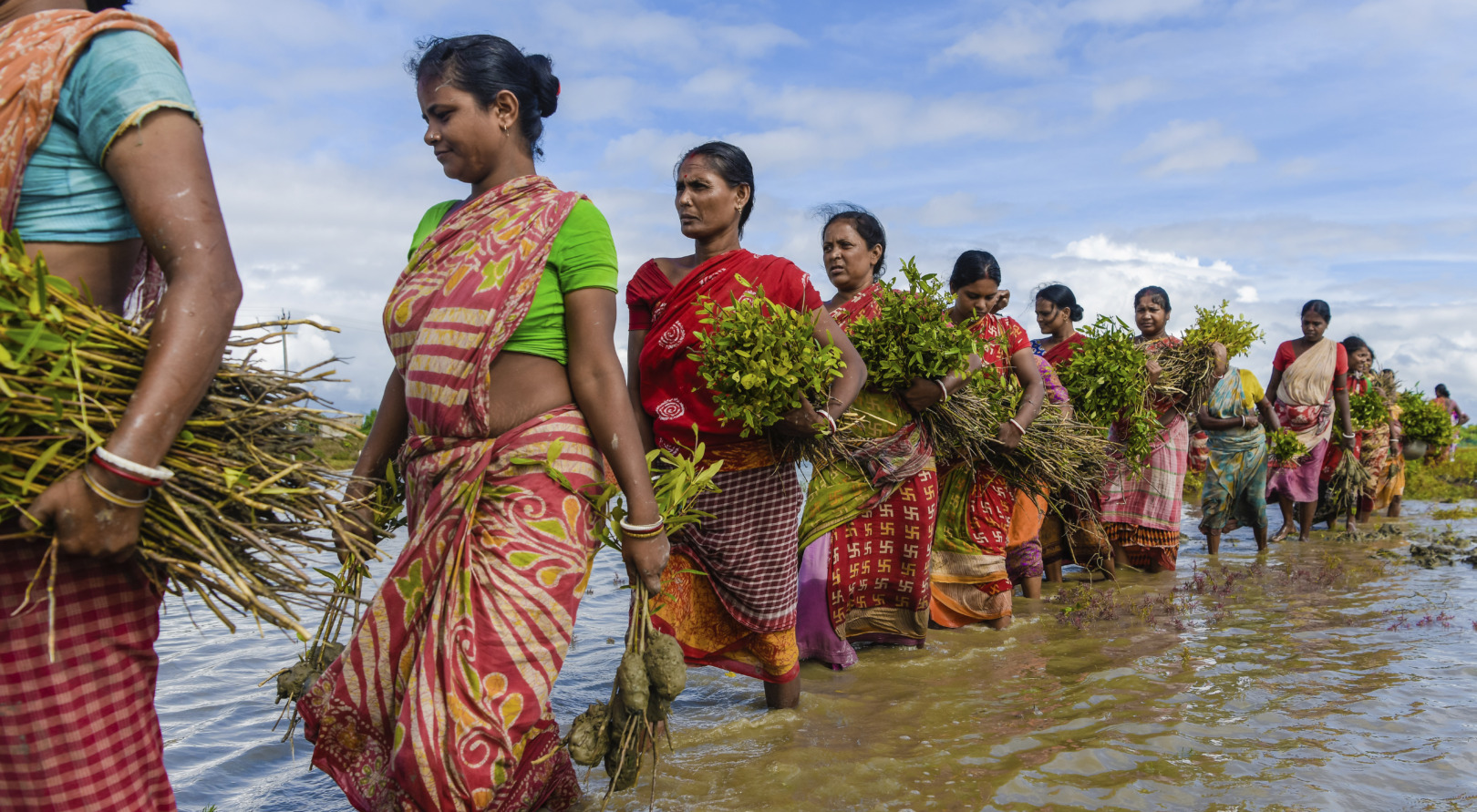
Editor’s Note: The opinions expressed here by the authors are their own, not those of Impakter.com — In the Cover Photo: Mangrove plantation drive, a group of women walking through shallow water, carrying mangrove saplings. Cover Photo Credit: Avijit Ghosh / Climate Visuals / CC BY-NC-ND 4.0.