In Luanda, extreme heat is rising faster than the city’s response to it. As reported in a recent analysis by the Red Cross Red Crescent Climate Centre and University College London, despite witnessing a 110% increase in extreme heat days, Angola’s capital has no dedicated municipal budget for heat and no local heat action plan.
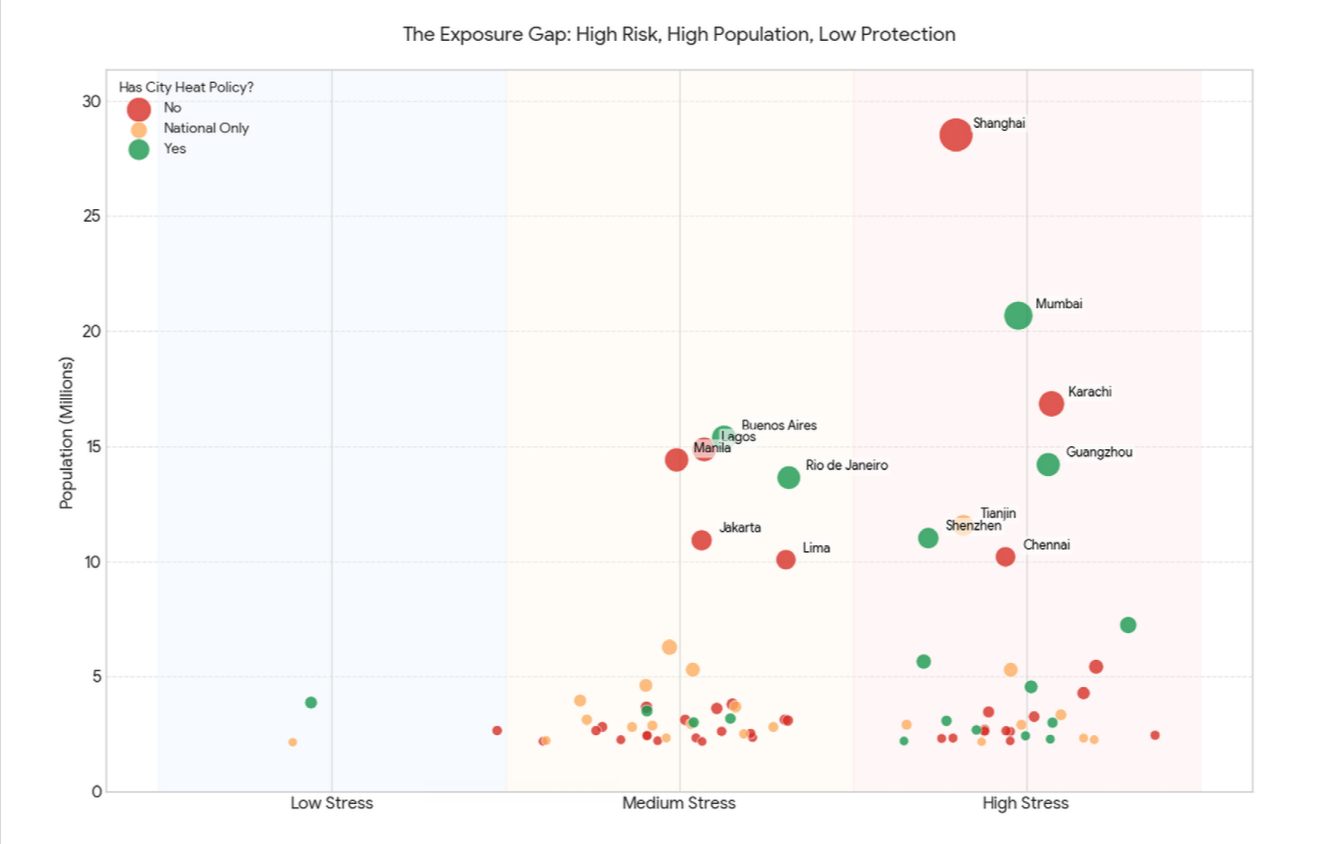
Luanda is not an outlier. The study assessed heat governance across 83 coastal cities in the Global South, and the findings were stark: 88% have no heat funding at all, and fewer than 5% have ever evaluated whether their heat policies work. Within this broader picture, the report identifies 18 major cities, home to more than 74 million people, as being in what it calls a “red zone” — cities facing severe heat exposure with zero budget and zero policy.
The researchers are not describing governments that failed to notice the danger, but cities where recognition of the heat threat has not translated into meaningful action. They identify five structural barriers that help explain why this gap persists.
What Is Driving This Governance Gap?
The first barrier is jurisdictional. As much as 60% of the 83 cities studied have no dedicated heat policy. This means that there is no office, no mandate in place, and no appointed official to monitor and act when temperatures spike.
The second is a data choice. Cities routinely classify floods and cyclones as disasters, triggering emergency funding and coordinated response. However, heat, as a concept, rarely receives that classification. A hazard that already kills more people globally than any other weather event stays administratively invisible, and invisible risks do not get budgeted for.
The third is precise timing. Governments tend to act only after catastrophe strikes, not before. This is evident in Baku, Azerbaijan, where the number of extreme heat days rose by 300% between 1990 and 2020. Despite the sudden rise, its government only formalized a heat response after a 2018 heatwave, which triggered a three-day, heat-induced power grid collapse.
The fourth factor is an “evaluation deficit.” Out of the 83 cities evaluated, fewer than 5% have ever evaluated whether their heat policies actually save lives.
The fifth concerns money. Eighty-eight percent of all 83 cities have no heat budget, and the cities facing the highest heat stress are the least likely of all to have one. The existence of budgets without a policy in place is as good as having no budget at all.
The cities of Dammam and Jeddah, in Saudi Arabia, have access to tens of millions of dollars in national climate financing, yet neither city has a dedicated heat action plan because none of that funding is utilized for municipal-level response. By contrast, Kochi, India, has a functioning heat plan that works with the Kerala State Disaster Management Authority and local stakeholders, while Buenos Aires has a dedicated Chief Heat Officer.
The difference between a red zone city and a functioning one is rarely the size of a national budget. It is whether anyone at the city level has been given the money and the mandate to spend it on heat as a recurring phenomenon.
Related Articles
Here is a list of articles selected by our Editorial Board that have gained significant interest from the public:
Why coastal cities, why now?
The researchers focused on coastal cities because they face a combination of climate risks that can compound the health impacts of extreme heat, such as rising sea levels, storm surges and flooding, all of which place additional pressure on infrastructure and public budgets.
Forecasters now expect the 2026 to 2027 El Niño to be among the strongest ever recorded. The U.S. Climate Prediction Center further strengthens this outlook, putting the odds of a very strong event above 90% this fall and tiwinter. At the same me, other researchers project the peak between November 2026 and January 2027. For the 18 red zone cities identified in the report, that timeline is not a distant risk. It is a countdown, arriving in a handful of months, with no budget set aside.
Who takes the biggest loss?
In a June 2026 report, “Counting the Cost of Heat: The Case for Urgent Solutions for Cities,” the Heat Resilience Action (HERA) modeled the economic toll of extreme heat in four cities: Ahmedabad, Bangkok, Monterrey and Freetown. Across these four cities, the heat drains 4-8% of the cities’ GDP in an average year and contributes to more than 1,000 deaths.
In Bangkok alone, heat-driven productivity losses cut the city’s GDP by an amount roughly equal to its entire municipal budget every single year, rising as high as 8% in an unusually hot one. Globally, the report finds that women working in the informal economy lose an estimated 57 billion dollars in wages annually to extreme heat. This loss ripples outward because women reinvest up to 90% of their earnings directly into their households, and the wage loss is further expected to rise by 44% by 2050.
The lack of policy-making and budget allocation runs deeper. Cities in the red zone are not saving money by refusing to budget for heat. They are simply moving the cost off the government’s books and onto the bodies and incomes of the people least able to absorb it.
According to Mongabay’s August 2026 reporting on the incoming El Niño, tropical cities face a specific, compounding danger. The heat is trapped in roads and rooftops during the day and released overnight, denying cities any real cooling period. This affects the urban poor most, many of whom continue to work outdoors without any protection: street vendors, construction crews, rickshaw pullers — people who cannot simply stay indoors when a heat dome settles over their city for weeks.
The WHO has warned of the extreme weather driven by El Niño, and this has prompted some governments to take action. Lagos aligned itself in June with the UN Environment Program’s “50 at 50” campaign under the banner “Lagos Rising Against the Urban Heat Island.” However, there seems to be a long bridge to cross between pledging to a banner and allocating a budget line. And for the 18 cities already sitting in the red zone, El Niño will not wait for either.
Luanda will not get a reprieve from El Niño because its national government has signed climate frameworks, or because its officials use the right language at international summits. Reprieve requires a budget line, a mandate, someone whose job it is to answer when the temperature spikes. Luanda, like 17 other cities with more than 74 million people in total, has none of these.
This has been the underlying finding in this report. The increase in the number of heat days is surely not missed by the government; however, their own budgets still allocate nothing to respond. The gap between Luanda’s climate rhetoric and its climate spending is not an oversight — it is a choice made every year.
Editor’s Note: The opinions expressed here by the authors are their own, not those of Impakter.com